

Sakura Beer c1912
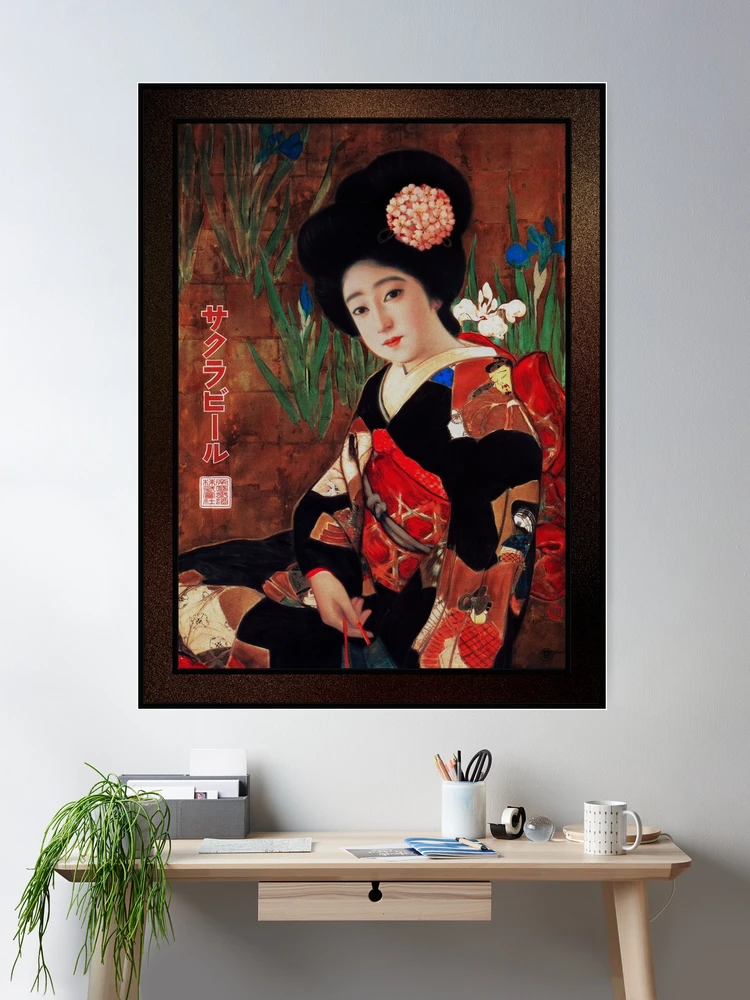
“Sakura Beer 1912” is a remarkable artwork created by the renowned Japanese painter Kitano Tsunetomi (1880 – 1947). This piece epitomizes the artist’s mastery in blending traditional Japanese aesthetics with a refined portrayal of contemporary themes.
Kitano, known for his skillful and delicate depictions of beautiful women and the world around them, expertly captures the essence of the Meiji, to the Shōwa and Taisho periods in Japan through his carefully composed artwork. In this particular piece, the subject is a poised woman dressed in an intricately adorned kimono, a subject frequently explored by Tsunetomi in his art, set against a backdrop of flowering irises and soft, earthy tones. The painting offers a glimpse into the social life of the time, where traditional beauty and modern influences merged.
Inhoudsopgave
Hoofdonderwerp: The Elegant Woman in Kimono
At the heart of the artwork stands a young woman, her poised posture and serene expression conveying a sense of grace and refinement. She is dressed in an elaborate kimono, the fabric meticulously detailed with vivid patterns of rich reds, goud, and soft blues, all of which are consistent with the traditional attire worn by women of her status during the early 20th century.
The woman’s face is painted with delicate features, her soft, fair skin, and subtle yet expressive eyes revealing a quiet elegance. Haar haar, styled in an elaborate updo, is adorned with a decorative pink sakura flower, a symbol of transience and beauty in Japanese culture. The flower’s placement, just above her left ear, draws attention to the fine details of her hairstyle, a reflection of the meticulous care and tradition associated with a woman’s appearance during this period.
The woman holds a small object, partially visible in the painting, suggesting that there may be a deeper narrative or symbolic meaning in her gesture, though this remains open to interpretation. Her pose and attire clearly reflect her position in society—a woman of grace, possibly from the upper class, who is symbolically tied to the natural beauty around her, depicted in the background of the painting.
The Floral Background: Symbolism and Setting
Achter het onderwerp, the backdrop of the painting features a lush scene of irises growing against a terracotta-colored wall. De irissen, with their deep blue and violet hues, create a striking contrast with the warm earth tones of the wall and the woman’s vibrant kimono. This combination of flowers and earthy tones serves to enhance the overall theme of natural beauty, and their prominence in the composition ties the subject to the traditional Japanese appreciation of nature. Irises often symbolize protection and faithfulness in Japanese culture, and their inclusion could be a subtle nod to the woman’s unwavering poise and dignity.
The terracotta-colored wall, gently muted and weathered, provides a sense of depth to the scene, evoking a warm, intimate setting. The natural light, evident in the soft highlights on the woman’s kimono and face, suggests that the scene is taking place in a serene, private space—perhaps a traditional Japanese home or garden, which was common for portraits of this nature.
Thema: Tradition Meets Modernity
“Sakura Beer 1912” does not just capture the beauty of a woman in traditional attire but also subtly integrates the influence of the era’s evolving social and cultural dynamics. The title itself, “Sakura Bier,” is a clever juxtaposition of two powerful symbols, Sakura, the beloved cherry blossom, and beer, a symbol of the increasing Western influence on Japanese society during the Taisho period. This period, which saw the rapid modernization of Japan, was marked by an embrace of Western technologies and ideas alongside the preservation of traditional cultural practices.
By naming the piece “Sakura Bier,” Kitano Tsunetomi seems to reference this cultural fusion. The sakura flower, long celebrated for its beauty and symbolic connection to fleeting moments in life, stands as a representation of Japan’s deep-rooted cultural heritage. The inclusion of beer, echter, may allude to the shifts in social gatherings and leisure activities brought on by Western influence, perhaps suggesting that the subject of the painting occupies a world where tradition and modernity coexist.
Stemming: Serene and Reflective
De stemming van “Sakura Beer 1912” is one of tranquility and introspection. The woman, seated with a composed demeanor, invites the viewer to pause and reflect on the quiet beauty of the scene. The soft colors and delicate details evoke a sense of calm, and the painting as a whole feels almost meditative. This peaceful atmosphere is enhanced by the harmonious blending of the subject and background, where both are treated with equal care and attention to detail. The overall mood is one of nostalgia, evoking the transitional period in Japan’s history, where the past and future coexisted in the hearts of its people.
The artist’s use of light and shadow adds to the contemplative tone of the painting. The light gently illuminates the subject, drawing attention to her features and the ornate details of her kimono, while the softer shadows create an atmosphere of depth and intimacy. This interplay between light and shadow serves to emphasize the fleeting, yet eternal, nature of beauty, a central theme in traditional Japanese art.
Materialen en techniek: A Masterful Blend of Tradition and Precision
Kitano Tsunetomi’s technique in “Sakura Beer 1912” reflects the mastery of traditional Japanese painting methods, characterized by fine lines, careful brushstrokes, and a deep understanding of color composition. The artist’s attention to detail is evident in the texture of the woman’s kimono, which seems almost tangible, with its complex patterns and subtle gradations of color. The irises in the background are similarly rendered with great care, their petals delicately painted to evoke the soft elegance of the flowers.
The use of natural tones, especially in the kimono and background, adds a rich, organic quality to the piece, while the fine brushwork throughout suggests that Kitano worked meticulously to create the ideal balance between realism and the stylized beauty inherent in traditional Japanese art. His skillful use of shading and contrast lends the work a sense of depth, making the image appear almost three-dimensional while maintaining its ethereal and refined aesthetic.
Conclusie
“Sakura Beer 1912” by Kitano Tsunetomi is a painting that beautifully captures the essence of the Taisho period in Japan, blending tradition with modern influences. The artist’s mastery in portraying the elegance of the female form, the serene beauty of nature, and the subtle interplay of cultural symbols makes this work a lasting example of the period’s aesthetic sensibilities. It is a timeless representation of an era caught between the past and the future, where tradition was both cherished and transformed.
Sakura Bier 1912 is een geretoucheerde digitale kunst oude meesters reproductie van een afbeelding in het publieke domein.
Bio -kunstenaar
Info hieronder van Wikipedia.org
Kitano Tsunetomi maakte aanvankelijk drukplaten voor illustraties in kranten. Bij 17 hij ging naar Osaka om schilder te worden.
Hij ontwierp nu illustraties voor verhalen die in kranten verschenen. Ook zijn grootformaat reclameposters met mooie vrouwen vonden erkenning.
In 1910 zijn foto "Assemblage van de kevers" (insecten, Sudaku mushi) en het volgende jaar de foto "Sunshine in the Rain" (Zonneschijn regen, soba) werden bekroond met een 3e prijs op de Bunter-tentoonstelling.
Daarmee had hij zich gevestigd als schilder in de Nihonga-stijl.
In 1914 Kitano exposeerde de foto "The Thread of Request" (Draad van wens, Negai geen ito) op de herrezen tentoonstelling Inten .
Vanaf dat moment bleef hij verbonden aan deze reeks tentoonstellingen en behoorde hij tot, samen met de Tokyo Kaburagi Kiyokata en Uemura Shōen in Kyoto, aan de vooraanstaande schilders van mooie vrouwen.
Sinds Kitano aanvankelijk "magische" mooie vrouwen portretteerde, hij werd gerekend tot de vleugel van de schilderkunst die zich bezighield met het ongewone, de "Gadan geen Akuma-ha" (Boze sekte van de schilder).
Uit de midden Taishō-periode, de foto van de Yodogimi moet worden benadrukt, die een nieuwe diepte van representatie heeft.
Met de Shōwa-periode, Kitano heeft het moderne Japan op een frisse manier vastgelegd.
Kitano was te zien in 1931 op de "Tentoonstelling van Japanse schilderkunst" in Berlijn. In 1989 de Japanse Post heeft twee postzegels uitgegeven voor 62 yen elk met een danseres uit de “Awa Odori”, de feestelijke processie in de prefectuur Tokushima (historisch Awa Provincie).