

Satin Rose
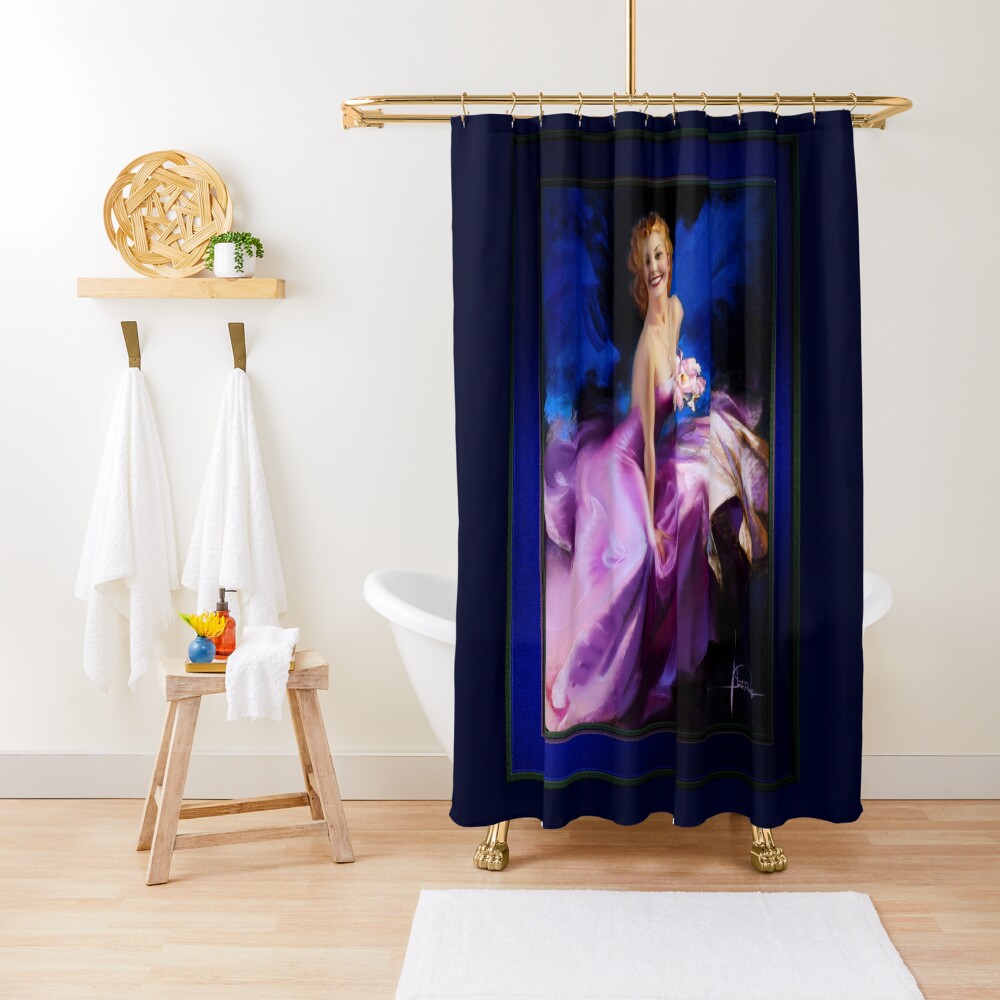
“Satin Rose” (1930), painted by the renowned American artist Rolf Armstrong (1889-1960), is an exemplary piece of early 20th-century American portraiture. Known for his luminous depictions of women in fashionable attire, Armstrong’s work captures a sense of beauty and elegance that resonates with the spirit of the Jazz Age and the Art Deco period. Yn y darn arbennig hwn, Armstrong presents an image of femininity and grace, illustrating the intricate details of a woman in a soft, satin gown.
Tabl Cynnwys
Y prif bwnc
“Satin Rose” is a young woman poised gracefully, her figure rendered with a delicate balance of light and shadow. She is the embodiment of youthful beauty, wearing a gown that flows and ripples around her in soft waves. Y gŵn, primarily a lavender satin, gleams in the light, its smooth fabric accentuated by folds and creases that give it a rich, almost tactile quality. Armstrong’s mastery of texture is evident in his treatment of the satin fabric, which shimmers with the soft sheen that is characteristic of this luxurious material.
Arddull, Techneg, and Medium
The woman’s face is full of vitality, exuding joy and warmth. Her smile is subtle but confident, and her eyes are directed toward the viewer, establishing a sense of direct engagement. Ei meddal, wavy blonde hair frames her face in an effortless, yet elegant manner. The roses she holds in her right hand, delicately grasped, add a touch of romance and softness to the composition, their pale pink petals mirroring the delicate hues of the gown. Armstrong’s use of flowers is not just ornamental; they symbolize beauty, femininity, a gras, further emphasizing the overall theme of the painting.
The background of the piece is richly colored with abstract brushstrokes that suggest a dreamy, almost ethereal quality. The deep blue tones of the background contrast with the soft, lighter shades of the woman’s gown, helping her figure to stand out as the central focus. This contrast between the warm lavender tones of the figure and the cool blues of the background creates a sense of depth and dimension, which enhances the realism of the portrait. The soft gradations of color contribute to the overall serene atmosphere of the work, where the light seems to caress the surface of the satin fabric, further enhancing the mood of elegance.
Objects and Composition
The composition is tightly focused on the figure, capturing her in a moment of serene joy. Armstrong’s decision to leave the background somewhat abstract and blurred directs the viewer’s attention entirely to the subject. This emphasis on the figure over the surroundings is a characteristic feature of many of Armstrong’s works, where the human form is celebrated in its natural beauty.
Armstrong’s style in “Satin Rose” exemplifies his signature technique of blending realism with a certain idealized quality. The portraiture is not merely a representation of a woman but rather an exploration of beauty, geinder, a gras. The artist’s use of light and shadow is subtle yet effective, highlighting the contours of the woman’s face and the folds of her gown in a way that gives the painting a sense of dimensionality. Armstrong’s skill in capturing fabric, yn arbennig, is unparalleled, and the way the satin gown appears to catch and reflect the light gives it a fluid, almost living quality.
Thema a Hwyliau
Mae thema “Satin Rose” is deeply rooted in the early 20th century’s appreciation for beauty and fashion, reflecting the cultural preoccupations of the time. The 1930s was an era that celebrated glamour, soffistigeiddrwydd, and modern femininity, and Armstrong’s work is an embodiment of these ideals. The use of satin fabric, the emphasis on luxurious textures, and the delicate portrayal of a young woman’s radiant beauty all speak to the high regard for elegance that permeated the social and artistic landscapes of the time.
The mood of the painting is one of warmth and serenity. The woman’s gentle smile, the soft folds of her gown, and the serene blue backdrop create an atmosphere of calm elegance. There is a sense of intimacy in the work, as if the viewer is being invited into a private moment with the subject, who stands before us in a poised yet approachable manner. The artist does not present her as an unattainable ideal but as a woman of grace and dignity, who radiates an inner beauty as much as the external qualities the painting depicts.
Nghasgliad
O ran deunyddiau, Armstrong employed traditional oil paints, using the medium to build up layers of color that add depth and texture to the scene. The painting’s surface, rich in color and form, highlights Armstrong’s ability to create smooth, almost luminescent textures, particularly in the depiction of fabric and skin. The piece is framed in a classical style, with a rich blue border that complements the tones of the background and further enhances the visual impact of the work.
Satin Rose is a remastered digital art old masters reproduction of a public domain image that is available as a canvas, acrylic and print metel ar-lein.
Bio artist yn deillio o Wikipedia.org
Ganwyd Rolf Armstrong yn John Scott Armstrong yn Bay City, Michigan ar Ebrill 21, 1889, i Richard a Harriet (Scott) Armstrong. Roedd ei dad yn berchen ar y Boy-Line Fire Boat Company, a oedd yn cynnwys llinell o longau teithwyr. Defnyddiwyd rhai yn Chicago i’w defnyddio yn Ffair Chicago World’s yno yn 1893.
Fodd bynnag, roedd busnes a theulu’r tad yn ei chael yn anodd, a chollwyd cartref y teulu i'w gau. Yn 1899, symudodd y teulu i Detroit, Michigan. Bu farw tad Rolf yn 1903, a blwyddyn yn ddiweddarach symudodd ef a'i fam i Seattle, Washington, yn dilyn ôl troed ei frawd hynaf, William, a oedd wedi symud yno flwyddyn ynghynt. Erbyn hyn roedd diddordebau artistig Rolf yn dod i'r amlwg yn fwy na phleser rhan-amser.
Symudodd i Chicago yn 1908, lle astudiodd yn ddiweddarach yn y Sefydliad Celf. Yna aeth ymlaen i Efrog Newydd, lle bu'n astudio gyda Robert Henri. Ar ôl taith i Baris yn 1919 i astudio yn yr Académie Julian, dychwelodd i Efrog Newydd a sefydlu stiwdio. Yn 1921 aeth i Minneapolis i astudio cynhyrchu calendr yn Brown & Bigelow.
Yn ystod y 1920au a'r 1930au, ymddangosodd ei waith ar lawer o ddarnau o gerddoriaeth ddalen, yn ogystal ag ar gloriau llawer o gylchgronau, yn fwyaf enwog am gylchgronau ffan ffilmiau fel Photoplay a Screenland. Mae ei waith yn cynnwys menywod yn bennaf; Mary Pickford, Bebe Daniels, a Greta Garbo yw ychydig o'r niferus a baentiodd.
Gwaith Armstrong ar gyfer yr Pictorial Review oedd yn bennaf gyfrifol am y cylchgrawn hwnnw yn sicrhau cylchrediad o fwy na dwy filiwn erbyn 1926. Flwyddyn yn ddiweddarach, ef oedd yr arlunydd calendr a werthodd orau yn Brown & Bigelow. Yn 1930, Cyflogodd RCA ef i baentio pin-ups i hysbysebu eu cynhyrchion, ac yn 1933 y Thomas D.. Llofnododd Cwmni Calendr Murphy ef i gynhyrchu cyfres o baentiadau ar gyfer eu llinell.
Ym mis Mawrth 1940, Blodau Tlysau, merch o Lumberton, Gogledd Carolina, anfonodd lun ohoni ei hun i Armstrong mewn ymateb i hysbyseb yr oedd wedi'i osod yn y New York Times. Armstrong, 50 ar y pryd, wedi ei leoli yn y Hotel des Artistes ar West 67th Street yn Manhattan ers hynny 1939, ac yn chwilio am fodelau newydd.
Gwahoddodd Flowers am gyfweliad. Ar Fawrth 25, 1940, Dechreuodd Blodau fodelu ar gyfer Armstrong. Parhaodd eu cydweithrediad proffesiynol a'u cyfeillgarwch am ddau ddegawd. Y paentiad cyntaf, yn dwyn y teitl “Sut ydw i'n gwneud?”, yn ôl pob sôn oherwydd Blodau, heb arfer â modelu, gofynnodd Armstrong dro ar ôl tro “Sut ydw i'n gwneud?” yn ystod y sesiwn fodelu, ei gyhoeddi gyntaf ar ôl i'r Ail Ryfel Byd ddechrau.
Brown ydoedd & Calendr gwerthu orau Bigelow ar gyfer 1942 ar adeg pan werthodd y cwmni filiynau o galendrau yn America, a daeth yn un o luniau mwyaf atgynhyrchiedig Armstrong. Roedd blodau'n boblogaidd ymhlith milwyr America yn ystod yr Ail Ryfel Byd, anfonodd rhai ohonynt lythyrau ati yn cynnig priodas. Copïwyd calendrau a silwetau Blodau Armstrong ar fomwyr ac awyrennau eraill fel celf trwyn a'u paentio ar dyredau tanc.
Daeth mor adnabyddus yn ystod y rhyfel, er yn fwy fel wyneb enwog nag yn ôl enw, bod llythyr milwr yn mynd i'r afael yn syml fel “Blodau Tlysau, Dinas Efrog Newydd” ei ddanfon yn gywir. I lawer o filwyr Americanaidd dramor, roedd hi'n cynrychioli'r “Pam Rydym yn Ymladd” ysbryd. U.S. Yr Arlywydd Franklin D. Ymrestrodd llywodraeth Roosevelt hi i helpu i hyrwyddo bondiau rhyfel.
Yr Ionawr 1, 1945 roedd rhifyn cylchgrawn TIME yn cynnwys un Armstrong’s “Tost o'r Dref” paentio Blodau mewn erthygl am Gelf Calendr. Nododd yr erthygl fod calendrau gyda “lluniau merched” oedd “prynwyd yn drwm gan ffowndrïau, siopau peiriannau, delwyr auto-gyflenwi.”
Priododd blodau yn 1946. Roedd hi a'i gŵr yn byw mewn sawl man wrth iddo roi cynnig ar nifer o fentrau busnes, gan gynnwys Laguna Beach, California, Greenville, De Carolina, Reno, Nevada, lle bu hi'n gweithio fel deliwr cardiau am gyfnod, a Dinas Efrog Newydd. Yn ôl Michael Wooldridge, coauthor o Pin up Dreams: Celf Glamour Rolf Armstrong, Galwodd Armstrong hi nifer o weithiau yn ystod y cyfnod yr oedd hi'n dilyn ei gŵr o le i le, i geisio ei pherswadio i ddychwelyd i Efrog Newydd a modelu ar ei gyfer.
Daeth ei gyrfa fodelu i ben gyda marwolaeth Armstrong yn 1960. Gadawodd gyfran fawr o'i gyfoeth personol i Flowers. Mewn Cyfanswm, Creodd Armstrong oddeutu hanner cant i chwe deg o weithiau gan ddefnyddio Flowers fel y model.
Bu farw Rolf Armstrong yn 1960 ar ynys Oahu, Hawaii fel un o'r goreuon “pin-up” artistiaid hanner cyntaf yr ugeinfed ganrif.