

The Red Hotline
The Red Hotline: A Celebration of Glamour and Playfulness
The Red Wifren gan Peter Driben (1903 – 1968), an esteemed American pin-up artist of the mid-20th century, was celebrated for his ability to infuse vitality and charm into his works; and this piece is a quintessential example of his artistry, epitomizing the flirtatious yet wholesome essence of pin-up culture. Driben‘s vibrant palette, mastery of form, and knack for storytelling through visual art are on full display in this piece.
Tabl Cynnwys
Prif Bwnc: The Radiant Blonde in Blue
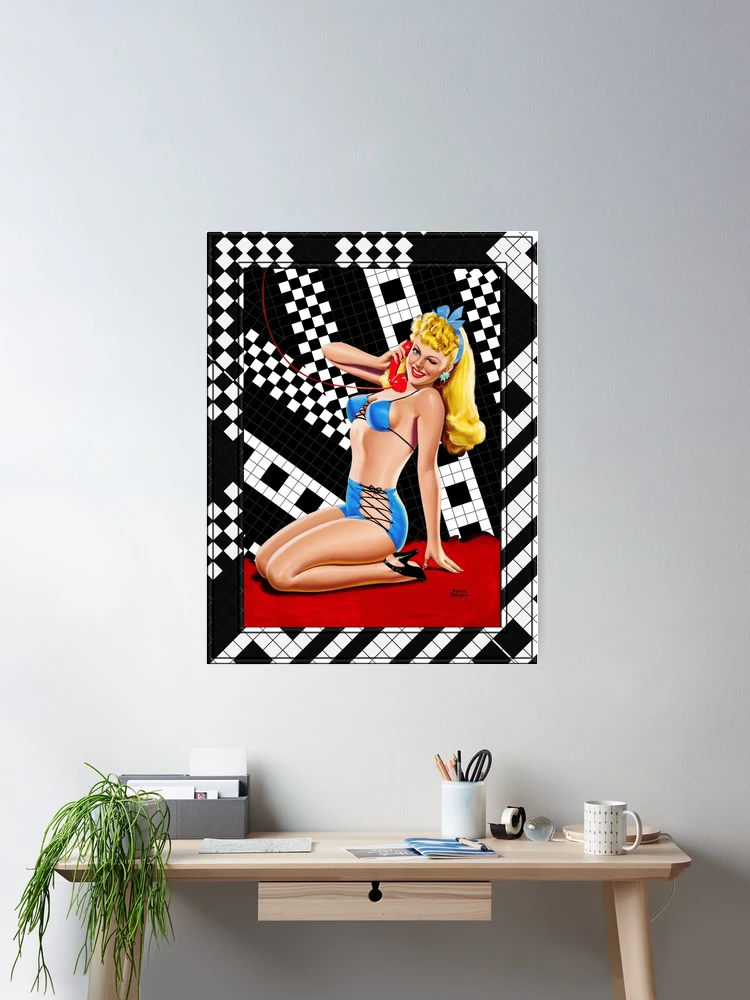
Wrth wraidd “The Red Hotline” lies a playful and coquettish depiction of a young blonde woman. Her golden hair cascades in carefully stylized waves, adorned with a large, cheerful blue bow that complements her swimsuit. The bright smile on her face, coupled with her winking eye, exudes an inviting charm, drawing viewers into the narrative. She holds a bright red telephone receiver, which lends the artwork its name and serves as a pivotal object within the composition.
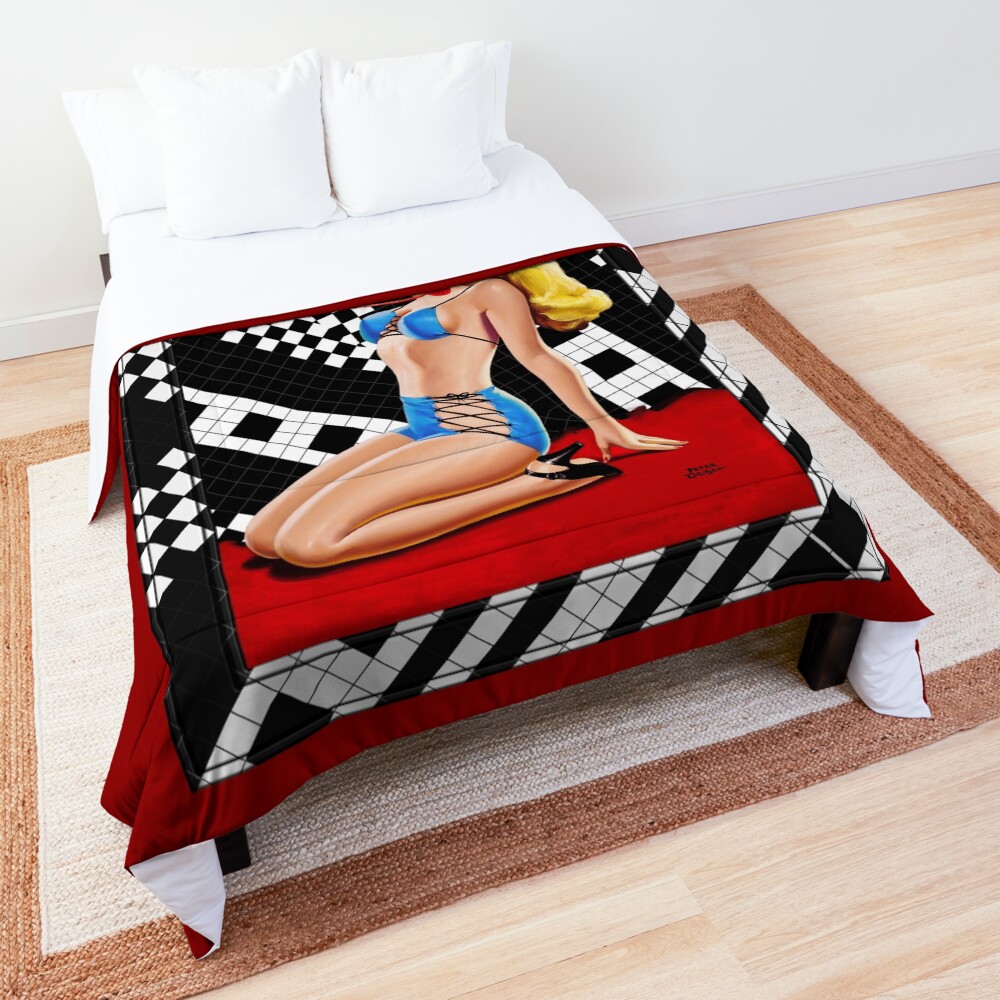
The subject is dressed in a light blue bikini with black lace detailing. The high-waisted bottoms, characteristic of 1940s and 1950s fashion, are secured with crisscrossed laces, adding a touch of suggestive allure without compromising the overall playfulness of the scene. Her slender figure, accented by the pose, kneeling on a red carpet with one hand on the ground and the other holding the phone, demonstrates Driben’s skillful portrayal of anatomy and movement.
Background and Surrounding Objects
The background of “The Red Hotline” is a dazzling geometric checkerboard pattern, executed in stark black and white. This graphic, almost optical illusion-like design provides a modernist contrast to the soft, feminine figure in the foreground. The abstract background evokes a sense of energy and boldness, reinforcing the dynamic quality of the composition.
The red telephone cord playfully winds across the frame, connecting the subject to an unseen caller and injecting a sense of narrative intrigue. The phone itself, a vibrant red, stands out sharply against the monochrome and blue elements, acting as both a visual and thematic anchor.
The red carpet beneath the woman serves a dual purpose. It frames her pose while adding a warm, inviting tone to the composition. This patch of red balances the cooler tones of her attire and ties back to the telephone, creating a cohesive color scheme.
Arddull a Thechneg
Driben’s work embodies the Golden Age of pin-up art, an era when illustrators captured an idealized, often cheeky depiction of femininity. His style is defined by bold colors, llinellau glân, and a high level of polish that recalls the glossy advertisements and magazine covers of his time.
Yn “The Red Hotline,” Driben’s use of light and shadow is subtle but effective. The glossy sheen on the telephone and the laces of the swimsuit adds a sense of texture and realism, while the soft shadows along the figure’s curves enhance her three-dimensionality. The artist’s attention to detail—such as the precise rendering of her glossy black heels or the subtle highlights in her hair—showcases his technical prowess.
Thema a Hwyliau
Mae thema “The Red Hotline” is lighthearted and playful, rooted in the optimism and cheeky humor that characterized mid-century pin-up art. The telephone introduces an element of storytelling, inviting viewers to imagine the conversation taking place. Is she flirting with a suitor? Sharing a laugh with a friend? The ambiguity allows for a range of interpretations, adding depth to the seemingly simple scene.
The mood is undeniably fun and flirtatious, yet it remains within the realm of innocent escapism. Driben’s pin-ups often walked the line between suggestiveness and wholesomeness, a balance that made them widely popular and accessible during their time. “The Red Hotline” is no exception, offering a playful fantasy that never veers into vulgarity.
Deunyddiau a Chanolig
While the specific medium of this piece isn’t detailed here, Driben was known for his work in gouache and oil paints. These mediums allowed him to achieve the vibrant colors and smooth finishes seen in “The Red Hotline.” The level of precision in the lines and shading suggests that this artwork was originally created as an illustration, likely intended for print in a magazine, calendar, or poster.
Cyd-destun Diwylliannol ac Etifeddiaeth
“The Red Hotline” reflects the cultural zeitgeist of its era. Created during a time when pin-up art was at its peak, it embodies the idealized femininity and playful sensuality that appealed to audiences in the mid-20th century. Driben’s works were part of a broader movement that celebrated beauty, hudoliaeth, and the allure of the everyday woman.
As a piece of pin-up art, “The Red Hotline” carries with it the legacy of a genre that influenced fashion, advertising, and popular culture. Heddiw, it stands as a nostalgic reminder of a bygone era, appreciated both for its aesthetic qualities and its historical significance.
Nghasgliad
“The Red Hotline” by Peter Driben is a masterful example of mid-century pin-up art. Its captivating subject, bold design, and vibrant execution showcase the artist’s talent and creativity. Driben’s ability to combine playfulness with technical precision ensures that this artwork remains an enduring icon of its genre. It captures a moment in time when glamour and charm were celebrated, offering viewers a delightful glimpse into the world of vintage illustration.
Mae hwn yn atgynhyrchiad hen feistri celf ddigidol wedi'i ailfeistroli o ddelwedd parth cyhoeddus sydd ar gael fel a print metel ar-lein.

Am Yr Artist
Gwybodaeth Isod O Wikipedia.org
Ganed Peter Driben yn Boston, ac astudiodd yn Ysgol Gelf Vesper George cyn symud i Baris yn 1925. Wrth gymryd dosbarthiadau yn y Sorbonne yn 1925, dechreuodd gyfres o luniadau pen-ac-inc hynod boblogaidd o sioe ferched y ddinas.
Ym mis Mawrth o 1934 Creodd Driben ei pin-up hysbys cyntaf sef clawr La Paree Stories; a chan 1935, roedd yn cynhyrchu cloriau ar gyfer Snappy, Pep, Nosweithiau Efrog Newydd, Bywyd Nos Ffrengig a Caprice.
Wrth i boblogrwydd Driben barhau i godi ar ddiwedd y tridegau creodd ragor o gloriau ar gyfer cyfnodolion eraill gan gynnwys Silk Stocking Stories, Ffilm Llawen-Go-Rownd a Hwyl Sgrin Go Iawn.
Ehangodd gyrfa Driben i hysbysebu pan symudodd i Efrog Newydd yn hwyr 1936. Yma creodd arddangosiadau ffenestr wedi'u torri'n marw tri dimensiwn gwreiddiol ar gyfer Philco Radios, Tywelion Bath Cannon, a Chwmni Pobi Weber.
Efallai mai ei waith enwocaf oedd y posteri gwreiddiol a gwaith celf cyhoeddusrwydd ar gyfer The Maltese Falcon. Roedd Peter Driben hefyd yn ffrind agos i'r cyhoeddwr Robert Harrison, ac yn 1941 cafodd gytundeb i gynhyrchu cloriau ar gyfer cylchgrawn newydd Harrison, Beauty Parade.
Oddi yno aeth Peter ymlaen i beintio cannoedd o gloriau ar gyfer y cyhoeddiad hwnnw ac ar gyfer y saith teitl arall roedd Harrison i'w lansio – fflyrt, Sibrwd, Syllu, Winc, Llygad, Giggles, a Joker.
Byddai Driben yn aml yn cyhoeddi cymaint â chwech neu saith o'i gloriau bob mis. Sefydlodd gwaith Driben i Harrison ef fel un o artistiaid pin-yp a hudoliaeth mwyaf cydnabyddedig a llwyddiannus America.. Ychydig cyn iddo ddechrau gweithio i Harrison, Priododd Driben yr arlunydd, actores a bardd, Louise Kirby.
Yn 1944 cynigiwyd y cyfle anarferol iddo, ar gyfer artist pin-up; hynny oedd i ddod yn gyfarwyddwr celf y New York Sun, swydd a gadwodd hyd 1946. Yn ystod y rhyfel, ysgogodd ei baentiad poblogaidd o filwyr Americanaidd yn codi'r faner yn Iwo Jima gryn dipyn o sylw gan y cyfryngau.
Yn 1956, Symudodd Driben a Louise i Miami Beach, lle treuliodd ei flynyddoedd ymddeol yn peintio portreadau (gan gynnwys un o Dwight D. Eisenhower) a gweithiau celfyddyd gain eraill, a drefnwyd yn arddangosfeydd llwyddianus gan ei wraig. Bu farw Driben yn 1968, Louise yn 1984.