

Sept putti portant une guirlande de fruits
L'œuvre intitulée “Sept putti portant une guirlande de fruits,” created between 1780 et 1787 by the German engraver William Dickinson (1758 – 1787), is a remarkable example of the classical baroque tradition. The piece originates from a painting by the Flemish master Peter Paul Rubens (1577 – 1640), known for his mastery of color, mouvement, and his portrayal of sensuality and vitality in his works. This engraving, which was part of a larger collection of works made by Dickinson, attempts to capture the grandeur of Rubens’s original painting in a medium that lends itself to precision and detail.
The image focuses on the figure of seven putti, each carrying a garland of ripe fruits, embodying the theme of abundance and the pleasures of nature. These cherubic figures, often associated with love and youthful innocence in classical mythology, are depicted as strong and energetic as they bear the burden of the lavish fruit garlands.
The putti are naked, their soft forms emphasizing the purity and vigor of youth, with their bodies twisted in various positions as they struggle under the weight of the bounty they carry. These figures symbolize not only the themes of fertility and natural abundance but also the complex relationships between innocence, labor, and the pleasure derived from nature’s richness.
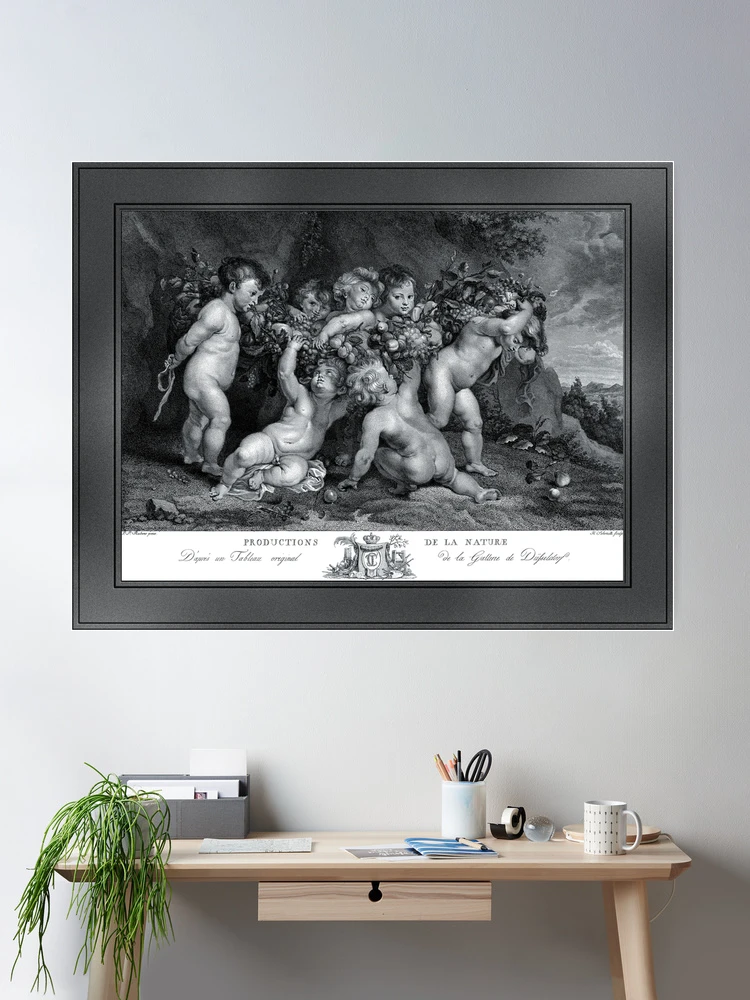
Table des matières
Le sujet principal et les chiffres
The seven putti are the central figures in this gravure. They are placed in dynamic, flowing poses, conveying a sense of movement and effort. Each child is shown with a garland of fruit that they carry with apparent effort, creating a sense of weight and abundance. Their cherubic faces are filled with expressions of determination, reflecting the labor of carrying the heavy garlands.
The putti are not simply decorative; they play a critical role in bringing the theme of nature’s generosity to the forefront. Their movements are graceful, yet each figure bears its own unique posture that suggests the strain of carrying the weight of nature’s bounty. Some are bent over, while others hold the garland overhead, and some are even balancing precariously on one leg, emphasizing the tension between ease and effort.
The fine detailing of the putti’s figures, especially their limbs and facial expressions, captures the sensuality Rubens was known for. The children’s bodies are rendered with a softness that evokes youthful vitality, while their expressions convey an innocence tinged with effort, underlining the contrast between youthful play and labor. The garlands themselves, brimming with ripe fruit such as apples and grapes, are rich in texture and appear almost tangible, adding to the naturalistic aspect of the engraving.
Objets et symbolisme
The most significant object in the engraving, beyond the putti themselves, is the garland of fruit. The garlands are a symbol of fertility, prosperity, and the pleasures of the natural world. The abundance of fruit speaks to the theme of nature’s bounty, a common motif in baroque art that emphasizes both the joy and the labor that come from cultivating and living in harmony with nature. The fruit, depicted in rich, fine detail, emphasizes the luxurious and sensual nature of Rubens’s work, creating a feeling of indulgence and festivity.
In addition to the fruit, the landscape in the background adds to the sense of depth and context. The figures of the putti are placed within a rural, rocky terrain, with undulating hills and distant mountains. The landscape serves to ground the figures in a natural environment, while the distant horizon, softened by a gentle mist, suggests an endless abundance. This timeless backdrop complements the theme of nature’s eternal bounty and connects the putti’s labor to the broader cycles of growth and harvest.
Le terrain et le paysage
The background of the engraving portrays a rocky, pastoral scene typical of many baroque works. The putti are placed on a gentle incline, surrounded by foliage and boulders, creating a sense of harmony between the figures and their environment. This landscape not only grounds the figures but also highlights the classical ideals of human interaction with nature. The rocky outcroppings contrast with the soft forms of the children, creating a dynamic tension between the natural elements and the human figures.
Beyond the hills, the soft contours of the distant mountains suggest the vastness of the world in which the putti reside. The light that bathes the landscape seems to glow from an unseen source, a characteristic often employed by Rubens to emphasize the ethereal quality of his subjects. The mood of the terrain is one of serenity and quiet, underscoring the peaceful coexistence of man and nature, while still conveying the idea of hard work that is rewarded by the richness of the harvest.
Style, Thème, et humeur
The engraving adopts the classical baroque style, with its focus on movement, vitalité, and exuberance. Rubens’s influence is unmistakable, as the figures are imbued with a sense of dynamic energy and sensuality that was characteristic of his work. The garlands of fruit, the soft rendering of the figures, and the lush landscapes are all components of Rubens’s stylistic hallmarks, filtered through Dickinson’s engraving technique. The overall mood of the piece is one of youthful exuberance mixed with the labor and effort required to harvest the fruits of the earth.
The theme of abundance, coupled with the figures of the putti, invokes a sense of joy and celebration. The scene is not one of mere labor but of a joyous and festive gathering of nature’s gifts. The work embodies the baroque tendency to celebrate the fullness of life, with an emphasis on sensual pleasures, fécondité, and the interconnectedness of humanity and nature.
Matériaux et techniques
En guise de gravure, this artwork reflects the technical skill of William Dickinson, who was known for his ability to capture the detailed textures of the original paintings. The precise lines of the engraving give the figures a sense of three-dimensionality and depth, making them appear lifelike despite the two-dimensional nature of the medium. The fine details of the fruit, the folds in the figures’ skin, and the textured surfaces of the rocks in the background are all rendered with remarkable clarity. The technique used by Dickinson to reproduce Rubens’s work allows for an intense focus on detail, which brings out the richness of the original painting while maintaining the integrity of its design.
Il s'agit d'une reproduction de maîtres anciens d'art numérique retouchée d'une image du domaine public.
La biographie de l'artiste est dérivée de Wikipedia.org
William est né à Londres, Angleterre sur 1746, et a commencé sa carrière en tant que graveur en utilisant la technique de gravure Mezzotint qui a été développée au 17ème siècle; et qui permet la création d'impressions avec des dégradés de tons doux et des noirs riches.
Le processus d'impression monochrome Mezzotint de la famille intaille, était le moyen de produire des demi-teintes sans utiliser de lignes ou de techniques basées sur des points comme les hachures, hachures ou pointillés (Réf: https://en.wikipedia.org/wiki/Mezzotinte).
Lors de l'utilisation de la méthode de gravure à la manière noire, il l'a appliquée à la création de caricatures et de portraits d'après les œuvres du portraitiste et peintre historique britannique Robert Edge Pine. (1730 – 1788); et à l'âge de 21 a reçu une prime de la Society of Arts.
À partir de ce moment, William a commencé à publier ses propres œuvres et 12 des années plus tard, il s'associerait à Thomas Watson (1750 – 1781); un graveur des méthodes meaaotint et pointillé.
Au cours du début au milieu des années 1790, William s'installerait à Paris, France où il réalise des gravures pour le nouveau régime puis plus tard pour Napoléon.