

Vénus et Adonis
“Vénus et Adonis,” créé dans 1729 par un peintre français François Lemoyne (1688 – 1737), presents a masterful depiction of a mythological scene from Ovid’s “Metamorphoses.” The painting captures an intense and emotional moment between the goddess Venus and her beloved Adonis. The work exemplifies the Rococo style that was flourishing in France at the time, characterized by its delicate forms, fluid brushwork, Et léger, ethereal color palette. Lemoyne’s expertise in rendering human forms and dramatic emotion is evident in this piece, which conveys a tender yet tragic narrative.
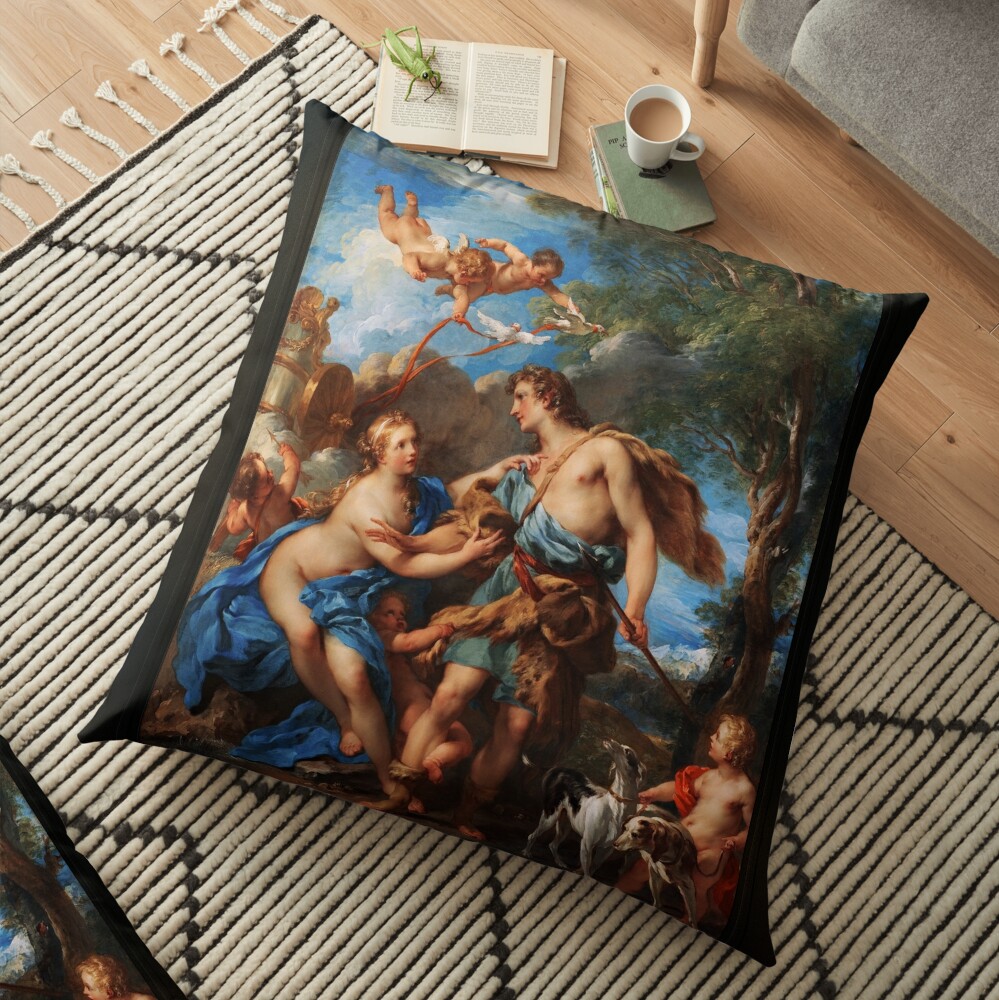
Table des matières
Le sujet principal et la composition
The central figures in “Vénus et Adonis” are the goddess Venus and her mortal lover Adonis. Vénus, depicted in a state of divine beauty, reaches toward Adonis, her expression filled with sorrow and longing. She is partially unclad, her flowing blue drapery accentuating her sensuous form. Her posture is one of both entreaty and desperation, as she gazes at Adonis, urging him not to go hunting despite the danger that lies ahead. The connection between the two figures is palpable—Venus’s hand rests gently on Adonis’s arm as if trying to keep him from leaving her side.
Adonis, muscular and youthful, stands in contrast to Venus’s softness. His attire is minimal, save for a brief loincloth and a fur mantle, highlighting his athletic form. His posture is firm, resolute, as he is seemingly determined to pursue his love for hunting. His gaze, pourtant, is conflicted, torn between his affection for Venus and his passion for the hunt, which will ultimately lead to his tragic death.
The figures are surrounded by playful cherubs, or putti, who represent the playful and amorous nature of Venus herself. Two cherubs are seen flying overhead, holding ribbons that further emphasize the dynamic and lively atmosphere of the scene. Other cherubs stand or crouch around the couple, some holding a bow, while another gently cradles a goat—perhaps an allusion to the innocent and untamed side of nature that both Venus and Adonis are drawn to.
Le paysage et le cadre
Le paysage dans “Vénus et Adonis” is an idealized pastoral scene, lush with greenery and dotted with trees, suggesting a peaceful and fertile world that contrasts with the impending violence of the hunt. Le doux, rolling hills are bathed in a warm light that gives the composition a serene, qualité presque onirique. This idyllic setting enhances the emotional tension of the narrative, as it serves as a backdrop to the tragic story of love and loss.
The sky in the painting is equally important, painted with a vibrant yet soft blue that leads the viewer’s eye upward toward the cherubs in flight. The clouds are soft and billowy, creating a sense of movement and lightness that contrasts with the heavy emotions depicted below. La composition entière, both terrestrial and celestial, is bathed in golden hues that reflect the Rococo style’s emphasis on lightness and beauty.
Matériaux et Techniques
Lemoyne’s use of oil paints is exemplary in this work. The brushwork is smooth and precise, with no visible strokes that might interrupt the soft, almost velvety texture of the scene. The paint is layered with great care to achieve a luminous, glowing effect on the skin tones of Venus and Adonis, highlighting their beauty and vitality. L’attention de l’artiste aux détails est évidente dans le rendu des tissus, particularly Venus’s flowing blue gown, which is depicted with soft folds that add a sense of movement to the piece.
The cherubs are painted with a lightness of touch that brings them to life, their delicate features and rounded bodies contrasting with the more mature forms of Venus and Adonis. The textures of the fur mantle on Adonis and the smooth, unblemished skin of Venus further contribute to the tactile quality of the painting, inviting the viewer to imagine the softness of their skin and the roughness of Adonis’s attire.
Style, Thème, et humeur
“Vénus et Adonis” embodies the Rococo style, characterized by its emphasis on sensuality, légèreté, et expression émotionnelle. La palette de couleurs de pastels doux et de tons dorés crée une atmosphère de rêve, tandis que la douceur du pinceau améliore la qualité éthérée de la scène. La sensualité des personnages et l'intensité émotionnelle de leur interaction traduisent la fascination rococo pour l'amour., passion, et la fragilité de la vie.
Le thème du tableau est ancré dans la mythologie classique, en particulier l'histoire d'amour tragique entre Vénus, la déesse de l'amour, et Adonis, le mortel qu'elle aime. Ce conte mythologique parle de la fugacité de la beauté et de la vie, comme Adonis, malgré sa beauté et sa jeunesse, est destiné à mourir dans un accident de chasse, laissant Vénus dévastée. Lemoyne capture ce moment poignant juste avant le départ d'Adonis, rendre le spectateur extrêmement conscient de la perte imminente.
L'ambiance du tableau est un équilibre délicat entre tendresse et chagrin. Les figures de Vénus et Adonis sont rendues avec une telle profondeur émotionnelle que le spectateur ne peut s'empêcher de ressentir le poids de leur séparation.. Les chérubins, avec leur énergie ludique, ajoute une couche d'ironie à la scène, car ils semblent ignorer la tragédie qui est sur le point de se dérouler. Cette combinaison d'innocence et de catastrophe imminente crée une atmosphère profondément émouvante..
Conclusion
François Lemoyne’s “Vénus et Adonis” est un superbe exemple d'art rococo qui combine le récit mythologique, profondeur émotionnelle, et maîtrise technique. La composition, riche en détails et en mouvement, invite le spectateur dans un monde de beauté, l'amour, et perte. L’utilisation de la lumière par Lemoyne, texture, et la couleur crée une scène à la fois sereine et chargée d'émotion, capturer le moment de l'amour juste avant sa fin tragique. Cette peinture, avec l'accent mis sur la sensualité, expression émotionnelle, et thèmes classiques, stands as a testament to the elegance and complexity of Rococo art.
Il s'agit d'une reproduction de maîtres anciens d'art numérique remasterisée d'une image du domaine public qui est disponible sous forme d'impression sur toile en ligne.