

A sparte a nutizia c1904
“A sparte a nutizia,” creatu in 1904 da u famosu pittore talianu Eugen von Blaas (1843 – 1931), hè una scena captivante chì combina magistralmente u realismu cù una narrativa emotiva. A pittura hè un esempiu squisitu di Blaas’ abilità di ritrarà a vita di ogni ghjornu, in particulare a vita di e donne in u principiu di u XXu seculu. Per mezu di a so meticulosa attenzione à i dettagli, paleta di culori vivaci, e magistrali pinzellature, crea una scena piena di vita è di calore, piena di narrazioni vibranti.
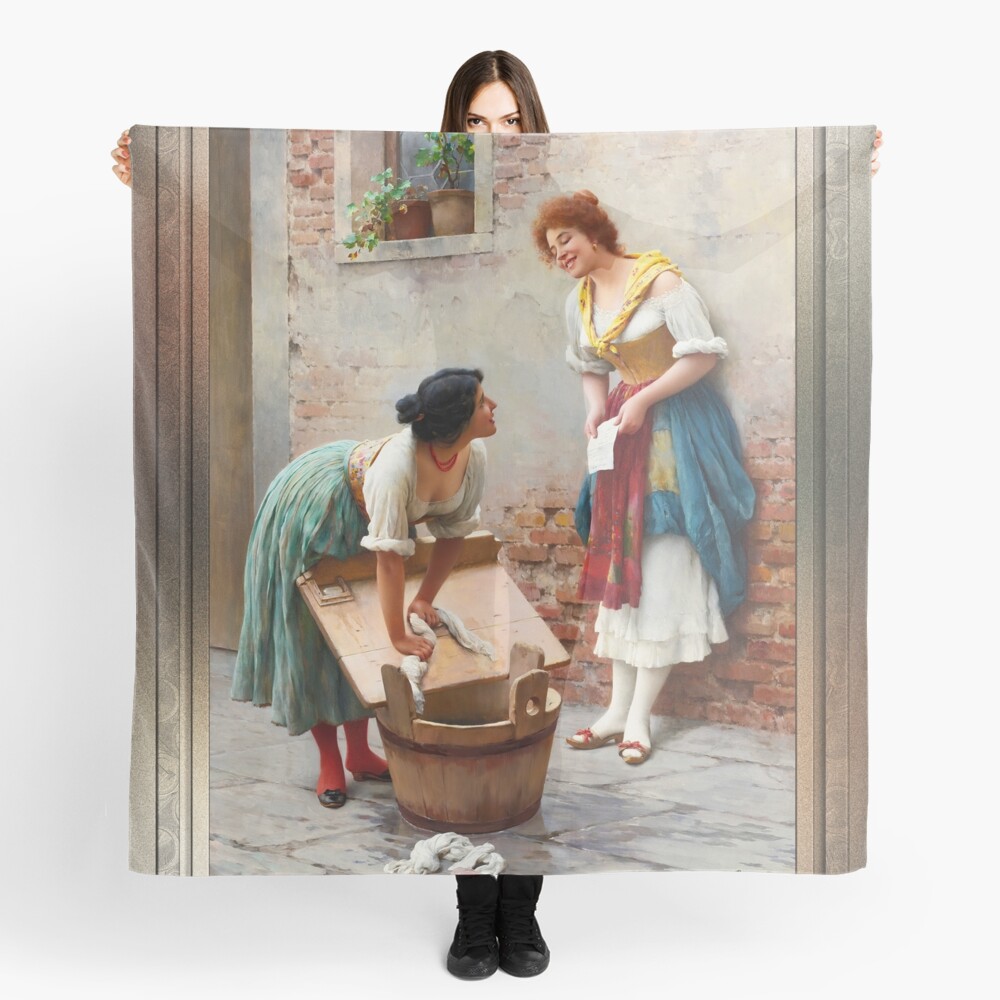
Table of Contents
Sugettu principali è figure
U tema centrale di l'opera d'arte gira intornu à duie donne in un mumentu intimu di cunversazione. Una donna si china nantu à una grande vasca di legnu, presumably to tend to laundry, while the other stands beside her with an expression of amusement or delight. The woman on the left, engaged in a domestic task, is depicted wearing a modest but vibrant dress with a loose blouse, typical of the time. Her dark hair is tied back, and her posture suggests a sense of modesty or perhaps humility in the act of doing chores. Her bare feet are planted firmly on the cobbled stone ground, adding to the realism of her portrayal.
The second woman, who stands on the right, is portrayed with a lively and spirited demeanor. She is dressed in an equally colorful outfit that reflects the vibrancy and dynamism of the era. The woman’s attire consists of a yellow shawl draped around her shoulders, paired with a flowing skirt that combines various colors including a deep red, turchinu, and white. Her lively expression, highlighted by her slightly tilted head and a broad smile, suggests that she is sharing some joyful news with the other woman. In e so mani, she holds a piece of paper, likely a letter or message, indicating that the news is being shared in a written form, adding an element of anticipation and curiosity.
The interaction between the two women is central to the composition, with the body language and facial expressions emphasizing the warmth and familiarity between them. The bent-over figure, who appears to be in the act of listening, engages with the storyteller in a way that conveys both attentiveness and joy. The scene captures the nuances of human emotion, offering a glimpse into the personal world of these women during this period.
Oggetti è Materiali
The scene is set in a quaint outdoor courtyard, with rustic architectural elements that reinforce the sense of domestic life. A simple wooden tub, with laundry spilling out, occupies the foreground of the image. The tub is made from rough-hewn wood, suggesting the utilitarian nature of the objects involved. Vicinu, laundry is scattered across the stone floor, including long lengths of rope and a few garments. The women’s task is clearly connected to their domestic responsibilities, yet the inclusion of the letter and the casual atmosphere gives a sense of lightness and joy to the scene.
In u fondu, a brick wall with small windows and a few scattered potted plants further grounds the setting in a traditional, rustic environment. The potted plants add a touch of life to the otherwise earthy and practical surroundings, helping to contrast with the more serious undertones of the labor-intensive task at hand. These potted plants, which are lush and green, further enhance the feeling of warmth and natural beauty, softening the more mundane aspects of the domestic chore.
Terrain è Sfondate
The terrain in the artwork features a cobbled stone path, weathered and worn by use. The stones appear smooth, rounded, and uneven, creating a rustic charm that is typical of many rural or traditional European settings. The stone path is likely part of an open-air courtyard or alley that leads toward a larger structure, possibly a home or a communal area. The light filtering through the surrounding plants and the diffuse sunlight suggest a bright, clear day, which adds an overall feeling of positivity to the scene.
The background is dominated by the aged brick wall of the building, where a single window with a simple pot of green plants is framed neatly in the composition. The window provides a hint of depth to the scene, creating a sense of an enclosed space while also allowing the viewer to perceive the broader world outside. The bricks are rendered with a realistic touch, their textures and subtle color variations showing Blaas’ skill in capturing light and shadow, lending the wall a sense of history and weathering.
Stile è tecnica artistica
Eugen von Blaas’ painting style is deeply rooted in academic realism, and this piece is no exception. A resa precisa di figure è oggetti, cumminatu cù u so usu di luce è ombra, dimostra a so capacità tecnica. Blaas era cunnisciutu per a so capacità di creà textures realistiche, è quì, impiega a so maestria in a rapprisintazioni di u tissu, tonalità di a pelle, è elementi naturali. I plegamenti di i vistimenti di e donne sò belli eseguiti, catturà u muvimentu di u tela è a so qualità tattile. In listessu modu, a lavanderia in a bagnera di lignu hè dipinta cun grande attenzione à i dettagli, u so tissu biancu cuntrastu cù i culori ricchi di u vestitu di e donne.
A paleta calda aduprata in u pezzu rinfurzà a so ligera, atmosfera allegra. I culori brillanti di i vestiti di e donne-giallu, rossu, blu - serve cum'è un puntu focale visuale chì attira l'ochju di u visor. Questi culori vivi sò cuntrastati cù i toni terri di a terra di petra è u muru di brique, grounding a cumpusizioni in un più rusticu, paràmetru di ogni ghjornu. I toni muti di u fondu è a dinamica di e donne, costumi vibranti cuntribuiscenu à una cumpusizioni equilibrata.
L'umore di l'opera d'arte hè unu di felicità cumuna, intimità domestica, è camaraderia. Parla di e rilazioni strette chì e donne formate durante u principiu di u XXu seculu, in particulare in i paràmetri domestici induve l'attu di sparta nutizie - sia gioia o triviale - era una parte impurtante di a vita suciale.. Blaas cattura stu mumentu di cunnessione trà e duie figure, trasfurmendu un travagliu di ogni ghjornu in una narrativa di amicizia è cumunità.
Cunclusione
“A sparte a nutizia” by Eugen von Blaas stands as a testament to the artist’s ability to portray the subtleties of human interaction and domestic life. The scene is full of warmth, joy, and a sense of shared experience. Through his skilled technique, Blaas gives the viewer an intimate glimpse into a world of vibrant color, emotional connection, and traditional tasks, all while masterfully capturing the essence of early 20th-century life.
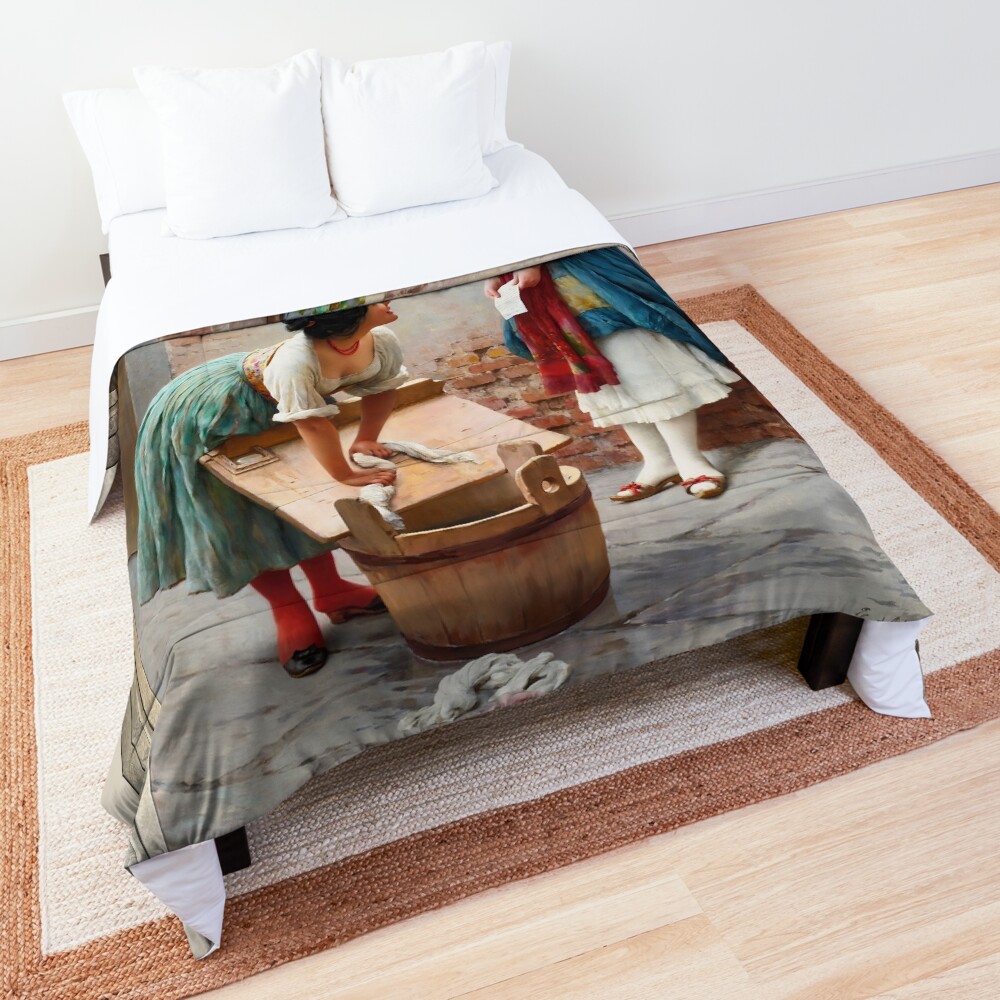
This is a remastered digital art old masters reproduction of a public domain image that is available for purchase online in a variety of material formats including canvas prints, stampe acriliche, stampe metalliche, stampe di lignu, stampe in cornice, manifesti, è cum'è stampe su tela arrotolata in una varietà di dimensioni da 12 centimetri à 72 centimetri secondu a dimensione di l'opera d'arte attuale è a stampa nantu à a tenda chì sceglite di cumprà l'arte da.
Biografia di l'artista
Info sottu Derivatu da Wikipedia.org
Eugen von Blaas was born at Albano, vicinu à Roma, à un babbu tirolese è mamma italiana. U so babbu Karl, ancu un pittore, era u so maestru. A so mamma, Agnesina Auda, era una donna rumana benestante. A famiglia si trasfirìu a Venezia quandu Karl divintò prufessore à l'Accademia di Venezia. Spessu pittò scene in Venezia, ma dinù ritratti è pitture religiose.
Frà e so opere sò a forma di matrimoniu in sacristia; Le bingo à Campielo à Venise; Una scena di burattini in un educanciatu; è a Ninetta. Le critique d'art Luigi Chirtani, Quandu u Pittura hè stata mostrata à l'Esposizione Naziunale di Venezia, l'hà descrittu cum'è Bella, lusinghi, bellucciu, accarezzatu, pulita, lucidatu, lavanderia in un dipintu di Mr. Vesica, u ritrattu predilettu di i grandi aristocratici veneziani, vestitu di satin di gala, gioielli brillanti, acconciature di i ricchi.
E so imagine culurite è piuttostu teatrali di a sucetà veneziana, p.e. Nantu à u Balcone (1877; Cullezzione privata), eranu assai diffirenti paragunatu à i pastelli delicati è incisioni di i cortili, balconi è canali di a Venezia muderna.
Eugène de Blaas’ i dipinti sò stati esposti à l'Accademia Reale, Società di Belle Arti, New Gallery è Arthur Tooth and Sons Gallery in Londra, è ancu à a Walker Art Gallery in Liverpool