

Sharing The News c1904
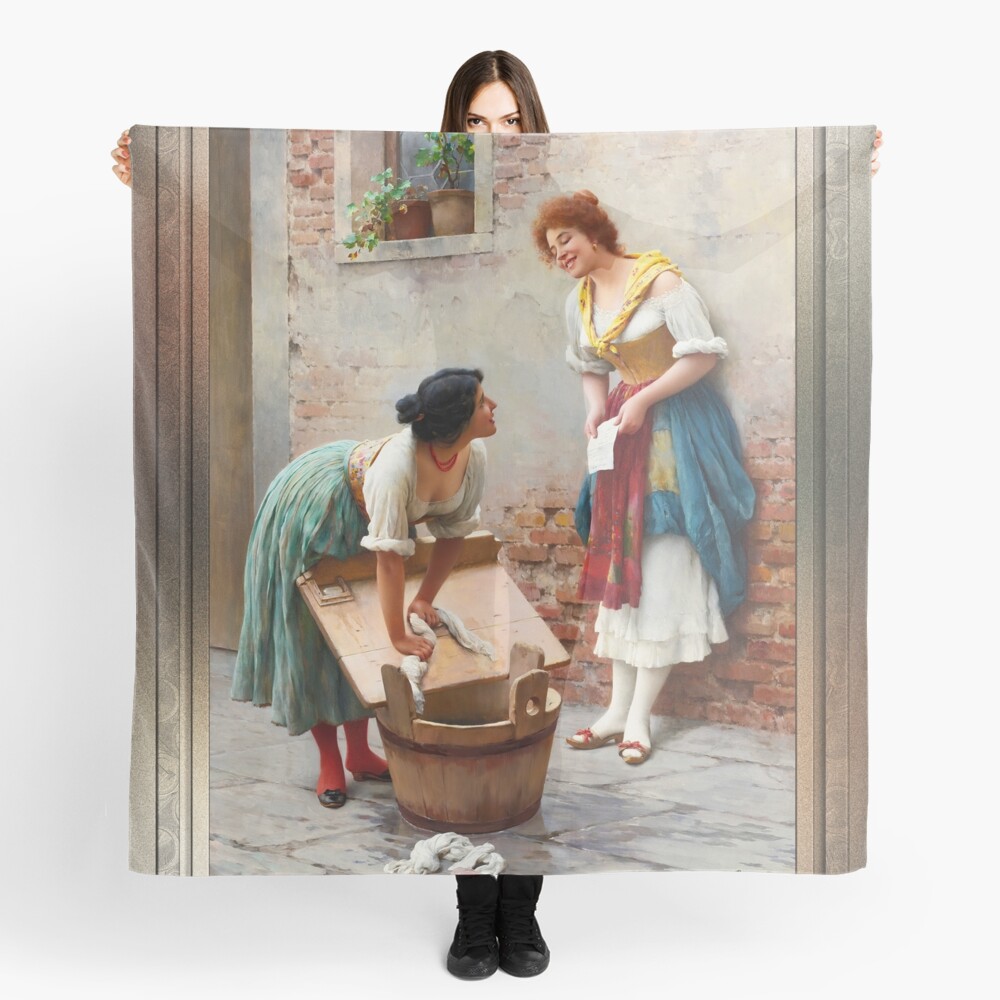
“Sharing The News,” wedi'i greu yn 1904 gan yr arlunydd Eidalaidd enwog Eugene von Blas (1843 – 1931), is a captivating scene that masterfully combines realism with an emotional narrative. The painting is an exquisite example of Blaas’ skill in portraying everyday life, particularly the lives of women in the early 20th century. Trwy ei sylw manwl i fanylion, vivid color palette, and masterful brushwork, he creates a scene full of life and warmth, filled with vibrant storytelling.
Tabl Cynnwys
Main Subject and Figures
The central theme of the artwork revolves around two women in an intimate moment of conversation. One woman is bending over a large wooden tub, presumably to tend to laundry, while the other stands beside her with an expression of amusement or delight. The woman on the left, engaged in a domestic task, is depicted wearing a modest but vibrant dress with a loose blouse, typical of the time. Her dark hair is tied back, and her posture suggests a sense of modesty or perhaps humility in the act of doing chores. Her bare feet are planted firmly on the cobbled stone ground, adding to the realism of her portrayal.
The second woman, who stands on the right, is portrayed with a lively and spirited demeanor. She is dressed in an equally colorful outfit that reflects the vibrancy and dynamism of the era. The woman’s attire consists of a yellow shawl draped around her shoulders, paired with a flowing skirt that combines various colors including a deep red, glas, and white. Ei mynegiant bywiog, amlygwyd gan ei phen ychydig yn gogwyddo a gwên lydan, yn awgrymu ei bod yn rhannu newyddion llawen gyda'r fenyw arall. Yn ei dwylo, mae hi'n dal darn o bapur, llythyr neu neges yn ôl pob tebyg, yn nodi bod y newyddion yn cael ei rannu ar ffurf ysgrifenedig, ychwanegu elfen o ddisgwyliad a chwilfrydedd.
Mae'r rhyngweithio rhwng y ddwy fenyw yn ganolog i'r cyfansoddiad, gydag iaith y corff a mynegiant yr wyneb yn pwysleisio'r cynhesrwydd a'r cynefindra rhyngddynt. Y ffigur plygu drosodd, sydd yn ymddangos yn y weithred o wrando, ymgysylltu â'r storïwr mewn ffordd sy'n cyfleu sylwgarwch a llawenydd. Mae'r olygfa yn cyfleu naws emosiwn dynol, gan gynnig cipolwg ar fyd personol y merched hyn yn ystod y cyfnod hwn.
Gwrthrychau a Deunyddiau
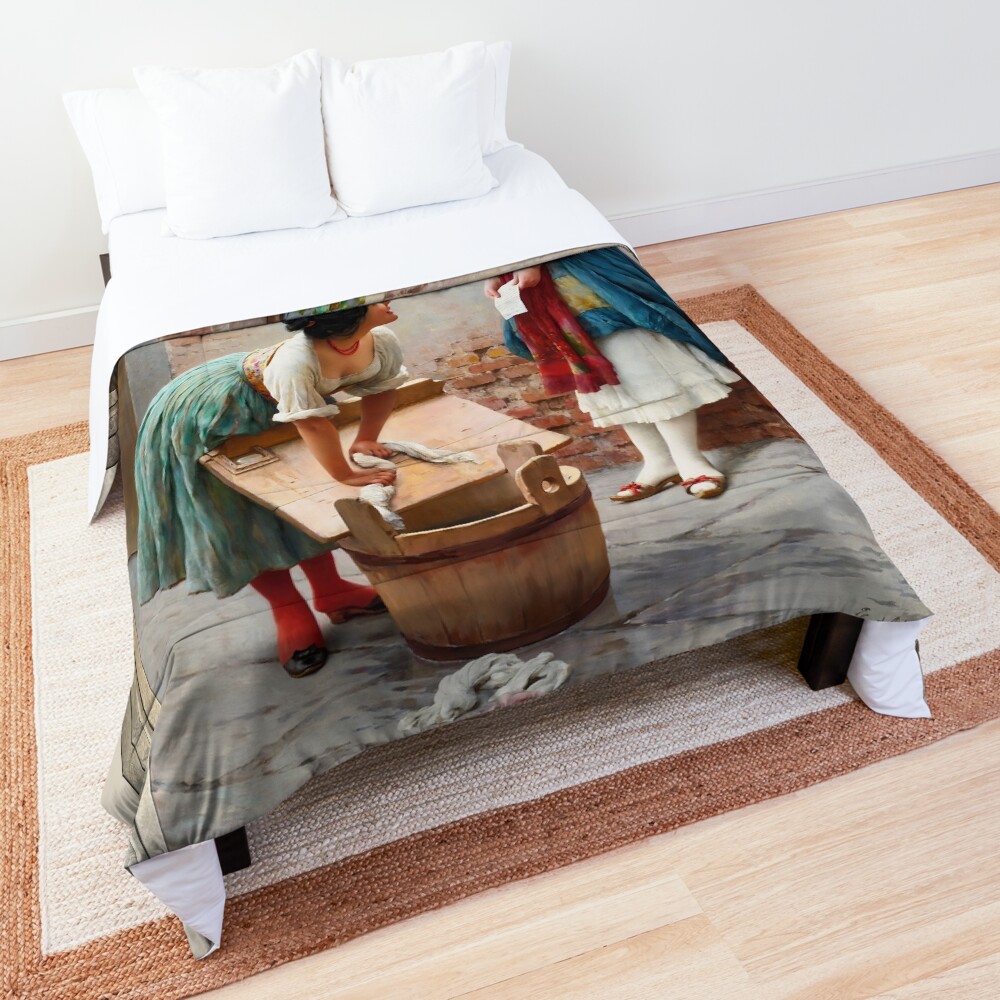
Mae'r olygfa wedi'i gosod mewn cwrt awyr agored hynod, gydag elfennau pensaernïol gwladaidd sy'n atgyfnerthu'r ymdeimlad o fywyd domestig. Twb pren syml, gyda golchi dillad yn gorlifo, yn meddiannu blaendir y ddelwedd. Mae'r twb wedi'i wneud o bren garw nadd, gan awgrymu natur iwtilitaraidd y gwrthrychau dan sylw. Gerllaw, mae golchdy wedi'i wasgaru ar draws y llawr carreg, gan gynnwys darnau hir o raff ac ychydig o ddillad. Mae cysylltiad amlwg rhwng tasg y merched a’u cyfrifoldebau domestig, eto mae cynnwys y llythyren a'r awyrgylch achlysurol yn rhoi teimlad o ysgafnder a llawenydd i'r olygfa.
Yn y cefndir, mae wal frics gyda ffenestri bychain ac ychydig o blanhigion gwasgaredig mewn potiau yn rhoi sylfaen draddodiadol i'r lleoliad, amgylchedd gwladaidd. Mae'r planhigion mewn potiau yn ychwanegu ychydig o fywyd i'r amgylchoedd priddlyd ac ymarferol, helping to contrast with the more serious undertones of the labor-intensive task at hand. These potted plants, which are lush and green, further enhance the feeling of warmth and natural beauty, softening the more mundane aspects of the domestic chore.
Tir a chefndir
The terrain in the artwork features a cobbled stone path, weathered and worn by use. The stones appear smooth, rounded, and uneven, creating a rustic charm that is typical of many rural or traditional European settings. The stone path is likely part of an open-air courtyard or alley that leads toward a larger structure, possibly a home or a communal area. The light filtering through the surrounding plants and the diffuse sunlight suggest a bright, clear day, which adds an overall feeling of positivity to the scene.
The background is dominated by the aged brick wall of the building, where a single window with a simple pot of green plants is framed neatly in the composition. The window provides a hint of depth to the scene, creating a sense of an enclosed space while also allowing the viewer to perceive the broader world outside. The bricks are rendered with a realistic touch, their textures and subtle color variations showing Blaas’ skill in capturing light and shadow, lending the wall a sense of history and weathering.
Arddull a Thechneg Artistig
Eugen von Blaas’ painting style is deeply rooted in academic realism, ac nid yw'r darn hwn yn eithriad. The precise rendering of figures and objects, combined with his use of light and shadow, demonstrates his technical skill. Blaas was known for his ability to create lifelike textures, and here, he employs his mastery in the depiction of fabric, tonau croen, and natural elements. The folds of the women’s garments are beautifully executed, capturing both the movement of the fabric and its tactile quality. Yr un modd, the laundry in the wooden tub is painted with great attention to detail, its white fabric contrasting against the rich colors of the women’s attire.
The warm palette used in the piece enhances its lighthearted, joyful atmosphere. The bright colors of the women’s dresses—yellow, coch, blue—serve as a visual focal point that draws the viewer’s eye. These vivid colors are contrasted with the earthy tones of the stone ground and brick wall, grounding the composition in a more rustic, everyday setting. The background’s muted tones and the women’s dynamic, vibrant costumes contribute to a balanced composition.
The mood of the artwork is one of shared happiness, domestic intimacy, and camaraderie. It speaks to the close relationships women formed during the early 20th century, particularly in domestic settings where the act of sharing news—be it joyous or trivial—was an important part of social life. Blaas captures this moment of connection between the two figures, transforming an everyday chore into a narrative of friendship and community.
Nghasgliad
“Sharing The News” by Eugen von Blaas stands as a testament to the artist’s ability to portray the subtleties of human interaction and domestic life. The scene is full of warmth, llawenydd, and a sense of shared experience. Through his skilled technique, Mae Blas yn rhoi cipolwg agos i'r gwyliwr ar fyd o liw bywiog, cysylltiad emosiynol, a thasgau traddodiadol, i gyd tra'n dal yn feistrolgar hanfod bywyd yn gynnar yn yr 20fed ganrif.
Mae hwn yn atgynhyrchiad hen feistr celf ddigidol wedi'i ailfeistroli o ddelwedd parth cyhoeddus sydd ar gael i'w brynu ar-lein mewn amrywiaeth o fformatau deunydd gan gynnwys printiau cynfas, printiau acrylig, printiau metel, printiau pren, printiau wedi'u fframio, posteri, ac fel printiau cynfas wedi'u rholio mewn amrywiaeth o faint o 12 modfedd i 72 modfeddi yn dibynnu ar faint y gwaith celf gwirioneddol a'r siop argraffu ar alw y byddwch yn dewis prynu'r celf ohoni.
Bio artist
Gwybodaeth Islaw sy'n Deillio o Wikipedia.org
Ganwyd Eugen von Blaas yn Albano, ger Rhufain, i dad o Tyrolean a mam Eidalaidd. Roedd ei dad Karl, hefyd peintiwr, oedd ei athraw. Ei fam, Agnesina Auda, roedd yn ddynes Rufeinig dda i wneud. Symudodd y teulu i Fenis pan ddaeth Karl yn Athro yn Academi Fenis. Byddai'n paentio golygfeydd yn Fenis yn aml, ond hefyd portreadau a phaentiadau crefyddol.
Ymhlith ei weithiau mae The nuptial form in the sacristy; Bingo yn Campielo yn Fenis; Golygfa bypedau mewn ysgol; a La Ninetta. Y beirniad celf Luigi Chirtani, pan gafodd y paentiad ei arddangos yn y Mostra Nazionale di Venezia, ei ddisgrifio fel Hardd, gwenieithus, pert, caressed, glanhau, caboledig, golchdy mewn darlun gan Mr. Bledren, hoff bortreadwr uchelwyr Fenisaidd mawr, gwisgo mewn satins gala, gemwaith disgleirio, steiliau gwallt y cyfoethog.
Ei ddelweddau cyfnod lliwgar a braidd yn theatraidd o gymdeithas Fenisaidd, e.e. Ar y Balconi (1877; Casgliad Preifat), yn dra gwahanol o gymharu â phasteli cain ac ysgythriadau o'r cyrtiau, balconi a chamlesi Fenis fodern.
Eugene de Blas’ arddangoswyd paentiadau yn yr Academi Frenhinol, Cymdeithas Celfyddyd Gain, Oriel Newydd ac Oriel Arthur Tooth and Sons yn Llundain, a hefyd yn Oriel Gelf Walker yn Lerpwl