

She’ll String Along With You
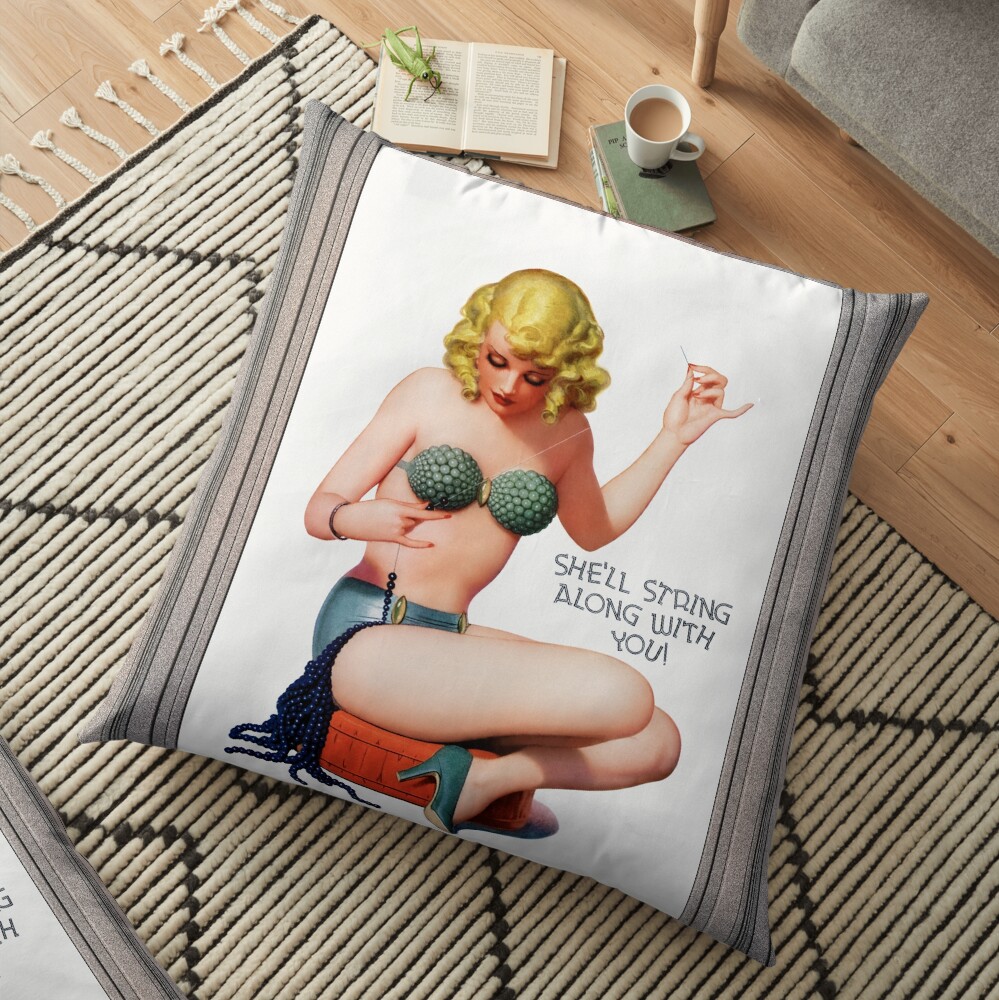
Enoch Bolles, an influential American artist (1883–1976), created the painting She’ll String Along With You in the early to mid-20th century. The work captures a moment of playful flirtation and lighthearted sensuality, encapsulating the spirit of the Jazz Age and the glamour of 1920s advertising art. This painting reflects Bolles’ affinity for pin-up art, which often depicted alluring women in exaggerated, sometimes comedic, poses meant to evoke a sense of charm and innocence, tinged with suggestiveness. The image’s overall feel is one of both humor and seduction, offering an intimate yet whimsical glance into the era’s visual culture.
Edukien taula
Gai nagusia eta osaera
At the heart of the painting is a woman seated on a plush, red cushion, gazing down at the string of beads she is threading through a needle. Her expression is one of focused concentration, yet there is an undercurrent of playful engagement, as if she’s aware of the viewer’s attention. The subject is rendered in soft, warm tones that accentuate her beauty—her blonde curls cascade around her shoulders, framing a face that is both serene and inviting. Bere jarrera, while graceful, is casual, lending a sense of naturalness to her poise.
She is dressed in a revealing outfit made up of large, spherical beads that cover her breasts and a matching belt made of beads that encircle her waist. This design enhances the sensuality of the figure without over-exposing the subject, maintaining a playful yet tasteful aura.
The composition cleverly balances the boldness of her attire with the softness of her demeanor, suggesting a juxtaposition between allure and innocence. The bright colors used in the beads create a vivid contrast against her fair skin and the soft whites and creams of the background. The string of beads, being the object of her attention, links both the subject’s immediate actions and the overarching theme of the painting—engagement, erakargarritasuna, and perhaps even a subtle invitation for interaction.
Objektuak eta sinbolismoa
The beads, central to the composition, are both a literal and metaphorical device in the artwork. As the woman threads the beads onto a string, the act becomes symbolic of connection and continuity. Beads, often associated with adornment and femininity, here take on the role of creating something new—a string that will eventually be completed. This act of creation mirrors the viewer’s construction of meaning, linking the viewer’s eye with the subject’s sensual motion and inviting them to be a part of the process.
The background is a pristine white, which helps to isolate the subject in the foreground, giving the viewer no distractions other than her, the beads, and the quiet activity of sewing. This clean space around her brings a sense of purity and highlights the simplicity of the scene. Biguna, almost ethereal quality of the background contrasts with the tactile, almost tangible texture of the beads, emphasizing the juxtaposition of material versus immaterial.
Thematic Exploration
Gaia She’ll String Along With You can be interpreted as a playful yet suggestive invitation. The use of the phrase “She’ll String Along With You,” displayed in bold lettering across the bottom of the frame, is a direct engagement with the viewer. Epea “string along” can refer both to the literal activity of threading beads and to the colloquial expression of leading someone on in a flirtatious manner. Bolles masterfully plays on this double meaning, enhancing the work’s flirtatious and teasing nature.
The artwork’s flirtation is understated yet undeniable. The figure’s semi-nude posture is not overtly sexual but instead rendered in a manner that suggests allure through subtlety. The woman’s modesty in her pose and attire invites curiosity without being crude, echoing the sophisticated yet liberated sexuality of the 1920s. This period, which was marked by significant social change, embraced a new form of womanhood, one that was confident, independent, and playful, as reflected in Bolles’ artwork.
Estilo artistikoa eta eragina
Bolles’ style in She’ll String Along With You is grounded in the Art Deco movement, a popular visual style of the 1920s and 1930s. His use of clean lines, kolore biziak, and stylized forms aligns with the elegance and modernity of the period.
The smoothness of the figure’s curves and the minimalistic backdrop are reminiscent of the streamlined aesthetic associated with Art Deco, which prized both beauty and efficiency in design. Biguna, flat colors and the focus on the woman’s figure exemplify Bolles’ ability to combine commercial art with fine art principles.
Bolles was known for his pin-up art, a genre that often combined commercial advertisement with artistic technique. Lan honetan, there is a clear sense of both, as the woman appears poised for a product advertisement, yet she is rendered with the grace of a fine art figure study. This intersection of commercial and artistic influence reflects Bolles’ contribution to both art and advertising, where the worlds of art, diseinua, and popular culture often collided.
Aldartea eta Giroa
Aldarte orokorra She’ll String Along With You is playful and inviting. The woman’s focused expression paired with the humor implied in the title creates a lighthearted, almost mischievous atmosphere. The interaction between the figure and the viewer is intimate but not confrontational.
There is a sense of whimsy in the way the woman is presented, she is not simply a subject to be gazed at, but an active participant in the creation of the scene. The work evokes a sense of casual allure, framed by the notion of invitation and flirtation, set against the larger cultural shift of the 1920s that celebrated more liberated and open expressions of femininity.
Bukaera
In She’ll String Along With You, Enoch Bolles captures a moment of delicate sensuality and playful charm. Through the use of vivid colors, smooth lines, and a simple yet suggestive composition, he invites the viewer into a world where beauty and humor coexist. Margolanaren erdian dagoen emakumea, engaged in the quiet act of threading beads, represents the fusion of art and advertisement, femininity and power, dena 1920ko hamarkadako estetika liluragarrian bilduta. Bollesek marko berean inozentzia eta erakargarritasuna harrapatzeko duen gaitasunak garaiaren izaera bikoitzaz hitz egiten du., askatasun sentimenduak eta bizitza modernoaren berezko tentsioek markatutakoa.
Domeinu publikoko irudi baten erreprodukzioa da mihise inprimatu sarean.
Artistaren biografia
Informazioa Behean Deribatua Wikipedia.org
Enoch Enoch Bolles lurrin kimikariarengandik jaio zen, Jr eta Catherine Keep Marion konderrian, Florida martxoan 3, 1883.
New Yorkeko National Academy of Design-en ikasi zuen (Ekialdea. 1825), eta bere lehen ilustrazioa argitaratu zuen umore aldizkarien azaletan; Epailea eta Puck sartu 1914; pulp aldizkaria Film Fun ilustratzeagatik ezagun bihurtuz.
Gero sartu 1923 Film Magazinerako azaleko artista esklusibo bihurtu zen eta postu horretan jarraituko zuen arte 1943, aldizkaria orduko Postmaster Generalaren material salatsuaren aurkako kanpainaren biktima bihurtu zenean.
Enochek Film Fun Magazine-n sortu zuen garaian 200 piezak azaleko artea, eta bederen 300 Ore pikanteen beste aldizkari batzuen azal osagarriak, tartean, Breezy Stories, Pep eta New York Nights.
Enoch-en hileroko All-American Beauty-en mozorro irudimentsuez planteatutakoa da American Pin Up Illustrationren artea definitzeaz arduratzen dena.. Ilustratzaile polifazetikoa ere izan zen, garai hartako produktu askorentzat publizitate-artea sortu zuena, hala nola Sun-Maid Raisins eta Zippo Lighters..
Urtean 60, urtean 1943 Enochek karrera profesionala amaitu behar izan zuen arazo psikologikoengatik, eta New Jerseyko Greystone Park Psikiatriko Ospitalean konfinatu zuten bere bizitza osoan; baina enkarguz egindako erretratuak egiten jarraitu zuen eta norberaren gozamenerako.
Azkenean, Greystone Parkeko Ospitale Psikiatrikotik atera zuten 1969 eta zazpi urte beranduago hil zen bihotzeko gutxiegitasunak jota, urte zituela 93.