

Natureza morta no ateliê
Natureza morta no ateliê c1868 por pintor finlandês Fernando von Wright (1822 – 1906); um pintor de paisagens e animais do século XIX
Esta é uma bela pintura de natureza morta ricamente colorida de um estúdio de artistas que se concentra apenas em uma rica mesa de madeira marrom escura altamente envernizada com um desenho ornamentado esculpido.
Sobre a mesa há um lindo abajur a óleo de mesa com base de cobre, tampo de latão e cúpula de porcelana em estilo vitoriano; que forma a peça central da cena; com grande detalhe dos elementos decorativos do metal, óleo no reservatório de vidro com o pavio de fita incluído.
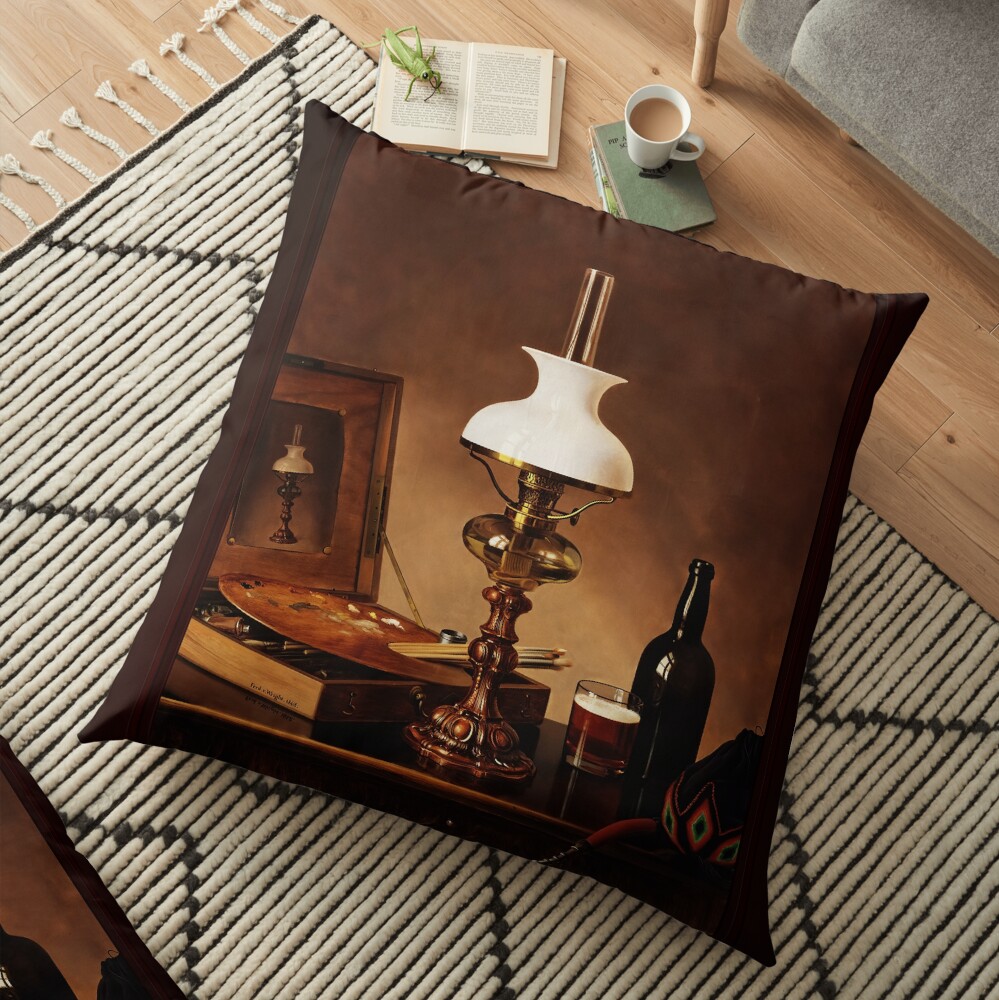
To the right is a black beer bottle and beside the bottle a short glass filled with freshly poured beer and beside that is a Nargile smoking pipe with with what may be a tobacco bag beside it.
To the left of the scene is a painters wooden palette that includes a metal cup on the lower portion, and that has dabs of white, amarelo, vermelho, verde, blue and black paint around the outer perimeter with paint brushes sticking out of the hole that the artist places his thumb.
This is resting on an open artist storage supply box, that has more brushes underneath the palette as well as tubes of paint and other items; and on the inside lid of the box is a photograph of a similar oil lamp used as a reference for the scene.
Still Life In The Atelier is a remastered digital art old masters reproduction of a public domain image that is available as a impressão em tela on-line.
Informações abaixo derivadas de Wikipédia.org
Ferdinand was the last of nine surviving children to the retired Finnish Major Henrik Magnus von Wright; his two older brothers Magnus von Wright (1805 – 1868) and Wilhelm von Wright (1810 – 1887) were painters and illustrators and he followed in their footsteps, showing an early aptitude for art, which was developed during the time he spent hunting and exploring nature, recording what he had observed in his sketchbooks.
Em 1837 he left Finland and traveled to Sweden with his second eldest brother Wilhelm; whom at the time was working as an illustrator for the Swedish Zoologist Bengt Fredrik Fries (1799 – 1839); então em 1838 he went back to Sweden to work for the Swedish amatuer Ornithologist Count Nils Bonde (1685 – 1760).
After going back to Finland on completion of his work; he then returned to Sweden in 1842 and briefly attended the Royal Swedish Academy of Arts studying under the Swedish sculptor Johan Niclas Byström (1783 – 1848); then two years later returned home to Finland.
Então em 1849 he traveled to Turku, Finland where he took additional painting lessons from Swedish Romantic Painter Robert Wilhelm Ekman (1808 – 1873); following his studies, he and his brothers went to Helsinki, the capital of Finland and set up a studio; and six years later he traveled to Dresden, Germany to study under the noted German animal painter Johann Siegwald Dahl (1827 – 1902).
During the 1870s he suffered several strokes that kept him bedridden; but he continued to paint, e em 1881 made his last trip to Orust to visit his brother Wilhelm who was also sick.
From this point on his work became more commercial, e em 1886 he produced his best known painting “The Fighting Capercailles” and was contributing articles to various ornithological publication.
About this time he received a state artists pension; and during the 1890s many of his former students came to visit, while in the late 90s bird painter Matti Karppanen (1873 – 1953) stayed on to be his pupil and assistant.