

Něžné holubice (Holubice; Něha)
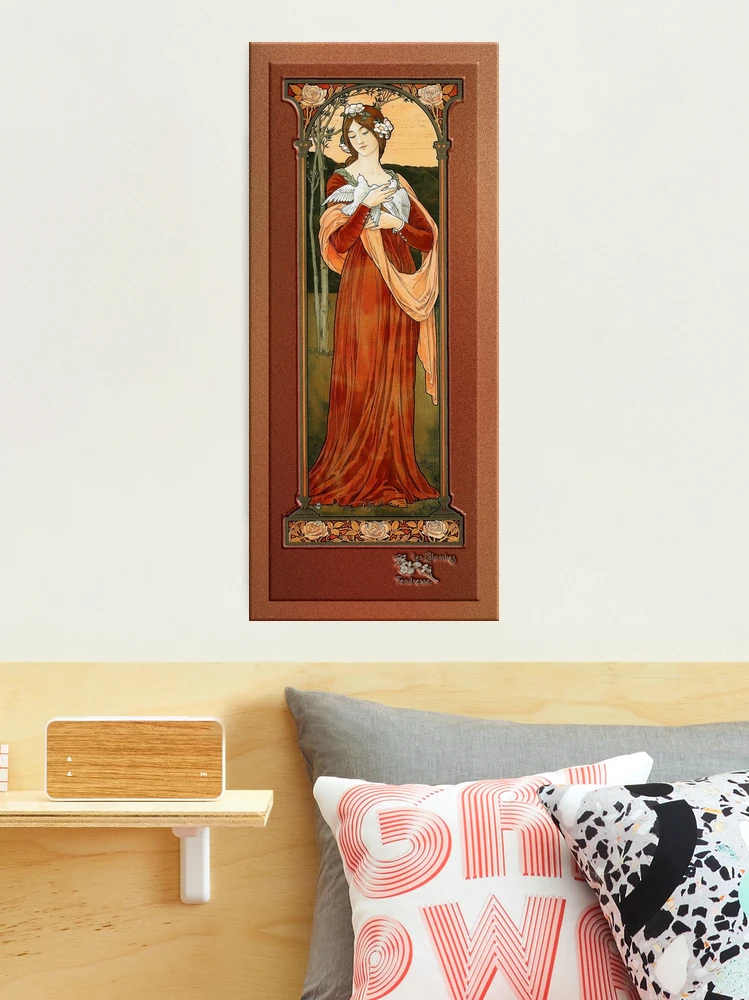
“Něžné holubice (Holubice; Něha)” is a beautiful work by Elisabeth Sonrel, created around the turn of the 20th century. Sonrel, a French artist born in 1874 a kdo zemřel v 1953, is renowned for her symbolic and highly decorative approach to painting. This particular piece exemplifies her delicate mastery of Art Nouveau and her affinity for portraying women in idealized, ethereal settings. The work features a woman holding two doves, a motif rich with symbolism, conveying themes of peace, nevinnost, and tenderness.
Obsah
Hlavní předmět a kompozice
Ústředním předmětem “Něžné holubice” is a graceful woman standing in a serene, slightly blurred landscape. She exudes a sense of tranquility, gazing downward as she gently holds two white doves in her arms. Her face is calm and introspective, radiating both innocence and grace. The woman’s long flowing red gown, which cascades dramatically down her body, is meticulously painted in rich, teplé tóny. The folds of the fabric are carefully rendered, highlighting the artist’s sensitivity to the nuances of texture and light. The gown is the focal point of her form, elegantly sweeping down to the ground, enhancing her ethereal presence.
Her pose and the way she holds the doves emphasize softness and fragility. Ptáci, symbols of peace and love, are cradled delicately in her arms, their white feathers providing a sharp contrast to the warm, earthy tones of her clothing and the background. The composition emphasizes the connection between the woman and the birds, evoking a sense of harmony and a bond with nature. The doves are not merely ornamental but serve as an integral part of the narrative, reinforcing the peaceful mood of the piece.
The Setting and Background
In the background of the painting, the artist has chosen a soft and somewhat indistinct landscape, which allows the figure of the woman to dominate the scene. The soft colors of the sky and the trees in the distance create an almost dreamlike atmosphere, as though the figure exists in an idealized, otherworldly space. The muted tones of the environment, composed mainly of light greens, hnědé, and yellows, complement the warm tones of the woman’s gown, creating a sense of unity in the composition. This choice of background adds to the sense of serenity, offering the viewer a quiet, reflective space.
Stromy, faintly visible in the background, stand tall but not imposing, blending into the soft, hazy light of the horizon. The use of nature as the setting is an integral part of the work, highlighting the peaceful, harmonious relationship between the human form and the natural world. The distant trees and rolling hills suggest a timeless, natural world, where the viewer can imagine the woman being one with the environment, adding to the calm and gentle mood of the piece.
The Symbolism of the Doves
The doves in the painting are a significant element in the overall composition. In Western art, doves are widely recognized as symbols of peace, čistota, A láska. Their presence in this piece is not only symbolic of the artist’s theme of tenderness but also reflects broader themes of femininity and grace. The fact that the woman is holding the doves so gently suggests a nurturing quality, reinforcing the motif of caring and peace. Doves are often associated with mythological and religious symbolism, and their presence here may also invoke ideas of spirituality and transcendence.
The white color of the doves further emphasizes purity and innocence, qualities often attributed to the feminine ideal. The doves in “Něžné holubice” act as a counterbalance to the earthy tones of the woman’s attire and the landscape, providing a moment of lightness and transcendence. This balance between the earthiness of the scene and the purity of the birds reinforces the peaceful, harmonious atmosphere that is central to the painting’s mood.
Art Nouveau Style and Influence
Sonrel’s work is a classic example of the Art Nouveau movement, which emerged in the late 19th century and reached its peak in the early 20th century. Art Nouveau is characterized by flowing lines, organické formy, and a focus on the decorative and ornamental. “Něžné holubice” embraces these stylistic elements, particularly in the intricate design of the borders and the floral motifs surrounding the woman’s figure. The sinuous, curving lines of the composition, particularly in the background and in the woman’s gown, are hallmarks of Art Nouveau’s influence.
The elegant framing of the piece, with its decorative borders adorned with roses and tendrils, reflects the movement’s focus on integrating art into daily life and its reverence for nature. Měkký, flowing forms and the rhythmic repetition of organic shapes also point to the influence of Art Nouveau, which often sought to harmonize the human figure with the natural world.
Nálada a emoční dopad
Nálada “Něžné holubice” is one of calmness, introspekce, and purity. The delicate handling of the subject matter, along with the soft color palette and harmonious composition, creates a serene atmosphere. The viewer is invited to pause and reflect upon the symbolic message of peace, tenderness, and harmony that the piece conveys. The emotional impact of the artwork is subtle but powerful, evoking feelings of peace, klid, and a connection to nature. There is an air of gentle reverence in the way the woman is depicted, as though she is a guardian of peace, holding the doves as symbols of the fragility and beauty of life itself.
Sonrel’s work captures a moment of serene beauty, pozastavena v čase. The attention to detail in the woman’s expression, záhyby jejích šatů, and the delicate handling of the doves invites the viewer to engage with the artwork on a deeply emotional level. The piece conveys a sense of timelessness, allowing the viewer to experience a moment of peaceful contemplation, much like the woman herself, standing in quiet communion with nature and the symbols of love and peace.
Tender Doves je retušovaná digitální umělecká reprodukce obrazu ve veřejném vlastnictví.
Umělec Bio zdvořilost Wikipedia.org
Elizabeth Sonrel (1874 Prohlídky – 1953 těsnění) byl francouzský malíř a ilustrátor v secesním stylu. Její díla zahrnovala alegorické náměty, mystika a symbolika, portréty a krajiny.
Byla dcerou Nicolase Stéphane Sonrel, malíř z Tours, a získala od něj rané školení. Pro další studium odešla do Paříže jako studentka Julese Lefebvrea na Ecole des Beaux-Arts..
v 1892 namalovala svou diplomovou práci, "Pax et Labor", dílo k vidění v Museum of Fine Arts of Tours. Od té doby vystavovala na Salon des Artistes Français mezi 1893 a 1941, její podpisové kusy jsou velké akvarely v prerafaelském způsobu, kterou přijala po cestě do Florencie a Říma, objevování renesančních malířů – některé její práce mají jasné podtexty Botticelliho. Její obrazy byly často inspirovány artušovskou romantikou, Božská komedie Danteho Alighieriho’ a "Nový život", biblická témata, a středověké legendy. Mezi její mystická díla patří ‚Ames errantes’ (Salon of 1894) a „Duchové propasti“.’ (Salon of 1899) a ‚Mladá žena s gobelínem‘.
Na výstavě Universelle of 1900, jehož hlavním tématem byla secese, její 1895 obraz „Spánek Panny“.’ (Spánek Panny), byl oceněn bronzovou medailí, a cenu Henriho Lehmanna 3000 franků Akademií výtvarných umění.[3] Z 1900 dále se omezila ve své malbě na portréty, malebné bretaňské krajiny, a příležitostné květinové studium.
Pravidelně podnikala malířské cesty do Bretaně, inspirované lesem Brocéliande, a od 1910 na různá místa na pobřeží, jako je Concarneau, Plougastel, Pont-l'Abbé a Loctudy, často pobývají v hostincích a v doprovodu jednoho nebo dvou studentů. Namalovala několik děl v Le Faouët, než postavila vilu v La Baule ve třicátých letech 20.. Pracuje hlavně v akvarelu a kvaši, objevila připravenou zásobu modelek mezi mladými dívkami v okolí, a shledal, že Bretonci jsou obecně přátelští, upřímný a sebevědomý.
Její poslední výstava v Salonu byla in 1941 ve věku 67. Existuje také záznam, že vystavovala v Liverpoolu. V jejích raných létech Sonrel produkoval plakáty, pohlednice a ilustrace, v secesním stylu.