

Doves Tendr (Y colomennod; Tynerwch)
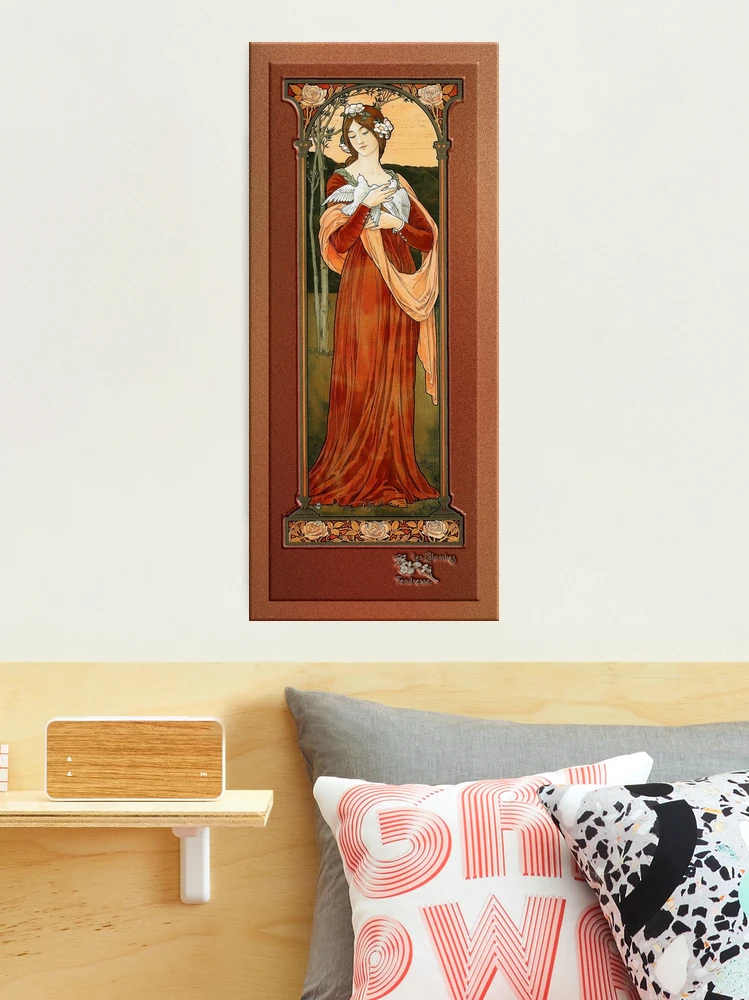
“Doves Tendr (Y colomennod; Tynerwch)” is a beautiful work by Elisabeth Sonrel, created around the turn of the 20th century. Sonrel, a French artist born in 1874 and who passed away in 1953, is renowned for her symbolic and highly decorative approach to painting. This particular piece exemplifies her delicate mastery of Art Nouveau and her affinity for portraying women in idealized, ethereal settings. The work features a woman holding two doves, a motif rich with symbolism, conveying themes of peace, diniweidrwydd, and tenderness.
Tabl Cynnwys
Y Prif Destyn a Chyfansoddiad
The central subject of “Doves Tendr” is a graceful woman standing in a serene, slightly blurred landscape. She exudes a sense of tranquility, gazing downward as she gently holds two white doves in her arms. Her face is calm and introspective, radiating both innocence and grace. The woman’s long flowing red gown, which cascades dramatically down her body, is meticulously painted in rich, warm tones. The folds of the fabric are carefully rendered, highlighting the artist’s sensitivity to the nuances of texture and light. The gown is the focal point of her form, elegantly sweeping down to the ground, enhancing her ethereal presence.
Her pose and the way she holds the doves emphasize softness and fragility. The birds, symbols of peace and love, are cradled delicately in her arms, their white feathers providing a sharp contrast to the warm, earthy tones of her clothing and the background. The composition emphasizes the connection between the woman and the birds, evoking a sense of harmony and a bond with nature. The doves are not merely ornamental but serve as an integral part of the narrative, reinforcing the peaceful mood of the piece.
Y lleoliad a'r cefndir
In the background of the painting, the artist has chosen a soft and somewhat indistinct landscape, which allows the figure of the woman to dominate the scene. The soft colors of the sky and the trees in the distance create an almost dreamlike atmosphere, as though the figure exists in an idealized, otherworldly space. The muted tones of the environment, composed mainly of light greens, browns, and yellows, complement the warm tones of the woman’s gown, creating a sense of unity in the composition. This choice of background adds to the sense of serenity, offering the viewer a quiet, reflective space.
Y coed, faintly visible in the background, stand tall but not imposing, blending into the soft, hazy light of the horizon. The use of nature as the setting is an integral part of the work, highlighting the peaceful, harmonious relationship between the human form and the natural world. The distant trees and rolling hills suggest a timeless, natural world, where the viewer can imagine the woman being one with the environment, adding to the calm and gentle mood of the piece.
The Symbolism of the Doves
The doves in the painting are a significant element in the overall composition. In Western art, doves are widely recognized as symbols of peace, purdeb, a chariad. Their presence in this piece is not only symbolic of the artist’s theme of tenderness but also reflects broader themes of femininity and grace. The fact that the woman is holding the doves so gently suggests a nurturing quality, gan atgyfnerthu motiff gofal a heddwch. Mae colomennod yn aml yn gysylltiedig â symbolaeth fytholegol a chrefyddol, a gall eu presenoldeb yma hefyd ddwyn i fynu syniadau am ysbrydolrwydd a thros- glwyddiaeth.
Mae lliw gwyn y colomennod yn pwysleisio ymhellach purdeb a diniweidrwydd, rhinweddau a briodolir yn aml i'r ddelfryd fenywaidd. Y colomennod yn “Doves Tendr” gweithredu i wrthbwyso arlliwiau priddlyd gwisg y fenyw a’r dirwedd, darparu eiliad o ysgafnder a throsgynoldeb. Mae'r cydbwysedd hwn rhwng daearoldeb yr olygfa a phurdeb yr adar yn atgyfnerthu'r heddychlon, awyrgylch cytûn sy’n ganolog i naws y paentiad.
Art Nouveau Style and Influence
Mae gwaith Sonrel yn enghraifft glasurol o fudiad Art Nouveau, a ddaeth i'r amlwg ar ddiwedd y 19eg ganrif a chyrhaeddodd ei hanterth ar ddechrau'r 20fed ganrif. Art Nouveau is characterized by flowing lines, organic forms, and a focus on the decorative and ornamental. “Doves Tendr” embraces these stylistic elements, particularly in the intricate design of the borders and the floral motifs surrounding the woman’s figure. The sinuous, curving lines of the composition, particularly in the background and in the woman’s gown, are hallmarks of Art Nouveau’s influence.
The elegant framing of the piece, with its decorative borders adorned with roses and tendrils, reflects the movement’s focus on integrating art into daily life and its reverence for nature. Y meddal, flowing forms and the rhythmic repetition of organic shapes also point to the influence of Art Nouveau, which often sought to harmonize the human figure with the natural world.
Hwyliau ac Effaith Emosiynol
Mae naws “Doves Tendr” is one of calmness, ymyrraeth, a phurdeb. The delicate handling of the subject matter, along with the soft color palette and harmonious composition, creates a serene atmosphere. The viewer is invited to pause and reflect upon the symbolic message of peace, tenderness, and harmony that the piece conveys. The emotional impact of the artwork is subtle but powerful, evoking feelings of peace, tranquility, and a connection to nature. There is an air of gentle reverence in the way the woman is depicted, as though she is a guardian of peace, holding the doves as symbols of the fragility and beauty of life itself.
Sonrel’s work captures a moment of serene beauty, atal dros dro. The attention to detail in the woman’s expression, the folds of her gown, and the delicate handling of the doves invites the viewer to engage with the artwork on a deeply emotional level. The piece conveys a sense of timelessness, allowing the viewer to experience a moment of peaceful contemplation, much like the woman herself, standing in quiet communion with nature and the symbols of love and peace.
Mae Tender Doves yn atgynhyrchiad hen feistri celf ddigidol wedi'i atgynhyrchu o ddelwedd parth cyhoeddus.
Bio artist trwy garedigrwydd Wikipedia.org
Elisabeth Sonrel (1874 Teithiau - 1953 Morloi) yn arlunydd a darlunydd Ffrengig yn arddull Art Nouveau. Roedd ei gweithiau'n cynnwys pynciau alegorïaidd, cyfriniaeth a symbolaeth, portreadau a thirweddau.
Roedd hi'n ferch i Nicolas Stéphane Sonrel, paentiwr o Tours, a derbyniodd ei hyfforddiant cynnar ganddo. Am astudiaeth bellach aeth ymlaen i Baris fel myfyriwr Jules Lefebvre yn yr Ecole des Beaux-Arts.
Yn 1892 paentiodd ei gwaith diploma, ‘Pax et Labour’, gwaith i'w weld yn y Musée des Beaux-Arts de Tours. O hynny ymlaen bu’n arddangos yn y Salon des Artistes Français rhwng 1893 a 1941, ei darnau llofnod yw dyfrlliwiau mawr mewn dull Cyn-Raffaelaidd, a fabwysiadodd ar ôl taith i Fflorens a Rhufain, darganfod paentwyr y Dadeni – peth o'i gwaith yn cael gwrthdroadau clir o Botticelli. Roedd ei phaentiadau yn aml yn cael eu hysbrydoli gan ramant Arthuraidd, Comedi Ddwyfol Dante Alighieri’ a 'Y Bywyd Newydd', themâu Beiblaidd, a chwedlau canoloesol. Mae ei gweithiau cyfriniol yn cynnwys ‘Ames errantes’ (Salon o 1894) a ‘Gwirodydd yr Abyss’ (Salon o 1899) a "Menyw ifanc gyda'r tapestri".
Yn yr Exposition Universelle o 1900, ei brif thema oedd Art Nouveau, hi 1895 paentio ‘Cwsg y Forwyn’ (Cwsg y Forwyn), dyfarnwyd medal efydd iddo, a gwobr Henri Lehmann o 3000 ffranc gan Academi y Celfyddydau Cain.[3] O 1900 ymlaen cyfyngodd ei llun i bortreadau, tirweddau golygfaol Llydaw, ac ambell astudiaeth flodau.
Roedd hi'n gwneud teithiau paentio rheolaidd i Lydaw, wedi'i ysbrydoli gan goedwig Brocéliande, ac o 1910 i amrywiol leoedd ar yr arfordir fel Concarneau, Plougastel, Pont-l'Abbé a Loctudy, yn aml yn aros mewn tafarndai ac yng nghwmni un neu ddau o fyfyrwyr. Peintiodd sawl gwaith yn Le Faouët cyn adeiladu fila yn La Baule yn y 1930au. Gweithio'n bennaf mewn dyfrlliw a gouache, darganfu gyflenwad parod o fodelau ymhlith merched ifanc yr ardal, a chanfu fod Bretons yn gyffredinol yn gyfeillgar, onest a hunanhyderus.
Roedd ei harddangosfa olaf yn y Salon i mewn 1941 yn oed 67. Mae yna gofnod hefyd iddi arddangos yn Lerpwl. Yn ei blynyddoedd cynnar cynhyrchodd Sonrel bosteri, cardiau post a lluniau, yn arddull Art Nouveau.