

Zarte Tauben (Die Tauben; Zärtlichkeit)
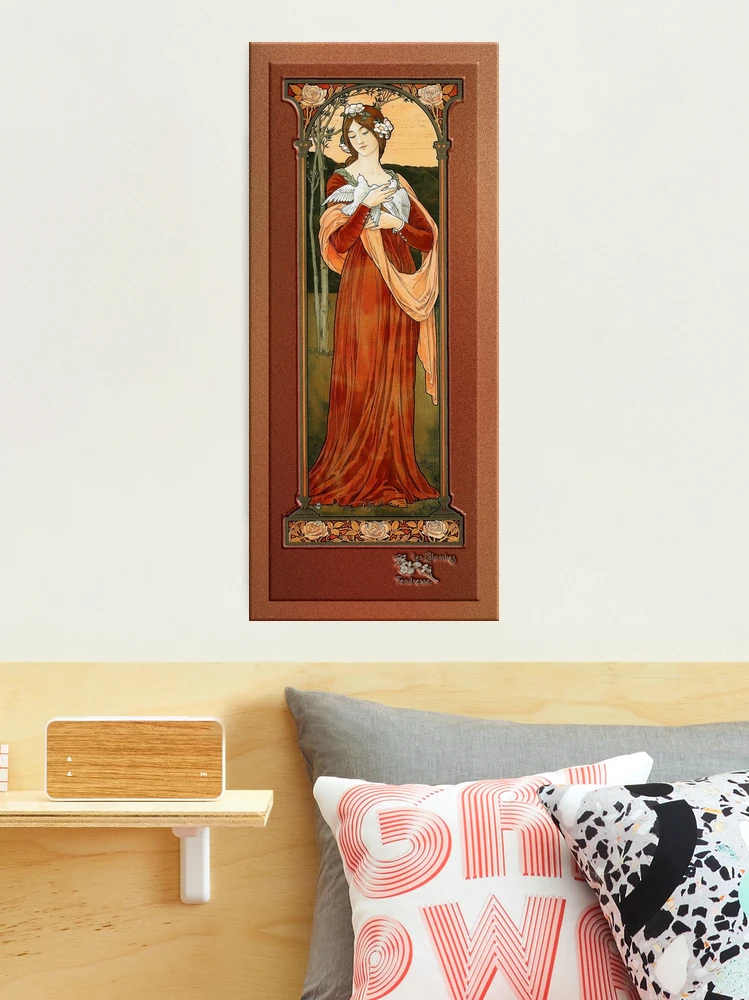
“Zarte Tauben (Die Tauben; Zärtlichkeit)” is a beautiful work by Elisabeth Sonrel, created around the turn of the 20th century. Sonrel, a French artist born in 1874 and who passed away in 1953, is renowned for her symbolic and highly decorative approach to painting. This particular piece exemplifies her delicate mastery of Art Nouveau and her affinity for portraying women in idealized, ethereal settings. The work features a woman holding two doves, a motif rich with symbolism, conveying themes of peace, Unschuld, and tenderness.
Inhaltsverzeichnis
Das Hauptthema und die Komposition
The central subject of “Zarte Tauben” is a graceful woman standing in a serene, slightly blurred landscape. Sie strahlt ein Gefühl der Ruhe aus, nach unten schauen, als sie sanft zwei weiße Tauben in ihren Armen hält. Ihr Gesicht ist ruhig und introspektiv, sowohl Unschuld als auch Gnade strahlen. Das lange fließende rote Kleid der Frau, Welche kaskadiert dramatisch über ihren Körper hinunter, ist sorgfältig in reich gestrichen, Warme Töne. Die Falten des Stoffes werden sorgfältig gerendert, Hervorhebung der Sensibilität des Künstlers gegenüber den Nuancen von Textur und Licht. Das Kleid ist der Schwerpunkt ihrer Form, elegant zu Boden fegen, Verbesserung ihrer ätherischen Präsenz.
Ihre Pose und die Art, wie sie die Tauben hält, betonen Weichheit und Zerbrechlichkeit. Die Vögel, Symbole des Friedens und der Liebe, sind zart in ihren Armen wiegen, Ihre weißen Federn sorgen für einen scharfen Kontrast zum Warmen, erdige Töne ihrer Kleidung und des Hintergrunds. Die Komposition betont die Verbindung zwischen Frau und den Vögeln, ein Gefühl der Harmonie und eine Verbindung zur Natur hervorrufen. Die Tauben sind nicht nur dekorativ, sondern dienen als integraler Bestandteil der Erzählung, Verstärkung der friedlichen Stimmung des Stücks.
Die Einstellung und der Hintergrund
Im Hintergrund des Gemäldes, Der Künstler hat eine weiche und etwas undeutliche Landschaft ausgewählt, Dies ermöglicht es der Figur der Frau, die Szene zu dominieren. Die weichen Farben des Himmels und der Bäume in der Ferne erzeugen eine fast traumhafte Atmosphäre, Als ob die Figur in einem idealisierten existiert, jenseitiger Raum. Die gedämpften Töne der Umwelt, bestand hauptsächlich aus leichten Grüns, Browns, und Gelb, Ergänzen Sie die warmen Töne des Kleides der Frau, ein Gefühl der Einheit in der Komposition schaffen. Diese Auswahl des Hintergrunds trägt zum Sinn der Gelassenheit bei, offering the viewer a quiet, reflective space.
Die Bäume, faintly visible in the background, stand tall but not imposing, blending into the soft, hazy light of the horizon. The use of nature as the setting is an integral part of the work, highlighting the peaceful, harmonious relationship between the human form and the natural world. The distant trees and rolling hills suggest a timeless, natural world, where the viewer can imagine the woman being one with the environment, adding to the calm and gentle mood of the piece.
The Symbolism of the Doves
The doves in the painting are a significant element in the overall composition. In Western art, doves are widely recognized as symbols of peace, Reinheit, und Liebe. Their presence in this piece is not only symbolic of the artist’s theme of tenderness but also reflects broader themes of femininity and grace. The fact that the woman is holding the doves so gently suggests a nurturing quality, reinforcing the motif of caring and peace. Doves are often associated with mythological and religious symbolism, and their presence here may also invoke ideas of spirituality and transcendence.
The white color of the doves further emphasizes purity and innocence, qualities often attributed to the feminine ideal. The doves in “Zarte Tauben” act as a counterbalance to the earthy tones of the woman’s attire and the landscape, providing a moment of lightness and transcendence. This balance between the earthiness of the scene and the purity of the birds reinforces the peaceful, harmonious atmosphere that is central to the painting’s mood.
Art Nouveau Style and Influence
Sonrel’s work is a classic example of the Art Nouveau movement, which emerged in the late 19th century and reached its peak in the early 20th century. Art Nouveau is characterized by flowing lines, organische Formen, and a focus on the decorative and ornamental. “Zarte Tauben” embraces these stylistic elements, particularly in the intricate design of the borders and the floral motifs surrounding the woman’s figure. The sinuous, curving lines of the composition, particularly in the background and in the woman’s gown, are hallmarks of Art Nouveau’s influence.
The elegant framing of the piece, with its decorative borders adorned with roses and tendrils, reflects the movement’s focus on integrating art into daily life and its reverence for nature. Das Weiche, flowing forms and the rhythmic repetition of organic shapes also point to the influence of Art Nouveau, which often sought to harmonize the human figure with the natural world.
Stimmung und emotionale Wirkung
Die Stimmung von “Zarte Tauben” is one of calmness, Selbstbeobachtung, und Reinheit. The delicate handling of the subject matter, along with the soft color palette and harmonious composition, creates a serene atmosphere. The viewer is invited to pause and reflect upon the symbolic message of peace, tenderness, and harmony that the piece conveys. The emotional impact of the artwork is subtle but powerful, evoking feelings of peace, Ruhe, and a connection to nature. There is an air of gentle reverence in the way the woman is depicted, as though she is a guardian of peace, holding the doves as symbols of the fragility and beauty of life itself.
Sonrel’s work captures a moment of serene beauty, suspended in time. The attention to detail in the woman’s expression, Die Falten ihres Kleides, and the delicate handling of the doves invites the viewer to engage with the artwork on a deeply emotional level. The piece conveys a sense of timelessness, allowing the viewer to experience a moment of peaceful contemplation, ähnlich wie die Frau selbst, standing in quiet communion with nature and the symbols of love and peace.
Zarte Tauben ist eine retuschierte digitale Kunst-Reproduktion alter Meister eines gemeinfreien Bildes.
Biografie des Künstlers mit freundlicher Genehmigung Wikipedia.org
Elisabeth Sonrel (1874 Touren – 1953 Dichtungen) war ein französischer Maler und Illustrator im Jugendstil. Ihre Werke umfassten allegorische Themen, Mystik und Symbolik, Porträts und Landschaften.
Sie war die Tochter von Nicolas Stéphane Sonrel, ein Maler aus Tours, und erhielt ihre frühe Ausbildung von ihm. Für weitere Studien ging sie als Schülerin von Jules Lefebvre an der Ecole des Beaux-Arts nach Paris.
Im 1892 sie hat ihre Diplomarbeit gemalt, „Pax und Arbeit“, ein Werk, das im Musée des Beaux-Arts de Tours zu sehen ist. Von da an stellte sie im Salon des Artistes Français zwischen 1893 und 1941, ihre charakteristischen Stücke sind große Aquarelle in präraffaelitischer Manier, die sie nach einer Reise nach Florenz und Rom adoptiert hat, die Renaissance-Maler entdecken – einige ihrer Arbeiten haben deutliche Obertöne von Botticelli. Ihre Gemälde wurden oft von der Artus-Romanze inspiriert, Dante Alighieris Göttliche Komödie’ und „Das neue Leben“, biblische Themen, und mittelalterliche Legenden. Zu ihren mystischen Werken gehören „Ames errantes“’ (Salon von 1894) und „Geister des Abgrunds“’ (Salon von 1899) und "Junge Frau mit dem Wandteppich".
Auf der Weltausstellung von 1900, das Hauptthema war Jugendstil, Sie 1895 Gemälde „Der Schlaf der Jungfrau“’ (Schlaf der Jungfrau), wurde mit einer Bronzemedaille ausgezeichnet, und den Henri-Lehmann-Preis von 3000 Franken von der Akademie der Schönen Künste.[3] Von 1900 von da an beschränkte sie ihre Malerei auf Porträts, malerische Landschaften der Bretagne, und die gelegentliche Blumenstudie.
Sie unternahm regelmäßige Malreisen in die Bretagne, inspiriert vom Wald von Brocéliande, und von 1910 zu verschiedenen Orten an der Küste wie Concarneau, Plougastel, Pont-l'Abbé und Loctudy, oft in Gasthäusern übernachten und von ein oder zwei Studenten begleitet. Sie malte mehrere Werke in Le Faouët, bevor sie in den 1930er Jahren eine Villa in La Baule baute. Arbeiten hauptsächlich in Aquarell und Gouache, sie entdeckte unter jungen Mädchen in der Gegend einen großen Vorrat an Models, und fand Bretonen im Allgemeinen freundlich, ehrlich und selbstbewusst.
Ihre letzte Ausstellung im Salon war in 1941 im Alter von 67. Es gibt auch eine Aufzeichnung darüber, dass sie in Liverpool ausgestellt hat. In ihren frühen Jahren produzierte Sonrel Poster, Postkarten und Illustrationen, im Jugendstil.