

Tender Doves (Les Colombes; Tendresse)
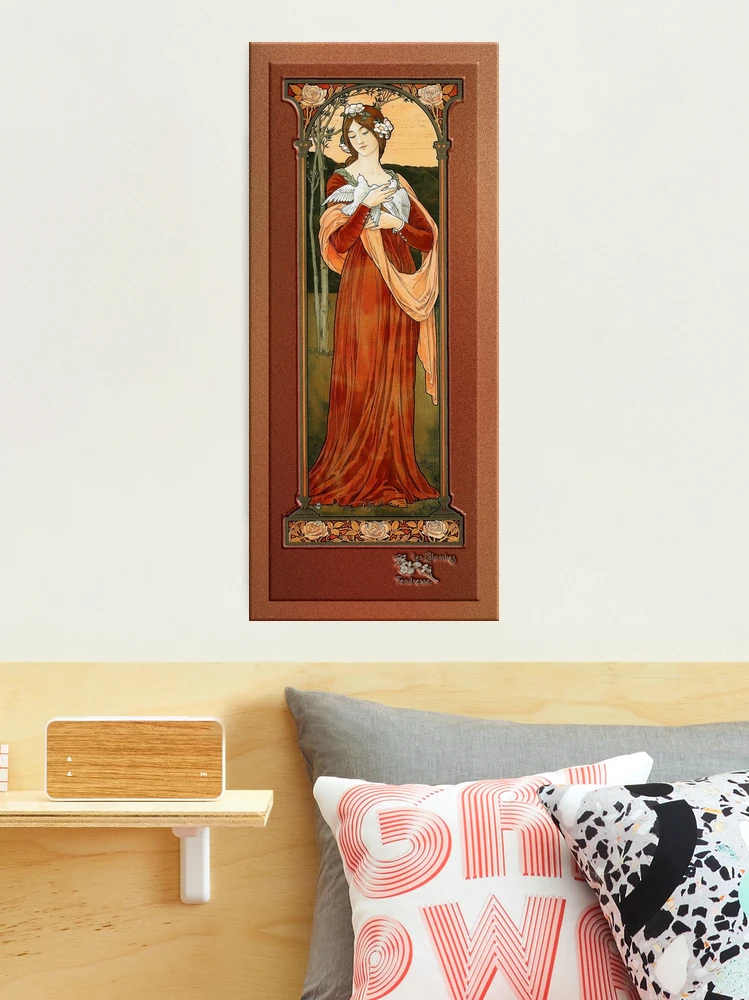
“Tender Doves (Les Colombes; Tendresse)” is a beautiful work by Elisabeth Sonrel, created around the turn of the 20th century. Sonrel, a French artist born in 1874 and who passed away in 1953, is renowned for her symbolic and highly decorative approach to painting. This particular piece exemplifies her delicate mastery of Art Nouveau and her affinity for portraying women in idealized, ethereal settings. The work features a woman holding two doves, a motif rich with symbolism, conveying themes of peace, Senkulpeco, and tenderness.
Enhavtabelo
La Ĉefa Temo kaj Kunmetaĵo
The central subject of “Tender Doves” is a graceful woman standing in a serene, slightly blurred landscape. She exudes a sense of tranquility, gazing downward as she gently holds two white doves in her arms. Her face is calm and introspective, radiating both innocence and grace. The woman’s long flowing red gown, which cascades dramatically down her body, is meticulously painted in rich, warm tones. The folds of the fabric are carefully rendered, highlighting the artist’s sensitivity to the nuances of texture and light. The gown is the focal point of her form, elegantly sweeping down to the ground, enhancing her ethereal presence.
Her pose and the way she holds the doves emphasize softness and fragility. The birds, symbols of peace and love, are cradled delicately in her arms, their white feathers providing a sharp contrast to the warm, earthy tones of her clothing and the background. The composition emphasizes the connection between the woman and the birds, evoking a sense of harmony and a bond with nature. The doves are not merely ornamental but serve as an integral part of the narrative, reinforcing the peaceful mood of the piece.
The Setting and Background
En la fono de la pentraĵo, the artist has chosen a soft and somewhat indistinct landscape, which allows the figure of the woman to dominate the scene. The soft colors of the sky and the trees in the distance create an almost dreamlike atmosphere, as though the figure exists in an idealized, otherworldly space. La silentigitaj tonoj de la medio, composed mainly of light greens, brunaj, kaj flavoj, complement the warm tones of the woman’s gown, creating a sense of unity in the composition. This choice of background adds to the sense of serenity, offering the viewer a quiet, reflective space.
La arboj, faintly visible in the background, stand tall but not imposing, blending into the soft, hazy light of the horizon. The use of nature as the setting is an integral part of the work, highlighting the peaceful, harmonious relationship between the human form and the natural world. The distant trees and rolling hills suggest a timeless, natural world, where the viewer can imagine the woman being one with the environment, adding to the calm and gentle mood of the piece.
The Symbolism of the Doves
The doves in the painting are a significant element in the overall composition. In Western art, doves are widely recognized as symbols of peace, pureco, kaj amo. Their presence in this piece is not only symbolic of the artist’s theme of tenderness but also reflects broader themes of femininity and grace. The fact that the woman is holding the doves so gently suggests a nurturing quality, reinforcing the motif of caring and peace. Doves are often associated with mythological and religious symbolism, and their presence here may also invoke ideas of spirituality and transcendence.
The white color of the doves further emphasizes purity and innocence, qualities often attributed to the feminine ideal. The doves in “Tender Doves” act as a counterbalance to the earthy tones of the woman’s attire and the landscape, providing a moment of lightness and transcendence. This balance between the earthiness of the scene and the purity of the birds reinforces the peaceful, harmonious atmosphere that is central to the painting’s mood.
Art Nouveau Style and Influence
Sonrel’s work is a classic example of the Art Nouveau movement, which emerged in the late 19th century and reached its peak in the early 20th century. Art Nouveau is characterized by flowing lines, organikaj formoj, and a focus on the decorative and ornamental. “Tender Doves” embraces these stylistic elements, particularly in the intricate design of the borders and the floral motifs surrounding the woman’s figure. The sinuous, curving lines of the composition, particularly in the background and in the woman’s gown, are hallmarks of Art Nouveau’s influence.
The elegant framing of the piece, with its decorative borders adorned with roses and tendrils, reflects the movement’s focus on integrating art into daily life and its reverence for nature. La mola, flowing forms and the rhythmic repetition of organic shapes also point to the influence of Art Nouveau, which often sought to harmonize the human figure with the natural world.
Humoro kaj emocia efiko
La humoro de “Tender Doves” is one of calmness, introspekto, and purity. The delicate handling of the subject matter, along with the soft color palette and harmonious composition, creates a serene atmosphere. The viewer is invited to pause and reflect upon the symbolic message of peace, tenereco, and harmony that the piece conveys. The emotional impact of the artwork is subtle but powerful, evoking feelings of peace, trankvilo, and a connection to nature. There is an air of gentle reverence in the way the woman is depicted, as though she is a guardian of peace, holding the doves as symbols of the fragility and beauty of life itself.
Sonrel’s work captures a moment of serene beauty, suspended in time. The attention to detail in the woman’s expression, the folds of her gown, and the delicate handling of the doves invites the viewer to engage with the artwork on a deeply emotional level. The piece conveys a sense of timelessness, allowing the viewer to experience a moment of peaceful contemplation, much like the woman herself, standing in quiet communion with nature and the symbols of love and peace.
Tender Doves is a retouched digital art old masters reproduction of a public domain image.
Artist Bio Courtesy Vikipedio.org
Elisabeth Sonrel (1874 Turneoj - 1953 fokoj) estis franca pentristo kaj ilustristo en la Secesio-stilo. Ŝiaj verkoj inkludis alegoriajn temojn, mistikismo kaj simbolismo, portretoj kaj pejzaĝoj.
Ŝi estis la filino de Nicolas Stéphane Sonrel, pentristo el Tours, kaj ricevis ŝian fruan trejnadon de li. Por plua studo ŝi daŭriĝis al Parizo kiel studento de Jules Lefebvre ĉe la Ecole des Beaux-Arts..
En 1892 ŝi pentris sian diplomverkon, "Paco kaj laboro", verko vidota ĉe la Musée des Beaux-Arts de Tours. De tiam ŝi ekspoziciis ĉe la Salon des Artistes Français inter 1893 kaj 1941, ŝiaj signaturpecoj estante grandaj akvareloj en Antaŭrafaelita maniero, kiun ŝi adoptis post vojaĝo al Florenco kaj Romo, malkovrante la renesancan pentristojn – iuj el ŝia laboro havanta klarajn nuancojn de Botticelli. Ŝiaj pentraĵoj ofte estis inspiritaj per artura enamiĝo, La dia komedio de Dante Alighieri’ Kaj 'La Nova Vivo', bibliaj temoj, kaj mezepokaj legendoj. Ŝiaj mistikaj verkoj inkluzivas 'Ames eraras’ (Salono de 1894) kaj 'la spiritoj de la abismo’ (Salono de 1899) Kaj "Juna Virino Havas Tapiŝon".
Ĉe la Universala Ekspozicio de 1900, kies primara temo estis Secesio, ŝia 1895 Pentrante 'la dormon de la virgulino’ (Dormo de la Virgulino), ricevis bronzan medalon, kaj la Henri Lehmann-premio de 3000 Francanoj de la Akademio de Belartoj.[3] De 1900 pluen ŝi limigis sian pentraĵon al portretoj, pitoreskaj Bretoniaj pejzaĝoj, kaj la foja studo de floroj.
Ŝi faris regulajn pentrovojaĝojn al Bretonio, inspirite de la arbaro de Brocéliande, kaj de 1910 al diversaj lokoj sur la marbordo kiel ekzemple Concarneau, Plougastel, Pont-l´abbé kaj Lorudy, ofte loĝante en gastejoj kaj akompanate de unu aŭ du studentoj. Ŝi pentris plurajn verkojn en Le Faouët antaŭ konstruado de vilao en La Baule en la 1930-aj jaroj.. Laborante ĉefe en akvarelo kaj guaŝo, ŝi malkovris pretan provizon de modeloj inter junaj knabinoj en la areo, kaj trovis bretonojn ĝenerale amikemaj, honesta kaj memfida.
Ŝia fina ekspoziciaĵo ĉe la Salono estis en 1941 en la aĝo de 67. Ekzistas ankaŭ noto pri ŝi ekspoziciis en Liverpool. En ŝiaj fruaj jaroj Sonrel produktis afiŝojn, poŝtkartoj kaj ilustraĵoj, en Secesio-stilo.