

Tendre colombes (Les Colombes; Tendresse)
“Tendre colombes (Les Colombes; Tendresse)” is a beautiful work by Élisabeth Sonrel, created around the turn of the 20th century. Sonrel, a French artist born in 1874 and who passed away in 1953, is renowned for her symbolic and highly decorative approach to painting. This particular piece exemplifies her delicate mastery of Art Nouveau and her affinity for portraying women in idealized, ethereal settings. The work features a woman holding two doves, a motif rich with symbolism, conveying themes of peace, innocence, and tenderness.
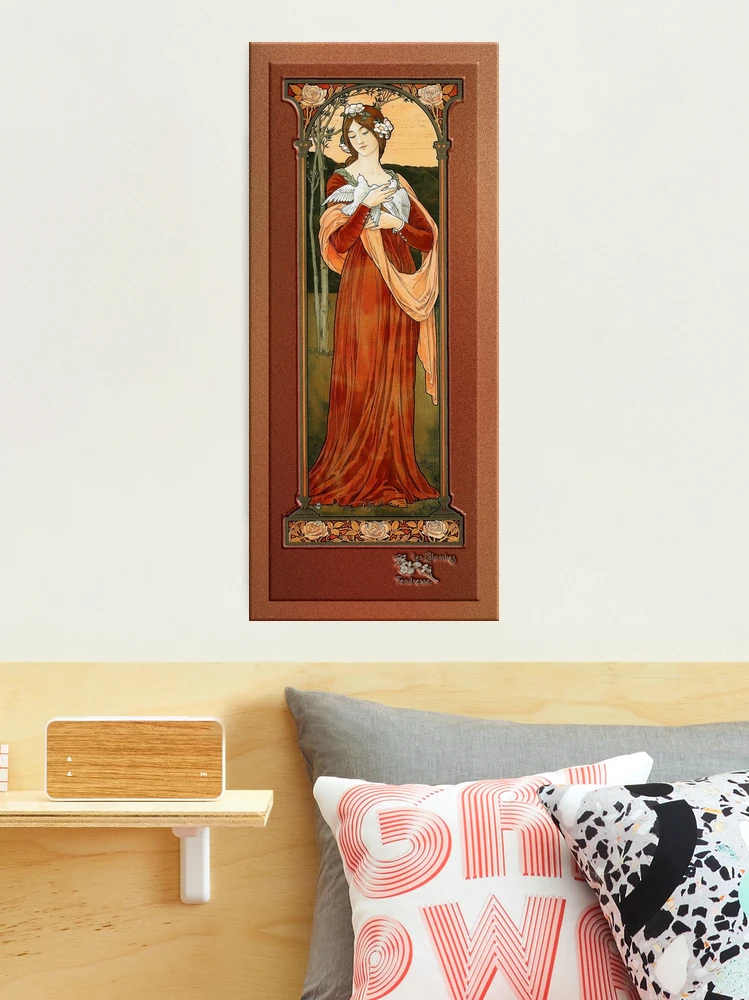
Table des matières
Le sujet principal et la composition
Le sujet central de “Tendre colombes” is a graceful woman standing in a serene, slightly blurred landscape. She exudes a sense of tranquility, gazing downward as she gently holds two white doves in her arms. Her face is calm and introspective, radiating both innocence and grace. The woman’s long flowing red gown, which cascades dramatically down her body, is meticulously painted in rich, tons chauds. The folds of the fabric are carefully rendered, highlighting the artist’s sensitivity to the nuances of texture and light. The gown is the focal point of her form, elegantly sweeping down to the ground, enhancing her ethereal presence.
Her pose and the way she holds the doves emphasize softness and fragility. Les oiseaux, symbols of peace and love, are cradled delicately in her arms, their white feathers providing a sharp contrast to the warm, earthy tones of her clothing and the background. The composition emphasizes the connection between the woman and the birds, evoking a sense of harmony and a bond with nature. Les colombes ne sont pas simplement ornementales mais font partie intégrante du récit., renforçant l'ambiance paisible de la pièce.
Le cadre et le contexte
En arrière-plan du tableau, l'artiste a choisi un paysage doux et quelque peu indistinct, ce qui permet à la figure de la femme de dominer la scène. Les couleurs douces du ciel et les arbres au loin créent une atmosphère presque onirique, comme si la figure existait dans un cadre idéalisé, espace d'un autre monde. Les tons sourds de l'environnement, composé principalement de verts clairs, les bruns, et les jaunes, compléter les tons chauds de la robe de la femme, créer un sentiment d'unité dans la composition. Ce choix de fond ajoute au sentiment de sérénité, offrant au spectateur un calme, espace réfléchissant.
Les arbres, à peine visible en arrière-plan, être grand mais pas imposant, se fondant dans la douceur, lumière brumeuse de l'horizon. L'utilisation de la nature comme décor fait partie intégrante de l'œuvre, mettant en valeur le calme, relation harmonieuse entre la forme humaine et le monde naturel. Les arbres lointains et les collines suggèrent un espace intemporel, monde naturel, où le spectateur peut imaginer la femme ne faisant qu'un avec l'environnement, ajoutant à l'ambiance calme et douce de la pièce.
The Symbolism of the Doves
Les colombes du tableau sont un élément important dans la composition globale. Dans l'art occidental, les colombes sont largement reconnues comme symboles de paix, pureté, et l'amour. Leur présence dans cette pièce n’est pas seulement symbolique du thème de la tendresse de l’artiste, mais reflète également des thèmes plus larges de féminité et de grâce.. Le fait que la femme tient les colombes si doucement suggère une qualité nourricière, renforcer le motif de bienveillance et de paix. Les colombes sont souvent associées au symbolisme mythologique et religieux, et leur présence ici peut également évoquer des idées de spiritualité et de transcendance.
La couleur blanche des colombes souligne encore davantage la pureté et l'innocence., qualités souvent attribuées à l'idéal féminin. Les colombes dans “Tendre colombes” agir comme un contrepoids aux tons terreux de la tenue vestimentaire de la femme et du paysage, offrir un moment de légèreté et de transcendance. Cet équilibre entre le côté terreux de la scène et la pureté des oiseaux renforce le caractère paisible, atmosphère harmonieuse qui est au cœur de l’ambiance du tableau.
Art Nouveau Style and Influence
Le travail de Sonrel est un exemple classique du mouvement Art Nouveau, qui a émergé à la fin du 19e siècle et a atteint son apogée au début du 20e siècle. L'Art Nouveau se caractérise par des lignes fluides, formes organiques, and a focus on the decorative and ornamental. “Tendre colombes” embraces these stylistic elements, particularly in the intricate design of the borders and the floral motifs surrounding the woman’s figure. The sinuous, curving lines of the composition, particularly in the background and in the woman’s gown, are hallmarks of Art Nouveau’s influence.
The elegant framing of the piece, with its decorative borders adorned with roses and tendrils, reflects the movement’s focus on integrating art into daily life and its reverence for nature. Le doux, flowing forms and the rhythmic repetition of organic shapes also point to the influence of Art Nouveau, which often sought to harmonize the human figure with the natural world.
Humeur et impact émotionnel
L'ambiance de “Tendre colombes” is one of calmness, introspection, et la pureté. The delicate handling of the subject matter, along with the soft color palette and harmonious composition, creates a serene atmosphere. The viewer is invited to pause and reflect upon the symbolic message of peace, tendresse, and harmony that the piece conveys. The emotional impact of the artwork is subtle but powerful, evoking feelings of peace, tranquillité, et une connexion avec la nature. There is an air of gentle reverence in the way the woman is depicted, as though she is a guardian of peace, holding the doves as symbols of the fragility and beauty of life itself.
Sonrel’s work captures a moment of serene beauty, suspendu dans le temps. The attention to detail in the woman’s expression, les plis de sa robe, and the delicate handling of the doves invites the viewer to engage with the artwork on a deeply emotional level. The piece conveys a sense of timelessness, permettant au spectateur de vivre un moment de contemplation paisible, un peu comme la femme elle-même, debout en communion tranquille avec la nature et les symboles de l'amour et de la paix.
Tender Doves est une reproduction retouchée de maîtres anciens d'art numérique d'une image du domaine public.
Biographie de l'artiste avec l'aimable autorisation Wikipedia.org
Elisabeth Sonrel (1874 Visites – 1953 Sceaux) était un peintre et illustrateur français de style Art Nouveau. Ses œuvres comprenaient des sujets allégoriques, mysticisme et symbolisme, portraits et paysages.
Elle était la fille de Nicolas Stéphane Sonrel, un peintre tourangeau, et a reçu sa première formation de lui. Pour poursuivre ses études, elle part pour Paris en tant qu'élève de Jules Lefebvre à l'Ecole des Beaux-Arts..
Dans 1892 elle a peint son travail de diplôme, « Pax et travail », a work to be seen at the Musée des Beaux-Arts de Tours. Dès lors elle expose au Salon des Artistes Français entre 1893 et 1941, ses pièces de signature étant de grandes aquarelles à la manière préraphaélite, qu'elle a adopté après un voyage à Florence et à Rome, à la découverte des peintres de la Renaissance – certains de ses travaux ayant des connotations claires de Botticelli. Ses peintures étaient souvent inspirées par la romance arthurienne, La Divine Comédie de Dante Alighieri’ et "La nouvelle vie", thèmes bibliques, et légendes médiévales. Ses œuvres mystiques incluent ‘Ames errantes’ (Salon de 1894) and ‘Les Esprits de l’abime’ (Salon de 1899) and ‘Jeune femme a la tapisserie’.
A l'Exposition Universelle de 1900, dont le thème principal était l'Art Nouveau, sa 1895 painting ‘Le Sommeil de la Vierge’ (Sommeil de la Vierge), a reçu une médaille de bronze, et le prix Henri Lehmann de 3000 francs by L’académie des Beaux-Arts.[3] De 1900 elle a limité sa peinture aux portraits, paysages pittoresques de la Bretagne, et l'étude occasionnelle des fleurs.
Elle fait régulièrement des voyages de peinture en Bretagne, inspiré de la forêt de Brocéliande, et de 1910 à divers endroits sur la côte comme Concarneau, Plougastel, Pont-l’Abbé and Loctudy, séjournant souvent dans des auberges et accompagnés d'un ou deux étudiants. Elle peint plusieurs oeuvres au Faouët avant de construire une villa à La Baule dans les années 30. Travail principalement à l'aquarelle et à la gouache, elle a découvert une offre immédiate de modèles chez les jeunes filles de la région, et a trouvé les Bretons généralement amicaux, honnête et sûr de lui.
Sa dernière exposition au Salon était en 1941 à l'âge de 67. Il y a aussi une trace d'elle ayant exposé à Liverpool. Dans ses premières années, Sonrel produisait des affiches, cartes postales et illustrations, in Art Nouveau style.