

Tender Doves (Les Colombes; Tendresse)
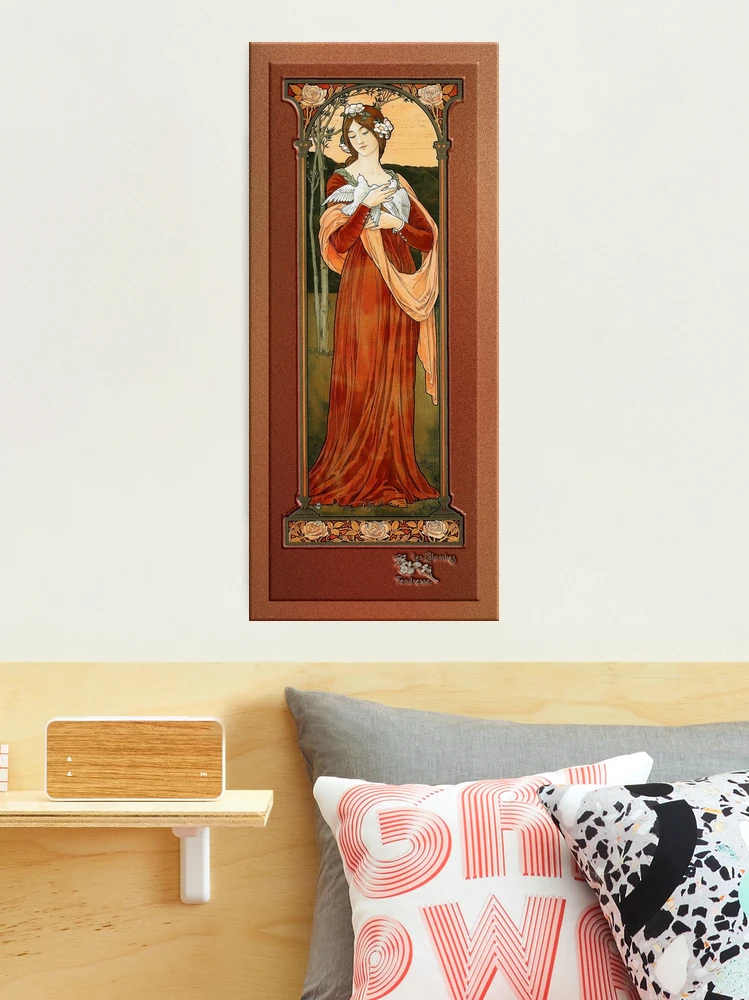
“Tender Doves (Les Colombes; Tendresse)” is a beautiful work by Elisabeth Sonkel, created around the turn of the 20th century. Sonrel, a French artist born in 1874 and who passed away in 1953, is renowned for her symbolic and highly decorative approach to painting. This particular piece exemplifies her delicate mastery of Art Nouveau and her affinity for portraying women in idealized, ethereal settings. The work features a woman holding two doves, a motif rich with symbolism, conveying themes of peace, innocence, and tenderness.
Ynhâldsopjefte
The Main Subject and Composition
It sintrale ûnderwerp fan “Tender Doves” is a graceful woman standing in a serene, slightly blurred landscape. She exudes a sense of tranquility, gazing downward as she gently holds two white doves in her arms. Her face is calm and introspective, radiating both innocence and grace. The woman’s long flowing red gown, which cascades dramatically down her body, is meticulously painted in rich, warm tones. The folds of the fabric are carefully rendered, highlighting the artist’s sensitivity to the nuances of texture and light. The gown is the focal point of her form, elegantly sweeping down to the ground, enhancing her ethereal presence.
Her pose and the way she holds the doves emphasize softness and fragility. The birds, symbols of peace and love, are cradled delicately in her arms, their white feathers providing a sharp contrast to the warm, earthy tones of her clothing and the background. The composition emphasizes the connection between the woman and the birds, evoking a sense of harmony and a bond with nature. The doves are not merely ornamental but serve as an integral part of the narrative, reinforcing the peaceful mood of the piece.
The Setting and Background
In the background of the painting, the artist has chosen a soft and somewhat indistinct landscape, which allows the figure of the woman to dominate the scene. The soft colors of the sky and the trees in the distance create an almost dreamlike atmosphere, as though the figure exists in an idealized, otherworldly space. The muted tones of the environment, composed mainly of light greens, brún, and yellows, complement the warm tones of the woman’s gown, creating a sense of unity in the composition. This choice of background adds to the sense of serenity, offering the viewer a quiet, reflective space.
The trees, faintly visible in the background, stand tall but not imposing, blending into the soft, hazy light of the horizon. The use of nature as the setting is an integral part of the work, highlighting the peaceful, harmonious relationship between the human form and the natural world. The distant trees and rolling hills suggest a timeless, natural world, where the viewer can imagine the woman being one with the environment, adding to the calm and gentle mood of the piece.
The Symbolism of the Doves
The doves in the painting are a significant element in the overall composition. In Western art, doves are widely recognized as symbols of peace, suverens, and love. Their presence in this piece is not only symbolic of the artist’s theme of tenderness but also reflects broader themes of femininity and grace. The fact that the woman is holding the doves so gently suggests a nurturing quality, reinforcing the motif of caring and peace. Doves are often associated with mythological and religious symbolism, and their presence here may also invoke ideas of spirituality and transcendence.
The white color of the doves further emphasizes purity and innocence, qualities often attributed to the feminine ideal. The doves in “Tender Doves” act as a counterbalance to the earthy tones of the woman’s attire and the landscape, providing a moment of lightness and transcendence. This balance between the earthiness of the scene and the purity of the birds reinforces the peaceful, harmonious atmosphere that is central to the painting’s mood.
Art Nouveau Style and Influence
Sonrel’s work is a classic example of the Art Nouveau movement, which emerged in the late 19th century and reached its peak in the early 20th century. Art Nouveau is characterized by flowing lines, Organyske foarmen, and a focus on the decorative and ornamental. “Tender Doves” embraces these stylistic elements, particularly in the intricate design of the borders and the floral motifs surrounding the woman’s figure. The sinuous, curving lines of the composition, particularly in the background and in the woman’s gown, are hallmarks of Art Nouveau’s influence.
The elegant framing of the piece, with its decorative borders adorned with roses and tendrils, reflects the movement’s focus on integrating art into daily life and its reverence for nature. De sêfte, flowing forms and the rhythmic repetition of organic shapes also point to the influence of Art Nouveau, which often sought to harmonize the human figure with the natural world.
Mood and Emotional Impact
De stimming fan “Tender Doves” is one of calmness, yntrospeksje, and purity. The delicate handling of the subject matter, along with the soft color palette and harmonious composition, creates a serene atmosphere. The viewer is invited to pause and reflect upon the symbolic message of peace, tenderness, and harmony that the piece conveys. The emotional impact of the artwork is subtle but powerful, evoking feelings of peace, rêst, and a connection to nature. There is an air of gentle reverence in the way the woman is depicted, as though she is a guardian of peace, holding the doves as symbols of the fragility and beauty of life itself.
Sonrel’s work captures a moment of serene beauty, suspended in time. The attention to detail in the woman’s expression, the folds of her gown, and the delicate handling of the doves invites the viewer to engage with the artwork on a deeply emotional level. The piece conveys a sense of timelessness, allowing the viewer to experience a moment of peaceful contemplation, much like the woman herself, standing in quiet communion with nature and the symbols of love and peace.
Tender Doves is a retouched digital art old masters reproduction of a public domain image.
Artist Bio Courtesy Wikipedia.org
Elisabeth Sonkel (1874 Tours - 1953 Sealen) wie in Frânske skilder en yllustrator yn de Art Nouveau-styl. Har wurk omfette allegoaryske ûnderwerpen, mystyk en symbolyk, portretten en lânskippen.
Sy wie de dochter fan Nicolas Stéphane Sonrel, in skilder út Tours, en krige har iere oplieding fan him. Foar fierdere stúdzje gie se troch nei Parys as studint fan Jules Lefebvre oan 'e Ecole des Beaux-Arts.
Yn 1892 hja skildere har diplomawurk, "Frede en wurk", in wurk te sjen yn it Musée des Beaux-Arts de Tours. Fan doe ôf eksposearre se yn de Salon des Artistes Français tusken 1893 en 1941, har hantekeningstikken binne grutte akwarellen op in pre-rafaelityske manier, dy't se oannaam nei in reis nei Florence en Rome, ûntdekke de Renêssânse skilders – guon fan har wurk hawwe dúdlike boppetonen fan Botticelli. Har skilderijen waarden faak ynspirearre troch Arthur-romantyk, Dante Alighieri's 'Divine Comedy’ en 'La Vita Nuova', bibelske tema's, en midsieuske leginden. Har mystike wurken omfetsje 'Ames errantes’ (Salon fan 1894) en ‘De geasten fan de ôfgrûn’ (Salon fan 1899) en ‘Jonge frou mei in tapijt’.
By de Exposition Universelle fan 1900, wêrfan it primêre tema Art Nouveau wie, har 1895 skilderij ‘De sliep fan de faam’ (Sleep of the Virgin), waard bekroane mei in brûnzen medalje, en de Henri Lehmann-priis fan 3000 franken troch The Academy of Fine Arts.[3] Fan 1900 fierder beheinde se har skilderij ta portretten, naturskjonne Bretanje lânskippen, en sa no en dan blomstúdzje.
Sy makke geregeld skildere reizen nei Bretanje, ynspirearre troch it bosk fan Brocéliande, en fan 1910 nei ferskate plakken oan 'e kust lykas Concarneau, Plougastel, Pont-l'Abbé en Loctudy, faak ferbliuw yn herbergen en begelaat troch ien of twa studinten. Se skildere ferskate wurken yn Le Faouët foardat se yn 'e jierren '30 in filla boude yn La Baule. Wurkje benammen yn akwarel en gouache, se ûntduts in klear oanbod fan modellen ûnder jonge famkes yn it gebiet, en fûn Bretons oer it algemien freonlik, earlik en selsbewuste.
Har lêste eksposysje yn 'e Salon wie yn 1941 yn de âldens fan 67. D'r is ek in rekord fan har eksposearre yn Liverpool. Yn har iere jierren makke Sonrel posters, ansichtkaarten en yllustraasjes, yn Art Nouveau styl.