

Нежные голуби (Голуби; Нежность)
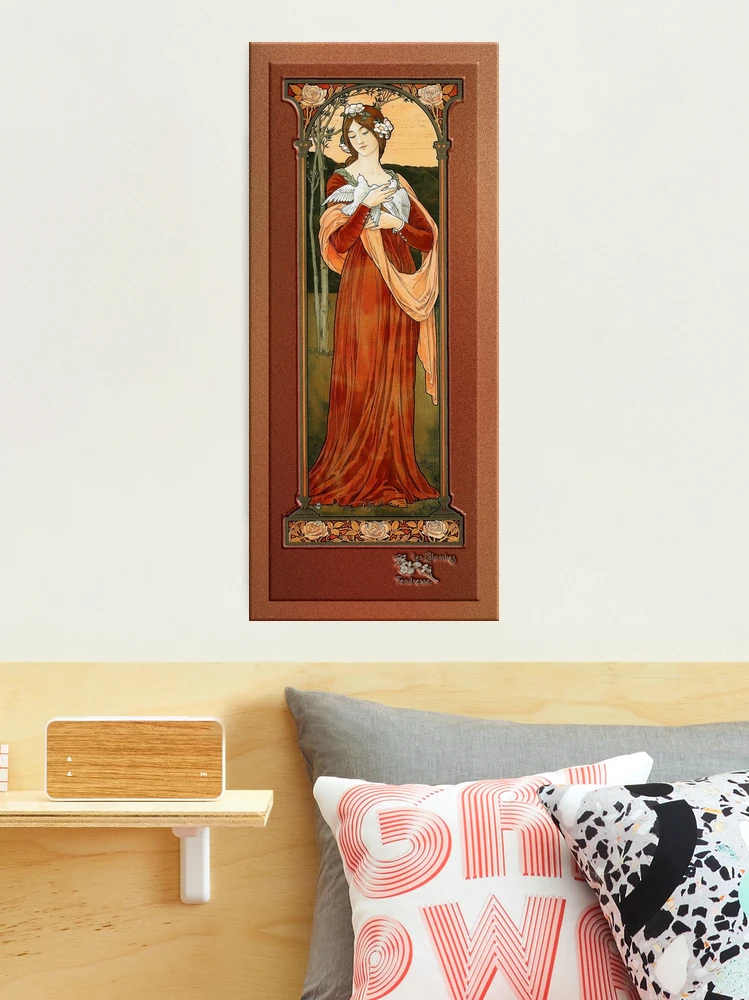
“Нежные голуби (Голуби; Нежность)” is a beautiful work by Элизабет Сонрель, created around the turn of the 20th century. Sonrel, a French artist born in 1874 and who passed away in 1953, is renowned for her symbolic and highly decorative approach to painting. This particular piece exemplifies her delicate mastery of Art Nouveau and her affinity for portraying women in idealized, ethereal settings. The work features a woman holding two doves, a motif rich with symbolism, conveying themes of peace, невиновность, and tenderness.
Оглавление
Основная тема и композиция
Центральный предмет “Нежные голуби” is a graceful woman standing in a serene, slightly blurred landscape. She exudes a sense of tranquility, gazing downward as she gently holds two white doves in her arms. Her face is calm and introspective, radiating both innocence and grace. The woman’s long flowing red gown, which cascades dramatically down her body, is meticulously painted in rich, теплые тона. The folds of the fabric are carefully rendered, highlighting the artist’s sensitivity to the nuances of texture and light. The gown is the focal point of her form, elegantly sweeping down to the ground, enhancing her ethereal presence.
Her pose and the way she holds the doves emphasize softness and fragility. Птицы, symbols of peace and love, are cradled delicately in her arms, their white feathers providing a sharp contrast to the warm, earthy tones of her clothing and the background. The composition emphasizes the connection between the woman and the birds, evoking a sense of harmony and a bond with nature. The doves are not merely ornamental but serve as an integral part of the narrative, reinforcing the peaceful mood of the piece.
Сеттинг и предыстория
На заднем плане картины, the artist has chosen a soft and somewhat indistinct landscape, which allows the figure of the woman to dominate the scene. The soft colors of the sky and the trees in the distance create an almost dreamlike atmosphere, as though the figure exists in an idealized, otherworldly space. The muted tones of the environment, composed mainly of light greens, коричневые, и желтые, complement the warm tones of the woman’s gown, creating a sense of unity in the composition. This choice of background adds to the sense of serenity, offering the viewer a quiet, reflective space.
Деревья, faintly visible in the background, stand tall but not imposing, blending into the soft, hazy light of the horizon. The use of nature as the setting is an integral part of the work, highlighting the peaceful, harmonious relationship between the human form and the natural world. The distant trees and rolling hills suggest a timeless, natural world, where the viewer can imagine the woman being one with the environment, adding to the calm and gentle mood of the piece.
The Symbolism of the Doves
The doves in the painting are a significant element in the overall composition. In Western art, doves are widely recognized as symbols of peace, чистота, и любовь. Their presence in this piece is not only symbolic of the artist’s theme of tenderness but also reflects broader themes of femininity and grace. The fact that the woman is holding the doves so gently suggests a nurturing quality, reinforcing the motif of caring and peace. Doves are often associated with mythological and religious symbolism, and their presence here may also invoke ideas of spirituality and transcendence.
The white color of the doves further emphasizes purity and innocence, qualities often attributed to the feminine ideal. The doves in “Нежные голуби” act as a counterbalance to the earthy tones of the woman’s attire and the landscape, providing a moment of lightness and transcendence. This balance between the earthiness of the scene and the purity of the birds reinforces the peaceful, harmonious atmosphere that is central to the painting’s mood.
Art Nouveau Style and Influence
Sonrel’s work is a classic example of the Art Nouveau movement, which emerged in the late 19th century and reached its peak in the early 20th century. Art Nouveau is characterized by flowing lines, органические формы, and a focus on the decorative and ornamental. “Нежные голуби” embraces these stylistic elements, particularly in the intricate design of the borders and the floral motifs surrounding the woman’s figure. The sinuous, curving lines of the composition, particularly in the background and in the woman’s gown, are hallmarks of Art Nouveau’s influence.
The elegant framing of the piece, with its decorative borders adorned with roses and tendrils, reflects the movement’s focus on integrating art into daily life and its reverence for nature. Мягкий, flowing forms and the rhythmic repetition of organic shapes also point to the influence of Art Nouveau, which often sought to harmonize the human figure with the natural world.
Настроение и эмоциональное воздействие
Настроение “Нежные голуби” is one of calmness, самоанализ, и чистота. The delicate handling of the subject matter, along with the soft color palette and harmonious composition, creates a serene atmosphere. The viewer is invited to pause and reflect upon the symbolic message of peace, нежность, and harmony that the piece conveys. The emotional impact of the artwork is subtle but powerful, вызывая чувство покоя, спокойствие, and a connection to nature. There is an air of gentle reverence in the way the woman is depicted, as though she is a guardian of peace, holding the doves as symbols of the fragility and beauty of life itself.
Sonrel’s work captures a moment of serene beauty, приостановлено вовремя. The attention to detail in the woman’s expression, складки ее платья, and the delicate handling of the doves invites the viewer to engage with the artwork on a deeply emotional level. The piece conveys a sense of timelessness, allowing the viewer to experience a moment of peaceful contemplation, очень как сама женщина, standing in quiet communion with nature and the symbols of love and peace.
Нежные голуби — это отретушированная цифровая репродукция изображения старых мастеров, находящегося в общественном достоянии..
Художник био вежливо Wikipedia.org
Элизабет Сонрель (1874 Туры - 1953 Уплотнения) был французским художником и иллюстратором в стиле модерн.. Ее работы включали аллегорические сюжеты., мистицизм и символизм, портреты и пейзажи.
Она была дочерью Николаса Стефана Сонреля., художник из Тура, и получила от него раннее обучение. Для дальнейшего обучения она отправилась в Париж в качестве ученицы Жюля Лефевра в Ecole des Beaux-Arts..
В 1892 она нарисовала свою дипломную работу, «Pax et Labor», работа, которую можно увидеть в Musée des Beaux-Arts de Tours. С тех пор она выставлялась в Salon des Artistes Français между 1893 и 1941, ее фирменные работы - большие акварели в прерафаэлитской манере., которую она приняла после поездки во Флоренцию и Рим, открытие художников эпохи Возрождения – некоторые из ее работ с явным подтекстом Боттичелли. Ее картины часто были вдохновлены романами о короле Артуре., "Божественная комедия" Данте Алигьери’ и "Новая жизнь", библейские темы, и средневековые легенды. Среди ее мистических работ «Эймс эрантес»’ (Салон 1894) и «Духи бездны»’ (Салон 1899) и "Молодая женщина с гобеленом".
На Всемирной выставке 1900, основной темой которого был модерн, ее 1895 картина «Сон Богородицы»’ (Сон Богородицы), был награжден бронзовой медалью, и премию Анри Лемана 3000 франков Академии художеств.[3] Из 1900 Впоследствии она ограничилась своей живописью портретами, живописные пейзажи Бретани, и случайное цветочное исследование.
Она совершала регулярные поездки в Бретань для рисования., вдохновленный лесом Brocéliande, и из 1910 в различные места на побережье, такие как Конкарно, Plougastel, Пон-л'Аббе и Локтуди, часто останавливаются в гостиницах в сопровождении одного или двух студентов. Она написала несколько работ в Le Faouët, прежде чем построить виллу в La Baule в 1930-х годах.. Работаю в основном акварелью и гуашью., она обнаружила готовый набор моделей среди молодых девушек в этом районе, и обнаружил, что бретонцы в целом дружелюбны, честный и уверенный в себе.
Ее последняя выставка в Салоне была в 1941 в возрасте 67. Есть также запись о том, что она выставлялась в Ливерпуле.. В ранние годы Сонрель выпускала плакаты., открытки и иллюстрации, в стиле модерн.