

The Age of Iron
The Age of Iron c1589 by Dutch Engraver Hendrick Goltzius (1558 – 1617); un incisore, Disegnatore, Pittore e editore di stampe.
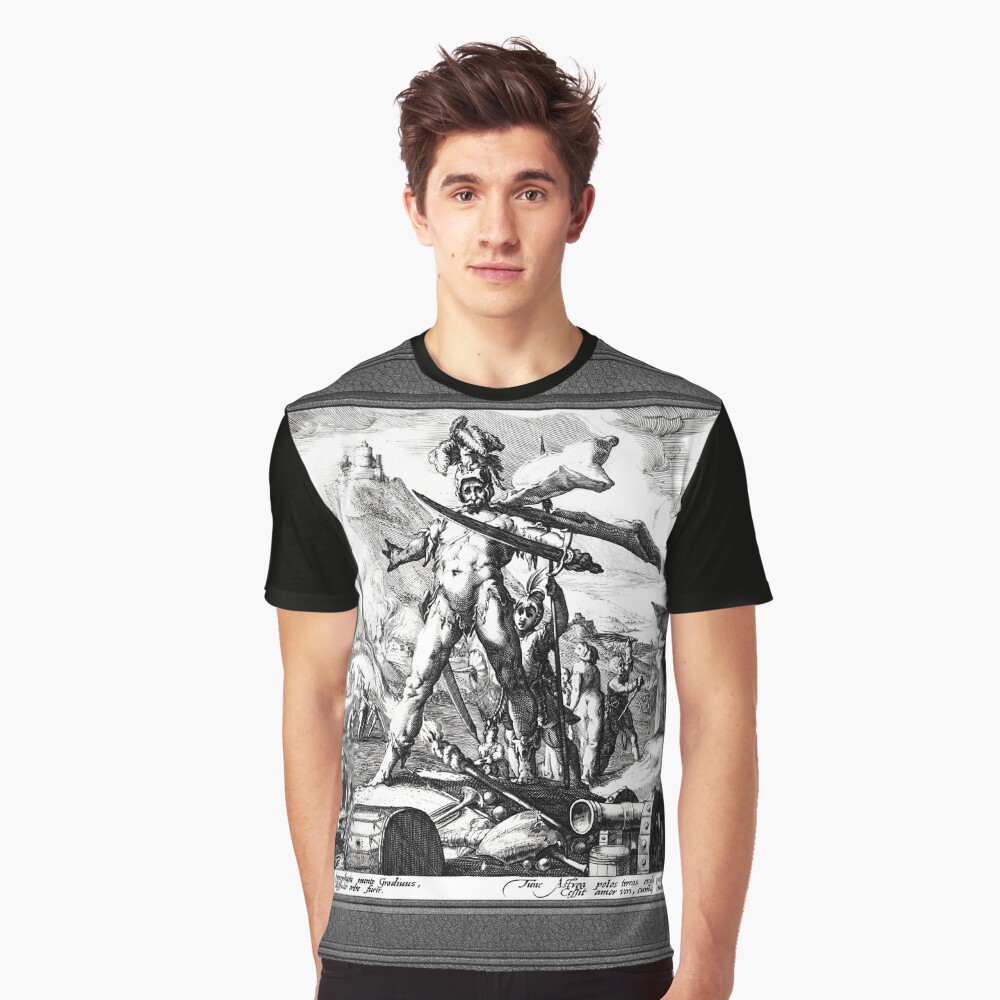
This engraving is a part of fourteen engravings of the Ages of Man, and depicts a scene from Greek Mythology which refers to a time of great conflict between nations during the 16th century.
In the scene there is an old soldier which is the central figure in conveying the plight of civilization as he stands on a mound of dirt or large boulder wearing tattered clothing a helmet with feathers, a weathered cape around his neck this blowing in the wind and a large sword in his left hand.
Behind him is a young childlike soldier that is dressed in a soldiers uniform holding a large shield in his right hand and a spear in his left hand that pointed straight up; with slaves or workers behind him, with other prisoners being lashed as they walk up a hill; while below them a prisoner sits by a fire that is tied to a tree.
In front of them both are the symbols of was, which include a canon, a barrel of gun powder, canon balls strewn about, a large drum, a horn and a lit torch.
In the scene we can see an assortment of workers that are most likely prisoners of war or slaves toiling the bare ground, and extracting its riches, with others being beaten and murdered.
In the distant background we can see a castle on the top of a mountain, as well as towns and villages, with some being set ablaze.

There is also a female figure to the upper right flying into the clouds carrying the symbols of justice in her left hand and a sword in her right.
Questa è una riproduzione di vecchi maestri di arte digitale rimasterizzata di un'immagine di pubblico dominio disponibile come file a stampa su tela arrotolata online.
Informazioni di seguito derivate da Wikipedia.org
Hendrick è nato vicino a Venlo a Bracht o Millebrecht, un villaggio allora nel Ducato di Julich, la sua famiglia si trasferì a Duisburg quando lui era 3 anni e quando raggiunse la maggiore età studiò pittura su vetro sotto il padre per diversi anni.
Ha poi studiato con l'olandese Polymath Dirck Volckertszoon Coornhert (1522 – 1590), con il quale ha studiato incisione.
Nel 1577 si è poi trasferito con Coornhert ad Haarlem nella Repubblica olandese, dove sarebbe rimasto per il resto della sua vita; e per un po' ad Haarlem lavorò con Philip Galle (1537 – 1612), per incidere una serie di stampe della storia di Lucrezia.
Nota a margine: Lucrezia; anglicizzato come Lucrezia, era una nobildonna nell'antica Roma, il cui stupro da Sesto Tarquinio (Tarquinio) e il successivo suicidio fece precipitare una ribellione che rovesciò la monarchia romana e portò alla transizione del governo romano da regno a repubblica.
A causa di un incendio alla mano destra, che Hendrick ha sofferto da bambino causandone la malformazione, divenne abile a causa di questa ferita a tenere il bulino (strumento di incisione affilato) come fu costretto a disegnare con i grandi muscoli del braccio e della spalla.
Hendrick era un maestro del “linea di gonfiore” e anche un pioniere del “punto e losanga” tecnica, dove i punti sono posti al centro di spazi a forma di losanga creati da tratteggio incrociato per affinare ulteriormente l'ombreggiatura tonale.