

El model de l'artista
Luis Ricardo Falero, un reconegut pintor espanyol actiu al segle XIX, va crear la seva obra mestra “El model de l'artista” a finals del 1800. Nascut a 1851 i morir en 1896, Falero era conegut per la seva hàbil representació de les dones, sovint ambientat amb fons rics que barrejaven temes clàssics amb matisos sensuals. Aquesta pintura, com moltes de les seves obres, retrata una model femenina que desprèn elegància i encant, capturant l'essència dels ideals clàssics i romàntics de bellesa. El tema es presenta com l'epítom de la gràcia, força, i presència etèria. La complexa comprensió de l'anatomia humana de Falero i el seu ús matisat de la llum i l'ombra donen vida al tema de l'obra d'art d'una manera gairebé tangible..
Taula de continguts
El subjecte i la seva presentació
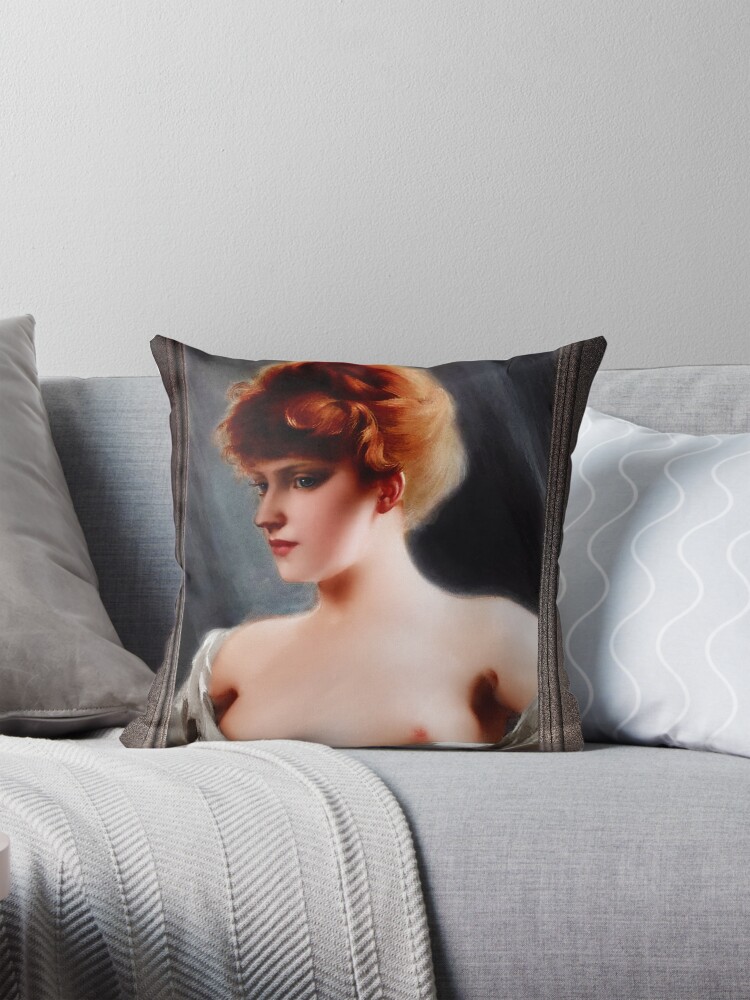
El tema central de “El model de l'artista” és una dona que mira lleugerament cap al costat, la seva expressió de contemplació tranquil·la. Està posicionada de perfil, oferint un retrat íntim però discret de la seva bellesa. La seva cara és delicada i composta, amb característiques sorprenentment detallades. La representació de l'artista dels seus cabells, un ric to vermellós, està meticulosament dissenyat amb suau, rínxols voluminosos que emmarquen la seva cara i cauen per l'esquena. This attention to her hair is not only an artistic choice but also an ode to the idealized beauty standards of the time.
The woman’s attire is minimal, focusing primarily on her figure. The fabric that she wears drapes over her body in an almost fluid manner, its softness contributing to the tactile sensation of the painting. The semi-transparent fabric allows for the graceful curve of her shoulder and the outline of her chest to be visible, subtly hinting at her form while maintaining an aura of modesty. The choice of soft whites and grays for the cloth contrasts with her skin tone, which is radiant and smooth, lending her an almost otherworldly appearance.
La composició i l'estat d'ànim
The composition of the painting is deliberate and composed, emphasizing the delicate balance between the subject and her surroundings. The backdrop is somewhat muted, rendered in soft, indistinct tones that allow the model to be the focal point. There is a play of light and shadow on her face and shoulders, suggesting a warm light source from the left. This light serves to highlight her features in a soft glow, donant-li una presència gairebé etèria. The use of shadow is also significant; it gently outlines her profile, adding depth to the overall composition and guiding the viewer’s gaze from her delicate face down to the curves of her body.
Falero’s ability to convey a sense of quiet sensuality is central to the mood of the painting. There is an air of mystery in her gaze, as though she is both the object of desire and yet removed from it. The contemplative nature of her expression, combined with the softness of her figure, evokes a sense of timeless beauty and purity. The mood of the painting can be described as serene, íntim, i una mica melancòlic, as if the subject is both a muse and a woman trapped in a moment of stillness.
Materials i Tècnica
Falero’s technique is evident in his masterful application of oil paint. The colors used in the painting are warm and muted, with a predominance of earth tones and soft highlights. The richness of the hues, particularly in the woman’s red hair, contrasts with the darker shadows and the neutral tones of her skin and background. The fluidity of the fabric and the softness of her skin are rendered in exquisite detail, showcasing the artist’s expertise in handling light and texture. The contrast between the smoothness of her skin and the textured brushwork used for the fabric creates a dynamic visual interest.
One of the key features of Falero’s work is his use of light to highlight specific aspects of his subjects. En aquesta pintura, the subtle play of light across the model’s skin and hair gives a sense of volume and depth. The artist has captured the sheen of her skin and the fine texture of her hair with a technique that enhances their lifelike quality, making them seem almost tangible. The interplay of light and shadow on the fabric further enriches the painting, giving it an added layer of realism.
Elements temàtics i estil
The thematic elements of “El model de l'artista” are rooted in the classical tradition, però també hi ha una sensualitat evident que Falero va impregnar sovint en les seves obres. La representació de la forma femenina va ser fonamental per a molts pintors acadèmics de l'època, i en aquesta peça, la model es pot veure alhora com un tema d'admiració i un símbol de bellesa. Hi ha una tensió entre la posada modesta de la model i la sensualitat visible de la seva forma. Aquest delicat equilibri parla del tema de l'objectivació de la dona en l'art, alhora que celebren la seva força i gràcia.
L'estil de Falero, que combinava elements de realisme amb romanticisme, és evident en els detalls finament executats de la cara i la figura de la model. La profunda comprensió de l'artista de l'art clàssic i la seva capacitat per combinar-lo amb un romàntic, almost dreamlike quality results in a painting that feels both grounded in the real world and elevated to an almost mythic realm. El model, despite her seemingly modest presentation, embodies the ideal of beauty that was so prominent in the 19th century, yet she is presented in a way that also evokes contemplation of her humanity.
Conclusió
En conclusió, “El model de l'artista” by Luis Ricardo Falero captures the duality of the female form as both an object of desire and a figure of grace. Through his meticulous technique and understanding of human anatomy, Falero imbues the subject with a sense of elegance and timeless beauty. La il·luminació suau, delicate fabrics, and contemplative expression all contribute to the mood of the painting, which remains one of quiet allure and sensuality. By merging classical ideals with romantic elements, Falero crea una obra que és alhora una celebració de la bellesa i una reflexió sobre la naturalesa de la representació artística.
Es tracta d’una reproducció de vells mestres d’art digital retocada d’una imatge de domini públic.
Artista Bio Derivat Wikipedia.org
Falero va néixer a Granada i originàriament va fer carrera a l'Armada espanyola, però ho va renunciar a la decepció dels seus pares; ja que va decidir viatjar a París, on va estudiar art, química i enginyeria mecànica.
Durant els estudis de química i enginyeria mecànica; considerava massa perillosos els experiments que havia de fer, així el va portar a centrar la seva atenció només en la pintura.
Com a resultat, es va convertir en estudiant del retratista i orientalista francès Gabriel-Joseph-Marie-Augustin Ferrier. (1847 – 1914). Després de París, es va traslladar a Londres, on va continuar els seus estudis, i finalment es va establir.
Falero tenia un interès particular per l'astronomia i va incorporar les constel·lacions celestes a moltes de les seves obres, tal com “El casament d'un cometa” i “Estrelles Bessones”. El seu interès i coneixements per l'astronomia també el van portar a il·lustrar les obres de Camille Flammarion.
En 1896, l'any de la seva mort, Maud Harvey va demandar a Falero per paternitat. La demanda al·legava que Falero va seduir Harvey quan era ella 17, primer servint de serventa, i després el seu model. Quan va descobrir que estava embarassada, la va acomiadar.
Va guanyar el cas i se li van concedir cinc xílings a la setmana en suport del seu fill. Falero va morir a l’University College Hospital, Londres, a l'edat de 45