

The Autumn c1896
Alphonse Mucha (1860 – 1939), a celebrated Czech painter and graphic artist, oprettet “Efteråret” i 1896 as part of his renowned “Seasons” series of allegorical portraits. This stunning painting reflects Mucha’s mastery of Art Nouveau, blending organic forms with elegant human figures. Through the use of flowing lines, delicate natural motifs, and symbolic representation, Mucha captured the essence of autumn in a way that evokes both the beauty and the melancholic passage of time associated with the season.
Indholdsfortegnelse
Hovedemne
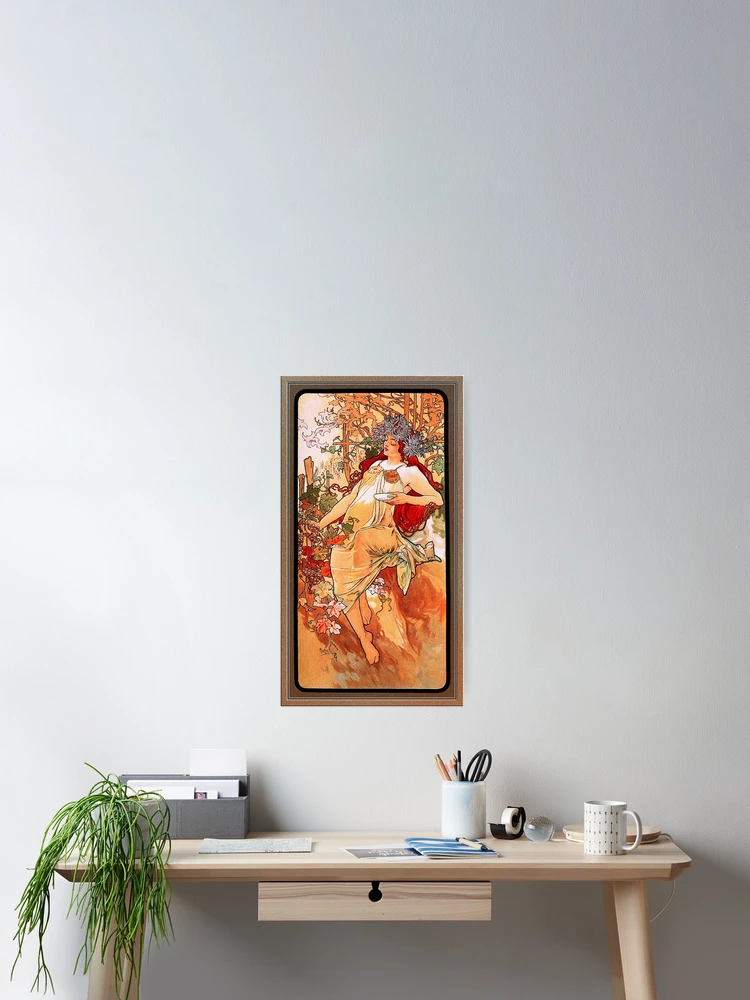
At the heart of the composition is a serene female figure, the embodiment of autumn itself. She is seated gracefully in a relaxed pose, her figure enveloped in flowing, diaphanous robes that seem to meld with the natural world around her. The color palette of her attire reflects the hues of the season: rich oranges, soft yellows, and muted browns that echo the changing leaves. A crown of chrysanthemums, symbolizing the late bloom of autumn, rests gently upon her head, further connecting her to the seasonal theme.
I hendes venstre hånd, the figure holds a bunch of grapes, a symbol of the harvest and the fruits of labor that are characteristic of autumn. The grapes, ripe and plentiful, speak to the abundance that the fall season often brings after the toil of the warmer months. The woman’s other hand holds a shallow dish, an emblematic gesture of offering or abundance, suggesting the nourishing role autumn plays in preparing for the colder months ahead. Her calm, almost dreamy expression adds a layer of tranquility to the scene, as if she is contemplating the beauty of the harvest or the inevitable fading of the season.
Objekter og symbolik
The symbolic nature of the painting is rich and layered. The grapes in the woman’s hand are a direct reference to the harvest, a time when nature yields its bounty. Mucha, known for his intricate symbolism, imbues these grapes with both a literal and metaphorical meaning: they represent the culmination of the cycle of growth and the transition to a period of rest. The woman’s gesture of holding the dish could be interpreted as an offering to the viewer, a visual invitation to partake in the season’s beauty, bounty, and passing moments.
Derudover, the surrounding natural elements also enhance the allegorical nature of the piece. Vines and leaves twist and wind around the woman, suggesting the intertwining of life with nature and the cycles that govern both. The presence of autumnal leaves scattered throughout the composition serves as a reminder of the inevitable passage of time and the transient nature of life. The leaves, once lush and green, are now tinged with the orange and red hues of fall, signifying maturity, change, and the approach of winter.
Terræn og baggrund
The background of the painting is a harmonious blend of organic forms and muted tones. While Mucha does not present a highly detailed landscape, the suggestion of a natural environment is clear. The soft swirling lines and abstracted trees and foliage that rise in the background echo the curves and patterns of the woman’s robes and the overall fluidity of the composition. The subtle, almost dreamlike quality of the background creates a contrast with the more grounded, earthy tones of the foreground, drawing the viewer’s attention to the figure while still maintaining a deep connection to the season she represents.
The terrain beneath the figure’s seated form is made up of soft, flowing lines that suggest the earth without overtly defining it. The lack of a specific, detailed landscape allows the figure to remain the primary focus, highlighting her connection to the environment without the distraction of a complicated background. This approach emphasizes the allegorical nature of the painting, allowing the viewer to engage with the subject matter on a symbolic level rather than a literal one.
Stil og teknik
“Efteråret” is quintessentially Art Nouveau, with its flowing lines, organiske former, og dekorative detaljer. Mucha’s characteristic style is evident in the intricate detailing of the leaves, blomster, and the woman’s flowing hair. The curvilinear forms of the composition evoke a sense of harmony and fluidity, while the delicate treatment of the figure and the surrounding natural elements exemplifies the refined elegance that Mucha is known for.
Mucha’s technique in this work showcases his ability to fuse the decorative and the symbolic. The woman’s form is rendered with soft curves and gentle proportions, maintaining an idealized yet natural appearance. The robes she wears appear almost weightless, fluttering in the air as if they are made of light itself. This sense of lightness contrasts with the more grounded, earthy elements of the grapes and leaves, which are meticulously detailed to emphasize their tactile, real-world presence.
The color palette of the painting is another hallmark of Mucha’s style. The use of warm autumnal tones, such as gold, amber, and ochre, creates a rich, inviting atmosphere. These colors, along with the soft interplay of light and shadow, add depth to the composition while maintaining an overall sense of harmony and balance. Mucha’s careful attention to color and form enhances the allegorical theme, reinforcing the idea that autumn is a time of abundance and reflection.
Stemning og tema
Stemningen af “Efteråret” is one of peaceful contemplation and quiet beauty. The figure exudes a sense of tranquility, as though she is at one with the natural world around her. There is no sense of urgency or anxiety in her pose or expression; snarere, she seems to be absorbed in the timeless rhythms of nature. This calmness evokes a mood of introspection, inviting the viewer to reflect on the passage of time, the cycles of nature, and the fleeting beauty of the autumn season.
The overarching theme of the painting is the celebration of autumn as a time of transition and harvest. Mucha’s allegorical approach elevates the season from a simple marker of time to a deeper symbol of growth, change, and the cyclical nature of life. The painting encourages a recognition of both the bounty of autumn and the quiet inevitability of its end, as winter approaches. It serves as a reminder that all things are in constant flux, and that beauty can be found in both the beginnings and endings that shape our world.
Efteråret (En del af sæsonserien af kvindelige allegoriske portrætmalerier) c1896 af den tjekkiske maler Alphonse Mucha (1860 – 1939); samt en gennemført Illustrator og grafiker, der var en stor kraft i jugendperioden; kendt for sin stiliserede, udsmykkede og dekorative teaterplakater.
En fortryllende ung dame med blomster i håret, har tendens til at dyrke druer i en have i efterårssæsonen.
Dette er en retoucheret digital kunst, som gamle mestre gengiver et billede af det offentlige domæne.
Kunstner Bio
Info nedenfor fra Wikipedia.org
Alfons Maria Mucha juli 24, 1860 – juli 14, 1939), internationalt kendt som Alphonse Mucha. Han var en fremtrædende tjekkisk maler, illustratør og grafiker, bor i Paris i jugendtiden, og er bedst kendt for sine tydeligt stiliserede og dekorative teatralsk plakater, især Sarah Bernhardts.
Han producerede illustrationer, reklamer, dekorative paneler, og designs, som blev blandt de mest kendte billeder i perioden.
I anden del af sin karriere, i en alder af 43, han vendte tilbage til sit hjemland Bohemia-Moravia-regionen i Østrig og dedikerede sig til at male en serie på tyve monumentale lærreder kendt som The Slav Epic, skildrer historien om alle de slaviske folk i verden, som han malede imellem 1912 og 1926.
I 1928, på 10 -årsdagen for Tjekkoslovakiets uafhængighed, han præsenterede serien for den tjekkiske nation. Han betragtede det som sit vigtigste arbejde. Det er nu udstillet i Prag.