

The Battle of Austerlitz
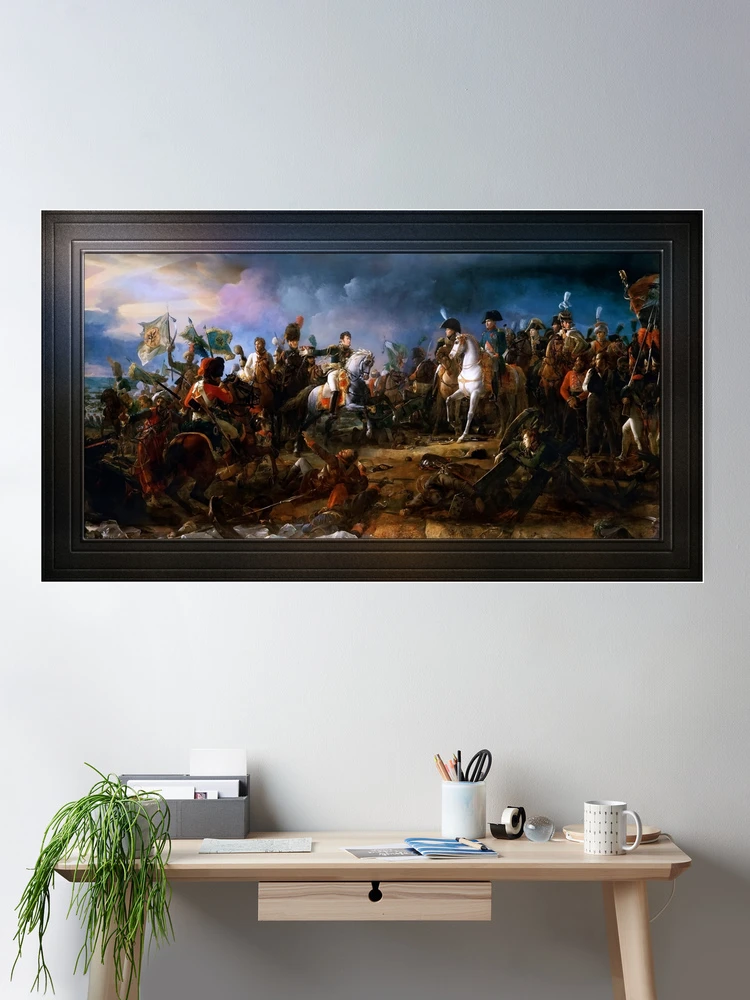
Kunstværket med titlen Det Battle of Austerlitz, (December 2nd, 1805), skabt omkring 1810 by French painter François Pascal Simon, Baron Gérard (1770 – 1837), captures one of the most significant battles of the Napoleonic Wars. Known as the Battle of the Three Emperors, this pivotal confrontation between Napoleon Bonaparte, Tsar Alexander I of Russia, and Holy Roman Emperor Francis II is immortalized in this grand composition. Scenen, set in the midst of chaos and carnage, vividly portrays the intensity and dramatic nature of warfare during the early 19th century. It is an exemplary work of historical art, a striking mix of realism, drama, and national pride.
Indholdsfortegnelse
Hovedemne: The Battlefield and Its Commanders
The central subject of the painting is a vast battlefield strewn with soldiers, flags, and fallen soldiers amidst the aftermath of intense combat. At the forefront, Napoleon Bonaparte, mounted on a white steed, stands as the undeniable focal point. His commanding posture exudes authority and confidence, reflecting his role as the mastermind behind the victory. His regal presence contrasts sharply with the chaos around him, which includes the deaths of numerous soldiers and the disarray of the battlefield. Napoleon’s horse is depicted as calm amidst the violence, as his sharp, focused gaze surveys the battlefield, likely calculating his next move.
Other key figures include the Tsar of Russia, Alexander I, whose dignified yet tense posture further emphasizes the turmoil of the conflict. His royal blue uniform, complete with gold epaulets and a decorative sash, signifies his nobility and status, while also showing his involvement in a struggle that he could not win. Til venstre for scenen, other officers are seen rallying their troops, coordinating efforts in the middle of a bloody battle. These military leaders, both French and foreign, represent the intersection of power, strategy, and the high cost of war. Their interactions and movements are charged with urgency and tension.
Objects and Symbols: Flags, Weapons, and Debris
In addition to the commanding figures, the scene is teeming with symbols of war. Various military flags can be seen fluttering in the wind, a visual representation of the allegiances in this conflict. The flags are emblazoned with symbols of national pride and military power, their detailed designs hinting at the ongoing struggle for supremacy. The color contrast of these flags against the muted tones of the sky and terrain reflects the struggle between opposing forces, Napoleon’s French army and the allied Russian and Austrian forces.
Weapons, including swords, muskets, and bayonets, are scattered across the scene, many of them abandoned or broken, symbolizing the personal toll that war takes on both soldiers and commanders. Disse genstande, while seemingly insignificant in their scattered state, contribute to the overall chaotic atmosphere of the battle. Derudover, the bodies of fallen soldiers, including both French and allied forces, litter the battlefield, emphasizing the devastation of war. Blood-stained uniforms and wounded men in the background reflect the personal cost of the grand political and military maneuverings.
Terræn og miljø: The Landscape of War
The landscape in The Battle of Austerlitz plays a crucial role in conveying the tone of the artwork. The background is dominated by tumultuous skies filled with stormy clouds, which intensify the scene’s mood of destruction and upheaval. The soft pink and purple hues of the clouds hint at the coming dusk, a symbolic representation of the end of the battle and the ominous aftermath that awaits the vanquished. The mountainous terrain in the distance offers a dramatic backdrop to the chaos unfolding in the foreground, while patches of fog or smoke obscure portions of the scene, adding to the disorientation of battle.
The ground is churned into mud and scattered with debris, as the clash of heavy artillery and cavalry have torn through the once-pristine field. The soil is punctuated by craters and trenches, illustrating the violent exchange of gunfire and cannonballs. This depiction serves as a visual reminder of the brutal physical toll warfare inflicts on the landscape, turning fertile earth into a desolate war zone.
Style and Artistic Technique: Realism and Drama
Baron Gérard’s painting is rendered in the neoclassical style, a reflection of the era’s preference for grandeur and idealization. The dramatic use of light and shadow creates a sense of depth, pulling the viewer’s eye from the foreground chaos to the distant horizon. The strong contrasts between light and dark enhance the sense of tension and drama, with the figures of Napoleon and his generals illuminated, creating a sense of focus on their leadership amidst the chaos. The battlefield itself is painted with great detail, capturing the human emotion of the scene, from the urgency of soldiers engaged in combat to the despair of the wounded.
The emotional intensity of the scene is amplified by Gérard’s careful attention to facial expressions, kropssprog, and the interaction of light with the soldiers’ uniforms. The vividness of the clothing, the rich golds and reds of Napoleon’s uniform, the dark coats of the Russian soldiers, and the bloody wounds of the fallen, conveys the raw reality of battle, while also celebrating the elegance and power of the leaders at its center. Gérard’s use of texture, particularly in his rendering of the horses and soldiers’ garments, adds to the sense of realism, bringing the viewer into the very moment of this monumental historical event.
Tema og humør: Victory, Ofre, and Tragedy
The mood of the painting is complex, balancing both triumph and tragedy. At the center of the composition, Napoleon’s victory is evident, as he surveys the battlefield with a sense of controlled determination. Imidlertid, the surrounding carnage, the broken bodies, the wounded, and the debris of war, reminds the viewer of the true cost of that victory. The victorious Napoleon is contrasted by the fallen and dying, creating a tension between the glory of military conquest and the somber realities of war.
The theme of heroism versus tragedy is deeply embedded in the composition. While Napoleon’s leadership is lauded, the human toll of his victory is undeniable. The figures of the fallen soldiers, both French and allied, serve as poignant reminders that war, though often seen as a means to an end, is a brutal and unforgiving force.
Konklusion
François Pascal Simon, Baron Gérard’s The Battle of Austerlitz is a masterful portrayal of one of the most significant battles in European history. Through its detailed depiction of the battlefield, its figures, and its use of light and shadow, the painting encapsulates the complexity of war, its grandeur, its leaders, and the devastating human cost. The emotional intensity of the scene, combined with its historical significance, makes this work a powerful and timeless reminder of the realities of military conflict.
You can read more about the conflict here: https://en.wikipedia.org/wiki/Battle_of_Austerlitz
The Battle of Austerlitz is a retouched digital art old masters reproduction of a public domain image.
Kunstnerbio fra Wikipedia.org
François Gérard was born in Rome to J. S. Gérard og Cleria Matteï. I en alder af tolv, Gérard opnåede optagelse på Pension du Roi i Paris. Fra Pensionen, han gik over til billedhuggeren Augustin Pajous atelier, som han efter to år forlod til historiemaleren Nicolas-Guy Brenets atelier, som han forlod næsten øjeblikkeligt for at placere sig selv under Jacques-Louis David.
I 1789, han konkurrerede om Prix de Rome, som blev båret af hans kammerat Girodet. I det følgende år (1790), han præsenterede sig igen, men hans fars død forhindrede fuldførelsen af hans arbejde og forpligtede ham til at følge sin mor til Rom.
I 1791, han vendte tilbage til Paris, men hans fattigdom var så stor, at han blev tvunget til at give afkald på sine studier til fordel for beskæftigelse, som ville give øjeblikkelig profit.
David benyttede sig straks af sin hjælp, og et af mesterens mest berømte portrætter, af Louis-Michel Le Pelletier de Saint-Fargeau, kan skylde meget til Gérards hånd.
Dette maleri blev udført tidligt 1793, året, hvor Gérard, efter anmodning fra David, blev udnævnt til medlem af den revolutionære domstol, fra de fatale beslutninger, som han, imidlertid, undviger altid sig selv.
I 1794, han fik førstepræmien i en konkurrence, hvis emne var Tiende august, det er, stormen af Tuileries Palace. Yderligere stimuleret af succeserne fra hans rival og ven Girodet i Salons of 1793 og 1794, Gérard (hjulpet af Jean-Baptiste Isabey, miniaturisten) produceret i 1795 hans berømte Bélisaire.
I 1796, et portræt af hans generøse ven (bevaret i dag i Louvre) opnået ubestridt succes, og pengene modtaget fra Isabey for disse to værker gjorde det muligt for Gérard at eksekvere 1797 hans Psyke og Kærlighed (illustration).[4] Til sidst, i 1799, hans portræt af Madame Mère etablerede hans position som en af datidens førende portrætmalere.
I 1808, så mange som otte (og i 1810, ikke mindre end fjorten) portrætter af ham blev udstillet på Salonen, og disse tal giver kun en indikation af de enorme tal, som han udførte årligt. Alle de ledende skikkelser fra imperiet og Bourbon-restaureringen, og alle de mest berømte mænd og kvinder i Europa, sad for Gérard.
Denne ekstraordinære mode skyldes dels charmen ved hans måde og samtale, for hans salon var lige så hyppigt besøgt som hans studie. Madame de Staël, George Canning, Talleyrand og hertugen af Wellington har alle vidnet om tiltrækningen af hans samfund.
Rig og berømt, Gérard blev stukket af anger for at opgive tidligere ambitioner; med mellemrum, han havde faktisk stræbt med Girodet og andre rivaler for at bevise sin styrke ved historiemaleri, stadig en mere prestigefyldt genre end portrætter.
Hans slag ved Austerlitz (1810) viste en bredde af opfindelser og stil, som var endnu mere iøjnefaldende i L'Entrée d'Henri IV à Paris (i Versailles), det arbejde, hvormed i 1817 han hyldede den hjemvendte Ludvig XVIII. Efter denne dato, Gérard afslog, iagttager med impotent sorg den romantiske skoles fremgang.
Spækket med hæder – baron of the Empire in 1809, medlem af Institut d 7 marts 1812, officer i Légion d'honneur, første maler til kongen – han arbejdede på, trist og modløs. Revolutionen af 1830 tilføjede til hans uro, og på 11 januar 1837, efter tre dages feber, han døde.
Gérard huskes bedst for sine portrætter. Farven på hans malerier har lidt, men hans Tegninger viser i uskadet Delikatesse Renheden af hans Linie, og kvinders er særligt bemærkelsesværdige for en jomfruelig enkelhed og ærlighed af udtryk. Hans elever omfattede Heinrich Christoph Kolbe.