

La bataille d'Austerlitz
L'œuvre intitulée Le Bataille d'Austerlitz, (2 décembre, 1805), créé autour 1810 by French painter François Pascal Simon, Baron Gérard (1770 – 1837), captures one of the most significant battles of the Napoleonic Wars. Known as the Battle of the Three Emperors, this pivotal confrontation between Napoleon Bonaparte, Tsar Alexander I of Russia, and Holy Roman Emperor Francis II is immortalized in this grand composition. La scène, set in the midst of chaos and carnage, vividly portrays the intensity and dramatic nature of warfare during the early 19th century. It is an exemplary work of historical art, a striking mix of realism, drame, and national pride.
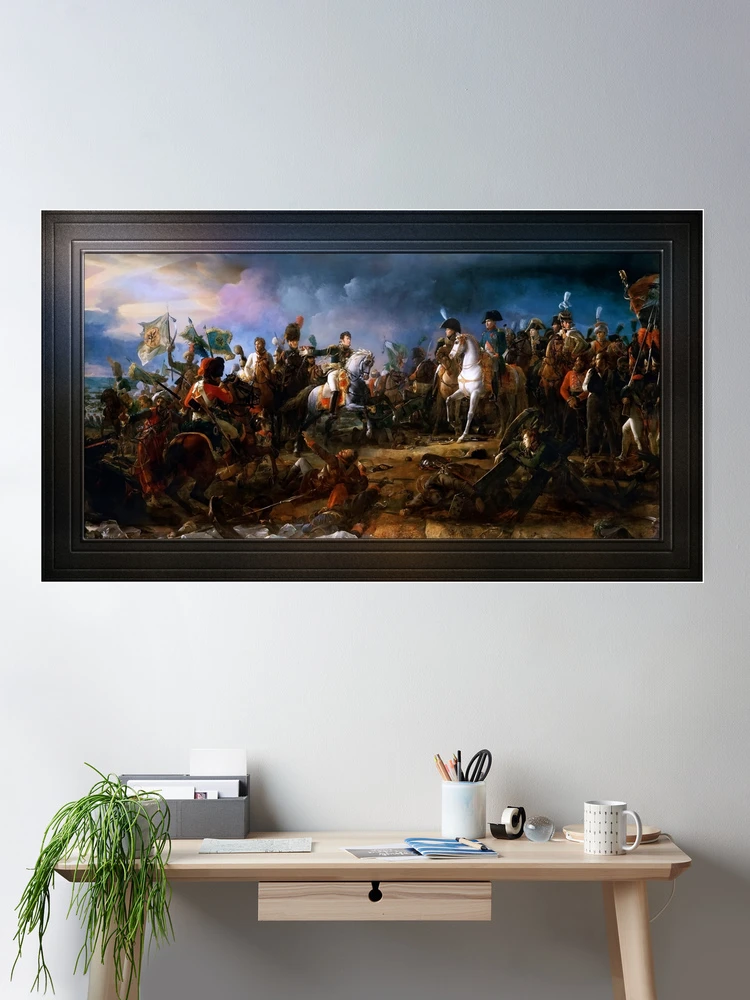
Table des matières
Sujet principal: The Battlefield and Its Commanders
The central subject of the painting is a vast battlefield strewn with soldiers, flags, et les soldats tombés au combat au lendemain d'intenses combats. À l'avant-garde, Napoléon Bonaparte, monté sur un cheval blanc, constitue le point focal indéniable. Sa posture imposante respire l'autorité et la confiance, reflétant son rôle de cerveau derrière la victoire. Sa présence royale contraste fortement avec le chaos qui l'entoure., qui comprend la mort de nombreux soldats et le désarroi du champ de bataille. Le cheval de Napoléon est représenté calme au milieu de la violence, comme son tranchant, un regard concentré surveille le champ de bataille, probablement en train de calculer son prochain mouvement.
Parmi les autres personnalités clés figurent le tsar de Russie, Alexandre Ier, dont la posture digne mais tendue souligne encore davantage la tourmente du conflit. Son uniforme bleu roi, complet avec des épaulettes dorées et une ceinture décorative, signifie sa noblesse et son statut, tout en montrant son implication dans une lutte qu'il n'a pas pu gagner. A gauche de la scène, on voit d'autres officiers rallier leurs troupes, coordonner les efforts au milieu d'une bataille sanglante. Ces chefs militaires, français et étrangers, représente l'intersection du pouvoir, stratégie, et le coût élevé de la guerre. Leurs interactions et leurs mouvements sont chargés d’urgence et de tension.
Objets et symboles: Flags, Weapons, and Debris
En plus des chiffres imposants, la scène regorge de symboles de guerre. Divers drapeaux militaires peuvent être vus flotter au vent, une représentation visuelle des allégeances dans ce conflit. Les drapeaux sont ornés de symboles de fierté nationale et de puissance militaire., leurs conceptions détaillées faisant allusion à la lutte en cours pour la suprématie. Le contraste des couleurs de ces drapeaux avec les tons sourds du ciel et du terrain reflète la lutte entre les forces opposées., L’armée française de Napoléon et les forces alliées russes et autrichiennes.
Weapons, y compris les épées, mousquets, et des baïonnettes, sont dispersés sur la scène, beaucoup d'entre eux sont abandonnés ou brisés, symbolisant le bilan personnel que la guerre fait peser sur les soldats et les commandants. Ces articles, bien qu'apparemment insignifiants dans leur état dispersé, contribuer à l'atmosphère chaotique générale de la bataille. aditionellement, les corps des soldats tombés au combat, incluant les forces françaises et alliées, jonchent le champ de bataille, soulignant les ravages de la guerre. Les uniformes tachés de sang et les hommes blessés en arrière-plan reflètent le coût personnel des grandes manœuvres politiques et militaires..
Terrain et environnement: The Landscape of War
Le paysage dans La bataille d'Austerlitz joue un rôle crucial dans la transmission du ton de l’œuvre d’art. L'arrière-plan est dominé par un ciel tumultueux rempli de nuages orageux, qui intensifient l’ambiance de destruction et de bouleversement de la scène. Les douces teintes roses et violettes des nuages font allusion au crépuscule à venir, une représentation symbolique de la fin de la bataille et des conséquences inquiétantes qui attendent les vaincus. Le terrain montagneux au loin offre une toile de fond dramatique au chaos qui se déroule au premier plan., tandis que des taches de brouillard ou de fumée obscurcissent des parties de la scène, ajoutant à la désorientation de la bataille.
Le sol est transformé en boue et parsemé de débris, alors que le choc de l'artillerie lourde et de la cavalerie a déchiré le champ autrefois vierge. Le sol est ponctué de cratères et de tranchées, illustrant les violents échanges de coups de feu et de boulets de canon. Cette représentation sert de rappel visuel des conséquences physiques brutales de la guerre sur le paysage., transformer une terre fertile en une zone de guerre désolée.
Style et technique artistique: Realism and Drama
La peinture du baron Gérard est rendue dans le style néoclassique, un reflet de la préférence de l’époque pour la grandeur et l’idéalisation. L'utilisation dramatique de la lumière et de l'ombre crée une impression de profondeur, attirant le regard du spectateur du chaos du premier plan vers l’horizon lointain. Les forts contrastes entre la lumière et l'obscurité renforcent le sentiment de tension et de drame., avec les figures de Napoléon et de ses généraux illuminées, créer un sentiment de concentration sur leur leadership au milieu du chaos. Le champ de bataille lui-même est peint avec beaucoup de détails, capturer l'émotion humaine de la scène, de l'urgence des soldats engagés au combat au désespoir des blessés.
L’intensité émotionnelle de la scène est amplifiée par l’attention particulière portée par Gérard aux expressions faciales., le langage corporel, et l’interaction de la lumière avec les uniformes des soldats. La vivacité des vêtements, les riches or et rouges de l’uniforme de Napoléon, les manteaux sombres des soldats russes, et les blessures sanglantes des morts, transmet la réalité brute de la bataille, tout en célébrant l'élégance et la puissance des dirigeants en son centre. L’utilisation de la texture par Gérard, notamment dans son rendu des chevaux et des soldats’ habits, ajoute au sentiment de réalisme, amener le spectateur au moment même de cet événement historique monumental.
Thème et humeur: Victory, Sacrifice, and Tragedy
L'ambiance du tableau est complexe, équilibrer à la fois le triomphe et la tragédie. Au centre de la composition, La victoire de Napoléon est évidente, alors qu'il examine le champ de bataille avec un sentiment de détermination contrôlée. pourtant, le carnage environnant, les corps brisés, les blessés, et les débris de guerre, rappelle au spectateur le véritable coût de cette victoire. Le Napoléon victorieux contraste avec les morts et les mourants, créant une tension entre la gloire de la conquête militaire et les sombres réalités de la guerre.
Le thème de l'héroïsme contre la tragédie est profondément ancré dans la composition.. Alors que le leadership de Napoléon est salué, le bilan humain de sa victoire est indéniable. Les chiffres des soldats tombés au combat, français et alliés, servir de rappels poignants que la guerre, bien que souvent considéré comme un moyen pour parvenir à une fin, est une force brutale et impitoyable.
Conclusion
François Pascal Simon, Celui du Baron Gérard La bataille d'Austerlitz est une représentation magistrale de l'une des batailles les plus importantes de l'histoire européenne. Grâce à sa représentation détaillée du champ de bataille, ses chiffres, et son utilisation de la lumière et de l'ombre, le tableau résume la complexité de la guerre, sa grandeur, ses dirigeants, et le coût humain dévastateur. L'intensité émotionnelle de la scène, combiné à son importance historique, fait de cette œuvre un rappel puissant et intemporel des réalités des conflits militaires.
Vous pouvez en savoir plus sur le conflit ici: https://en.wikipedia.org/wiki/Battle_of_Austerlitz
La bataille d'Austerlitz est une reproduction de maîtres anciens d'art numérique retouchée d'une image du domaine public.
Artiste Bio de Wikipedia.org
François Gérard est né à Rome de J. S. Gérard et Cléria Matteï. A l'âge de douze ans, Gérard obtient l'admission à la Pension du Roi à Paris. De la pension, il passa à l'atelier du sculpteur Augustin Pajou, qu'il quitte au bout de deux ans pour l'atelier du peintre d'histoire Nicolas-Guy Brenet, qu'il quitta presque aussitôt pour se placer sous Jacques-Louis David.
Dans 1789, il a concouru pour le Prix de Rome, qui fut emporté par son camarade Girodet. L'année suivante (1790), il s'est de nouveau présenté, mais la mort de son père empêcha l'achèvement de ses travaux et l'obligea à accompagner sa mère à Rome.
Dans 1791, il est rentré à Paris, mais sa pauvreté était si grande qu'il a été contraint de renoncer à ses études en faveur d'un emploi qui rapporterait un profit immédiat.
David a immédiatement profité de son aide, et l'un des portraits les plus célèbres de ce maître, of Louis-Michel Le Pelletier de Saint-Fargeau, peut-être beaucoup à la main de Gérard.
Cette peinture a été exécutée au début de 1793, l'année où Gérard, à la demande de David, a été nommé membre du tribunal révolutionnaire, des décisions fatales dont il, pourtant, s'absentait invariablement.
Dans 1794, il a obtenu le premier prix d'un concours, dont le sujet était Le 10 août, C'est, la prise du palais des Tuileries. Stimulé encore par les succès de son rival et ami Girodet dans les Salons de 1793 et 1794, Gérard (aidé de Jean-Baptiste Isabey, le miniaturiste) produit en 1795 son célèbre Bélisaire.
Dans 1796, un portrait de son généreux ami (aujourd'hui conservé au Louvre) obtenu un succès incontesté, et l'argent reçu d'Isabey pour ces deux travaux a permis à Gérard d'exécuter en 1797 his Psyche et l’Amour (illustration).[4] Enfin, dans 1799, son portrait de Madame Mère a établi sa position comme l'un des plus grands portraitistes de l'époque.
Dans 1808, jusqu'à huit (et en 1810, pas moins de quatorze) des portraits de lui ont été exposés au Salon, et ces chiffres ne donnent qu'une indication des nombres énormes qu'il exécutait chaque année. Toutes les figures de proue de l'Empire et de la Restauration Bourbon, et tous les hommes et femmes les plus célèbres d'Europe, assis pour Gérard.
Cette vogue extraordinaire était due en partie au charme de ses manières et de sa conversation, car son salon était aussi fréquenté que son atelier. Madame de Staël, Georges Canning, Talleyrand et le duc de Wellington ont tous témoigné de l'attrait de sa société.
Riche et célèbre, Gérard a été piqué par le remords pour des ambitions antérieures abandonnées; à intervalles, il s'était en effet efforcé avec Girodet et d'autres rivaux de prouver sa force en peinture d'histoire, un genre encore plus prestigieux que le portrait.
His Bataille d’Austerlitz (1810) a montré une ampleur d'invention et de style qui était encore plus visible dans L'Entrée d'Henri IV à Paris (à Versailles), le travail avec lequel dans 1817 il a rendu hommage au retour de Louis XVIII. Après cette date, Gérard a refusé, observant avec une douleur impuissante les progrès de l'école romantique.
Chargé d'honneurs – baron de l'Empire à 1809, membre de l'Institut sur 7 Mars 1812, officer of the Légion d’honneur, premier peintre du roi – il a travaillé sur, triste et découragé. La révolution de 1830 ajouté à son inquiétude, et sur 11 janvier 1837, après trois jours de fièvre, il est mort.
Gérard est surtout connu pour ses portraits. La couleur de ses tableaux a souffert, mais ses dessins montrent avec une délicatesse intacte la pureté de son trait, et celles des femmes sont particulièrement remarquables par une simplicité virginale et une franchise d'expression. Ses élèves comprenaient Heinrich Christoph Kolbe.