

Venus 'fødsel: A Celebration of Classical Beauty
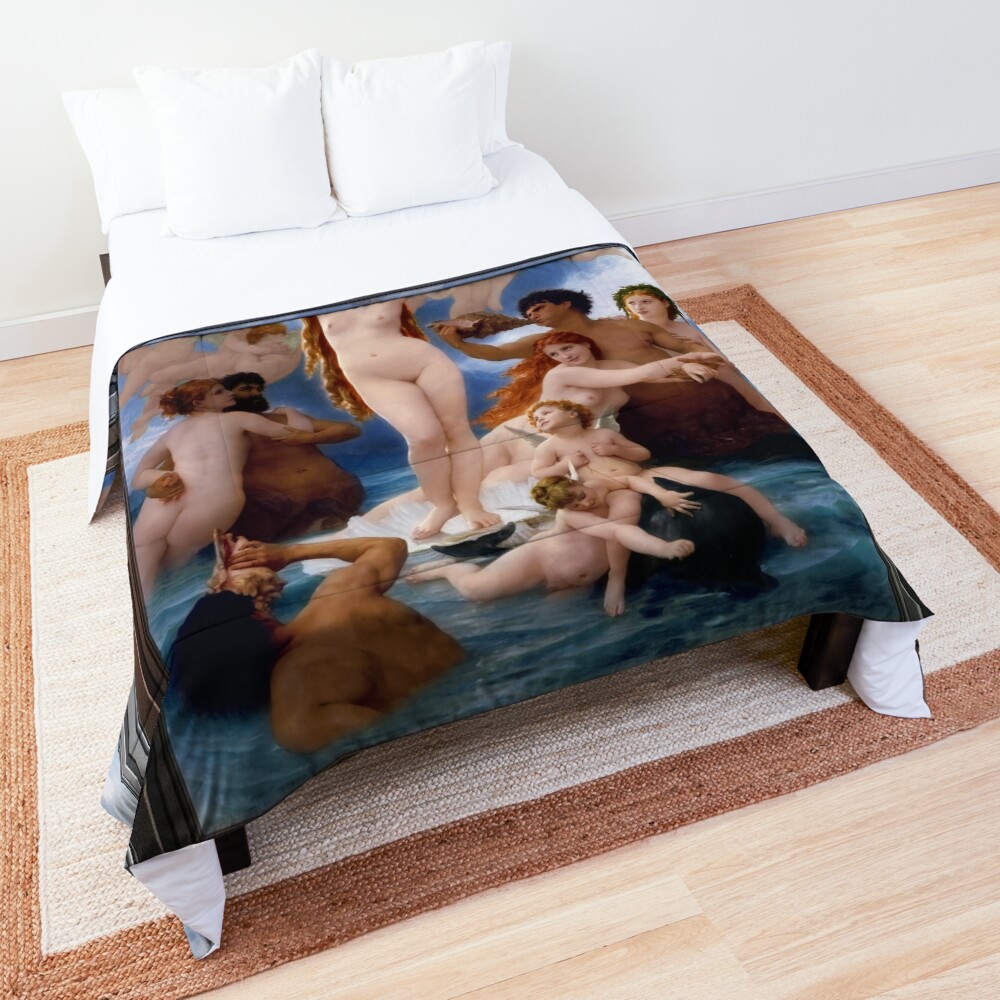
Venus 'fødsel c1879 by French Painter William-Adolphe Bouguereau (1825 – 1905), stands as a quintessential example of Academic art, embodying the principles of idealized beauty and technical mastery prevalent in mid-19th century France. This large-scale oil painting draws heavily from classical mythology, depicting the arrival of the goddess Venus (Aphrodite to the Greeks) upon the shores of Cyprus. Imidlertid, Bouguereau’s interpretation is far removed from earlier depictions; instead of a dramatic or tempestuous emergence, he presents a scene of serene grace and gentle unfolding.
Indholdsfortegnelse
Kompositionsstruktur & Narrativt flow
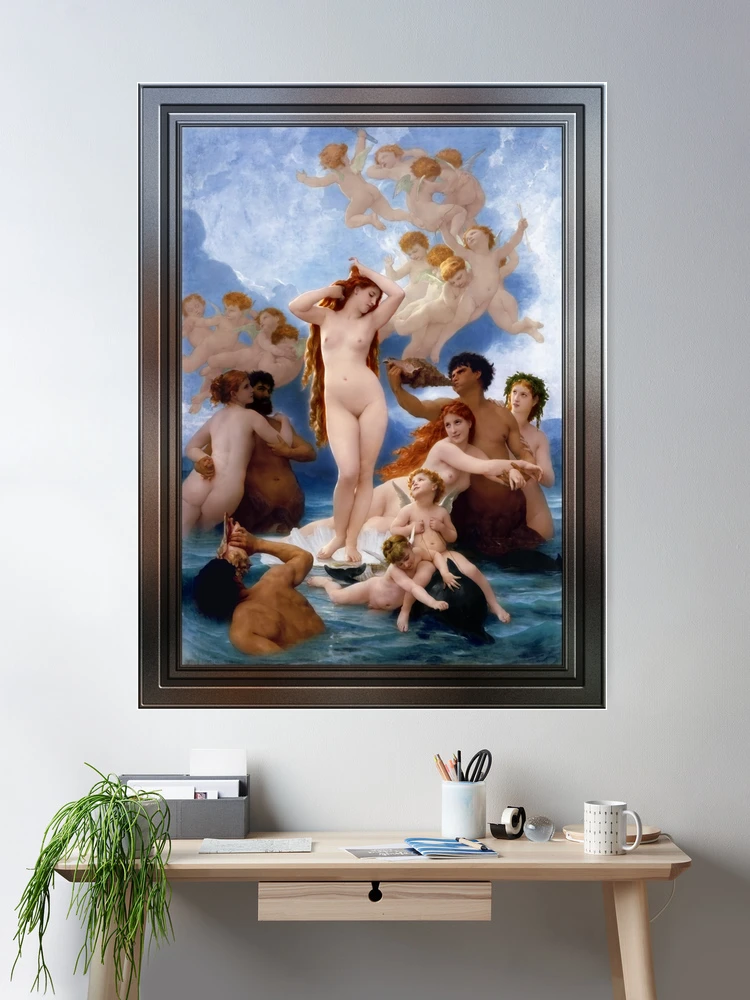
The composition is meticulously structured around Venus herself, positioned centrally within the canvas. She stands upon a massive scallop shell, which serves as her floating pedestal, gently approaching the shoreline. The arrangement isn’t haphazard; it’s carefully orchestrated to guide the viewer’s eye. To her left, a figure representing Zephyr, the west wind, and his consort Chloris, blow Venus towards the shore, their bodies intertwined in a dynamic pose that conveys movement and gentle force. On the right, a nymph, likely Hora, awaits with a floral garland, ready to welcome the goddess. The figures surrounding Venus are not merely decorative; they contribute to the narrative flow, illustrating the forces that brought her into being and the welcoming reception she receives.
Anatomical Precision & Idealized Form
Bouguereau’s reputation rested on his exceptional skill in depicting the human form with anatomical accuracy. I “Venus 'fødsel,” this is evident in every curve and contour of the figures. The bodies are rendered with a smooth, almost porcelain-like quality, showcasing an idealized beauty that adheres to classical standards. There’s no attempt at realism in the sense of portraying imperfections; i stedet, Bouguereau elevates the human form to a state of perfect harmony and proportion. Venus’s pose is particularly striking – she stands with one foot slightly raised, creating a sense of poised elegance and effortless grace. The subtle modeling of her flesh, achieved through delicate gradations of light and shadow, further enhances the illusion of three-dimensionality and tactile realism.
Farvepalet & Atmospheric Effects
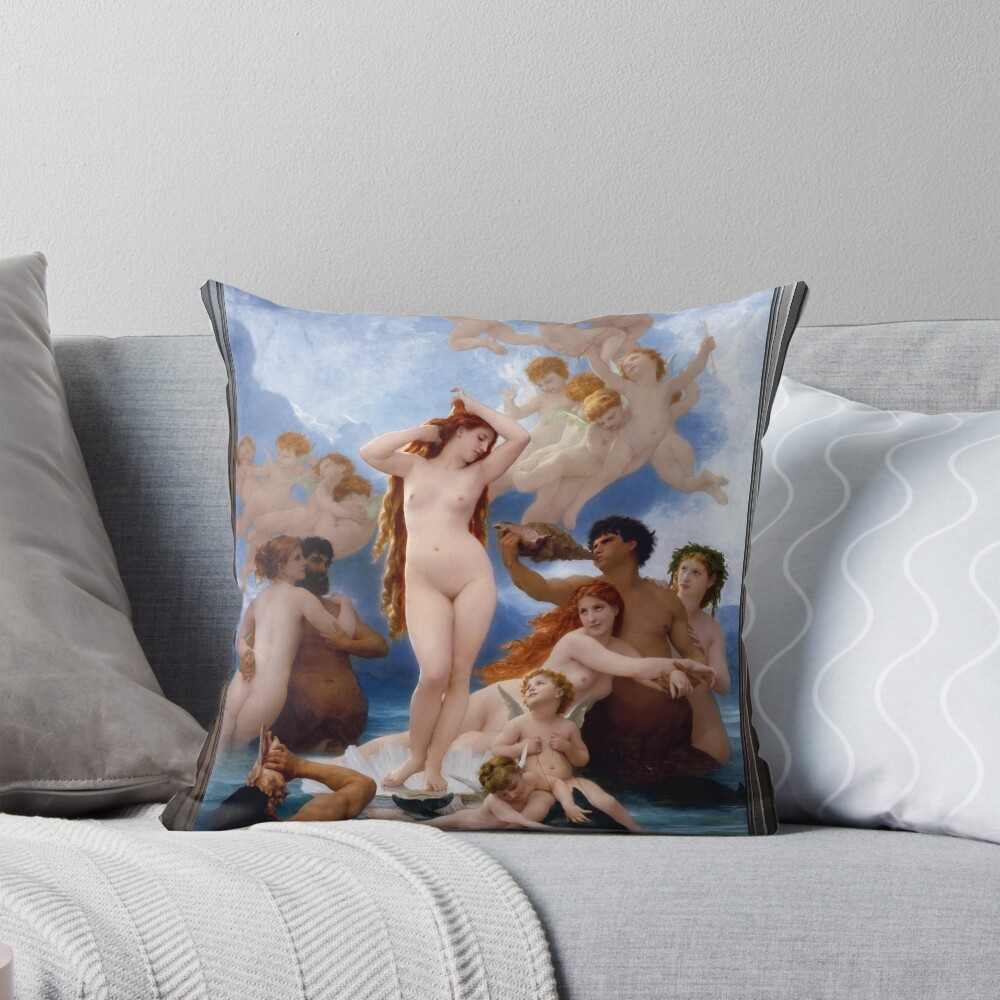
The color palette employed in “Venus 'fødsel” is predominantly soft and harmonious. Pale blues and greens dominate the seascape, creating a sense of tranquility and ethereal beauty. The sky is rendered with swirling clouds, suggesting a gentle breeze and an atmosphere of otherworldly calm. Venus’s skin tones are luminous, contrasting beautifully with her flowing auburn hair, which cascades down her shoulders in loose waves. The warm hues of the flesh tones are balanced by the cooler colors of the surrounding environment, creating a visually pleasing contrast that draws attention to the central figure. Bouguereau masterfully uses light and shadow to create depth and volume, enhancing the overall sense of realism and beauty.
Symbolik & Classical Allusions
Beyond its aesthetic appeal, “Venus 'fødsel” is rich in symbolism and classical allusions. The scallop shell upon which Venus stands is a recurring motif associated with her birth in mythology – born from sea foam (Greek: aphros), hence her name Aphrodite. Zephyr and Chloris represent the gentle forces of nature that guide Venus’s arrival, while Hora symbolizes welcome and celebration. The floral garland offered by the nymph signifies beauty and fertility. These symbolic elements contribute to the painting’s overall meaning, reinforcing its connection to classical mythology and celebrating the goddess as a symbol of love, skønhed, and renewal.
Bouguereau’s Artistic Legacy & Academic Tradition
Bouguereau was a leading figure in the Academic art movement, which emphasized technical skill, idealized forms, and adherence to established artistic conventions. “Venus 'fødsel” exemplifies these principles perfectly. The painting’s popularity during its time reflects the public’s appreciation for classical themes and the mastery of traditional techniques. While later generations would critique Academic art for its perceived lack of originality and emotional depth, Bouguereau’s work remains admired for its technical brilliance and enduring beauty. “Venus 'fødsel” continues to captivate viewers with its serene atmosphere, idealized forms, and celebration of classical mythology. It stands as a testament to the power of artistic skill and the enduring appeal of timeless themes.
Kunstnerbio med høflighed Wikipedia.org
William-Adolphe Bouguereau blev født i La Rochelle, Frankrig, på 30 november 1825, ind i en familie af vin- og olivenoliehandlere.[4] Søn af Théodore Bouguereau (Født 1800) og Marie Bonnin (1804), kendt som Adeline, William blev opdraget som katolik. Han havde en ældre bror, Alfred, og en yngre søster, Marie (kendt som Hanna), der døde, da hun var syv.
Familien flyttede til Saint-Martin-de-Ré i 1832. En anden søskende blev født i 1834, Kitty. I en alder af 12, Bouguereau tog til Mortagne for at blive hos sin onkel Eugène, en præst og udviklede en kærlighed til naturen, religion og litteratur.
I 1839, han blev sendt for at studere for præstedømmet på et katolsk kollegium i Pons. Her blev han lært at tegne og male af Louis Sage, der havde studeret under Ingres. Bouguereau forlod modvilligt sine studier for at vende tilbage til sin familie, nu bosat i Bordeaux.
Der mødte han en lokal kunstner, Charles Marionneau, og begyndte på den kommunale skole for tegning og maling i november 1841. Bouguereau arbejdede også som butiksassistent, håndfarve litografier og lave små malerier, der blev gengivet ved hjælp af krolitografi.
Han var snart den bedste elev i sin klasse, og besluttede at blive kunstner i Paris. For at finansiere flytningen, han solgte portrætter - 33 olier på tre måneder. Alle var usignerede, og kun en er blevet sporet. Han ankom til Paris i alderen 20 i marts 1846.
Lighed før døden (Lighed før døden), 1848, olie på lærred, 141 × 269 cm (55.5 × 105.9 i), Orsay Museum, Paris. Lighed er Bouguereaus første store maleri, produceret efter to år på École des Beaux-Arts de Paris i en alder af 23.
Bouguereau blev student ved École des Beaux-Arts.[4] For at supplere sin formelle uddannelse i tegning, han deltog i anatomiske dissektioner og studerede historiske kostumer og arkæologi.
Han blev optaget i studiet af François-Édouard Picot, hvor han studerede maleri i den akademiske stil. Dante og Virgil i helvede (1850) var et tidligt eksempel på hans nyklassiske værker.
Akademisk maleri satte den højeste status på historiske og mytologiske emner, og Bouguereau besluttede at vinde Prix de Rome, hvilket ville give ham en treårig bopæl i Villa Medici i Rom, Italien, hvor han ud over formelle lektioner på egen hånd kunne studere renæssancekunstnerne og deres mesterværker, samt græsk, Etruskisk, og romerske antikviteter.
The Birth Of Venus is a retouched digital art old masters reproduction of a public domain image that is available online as a rullet lærred print.