

Breith Véineas: A Celebration of Classical Beauty
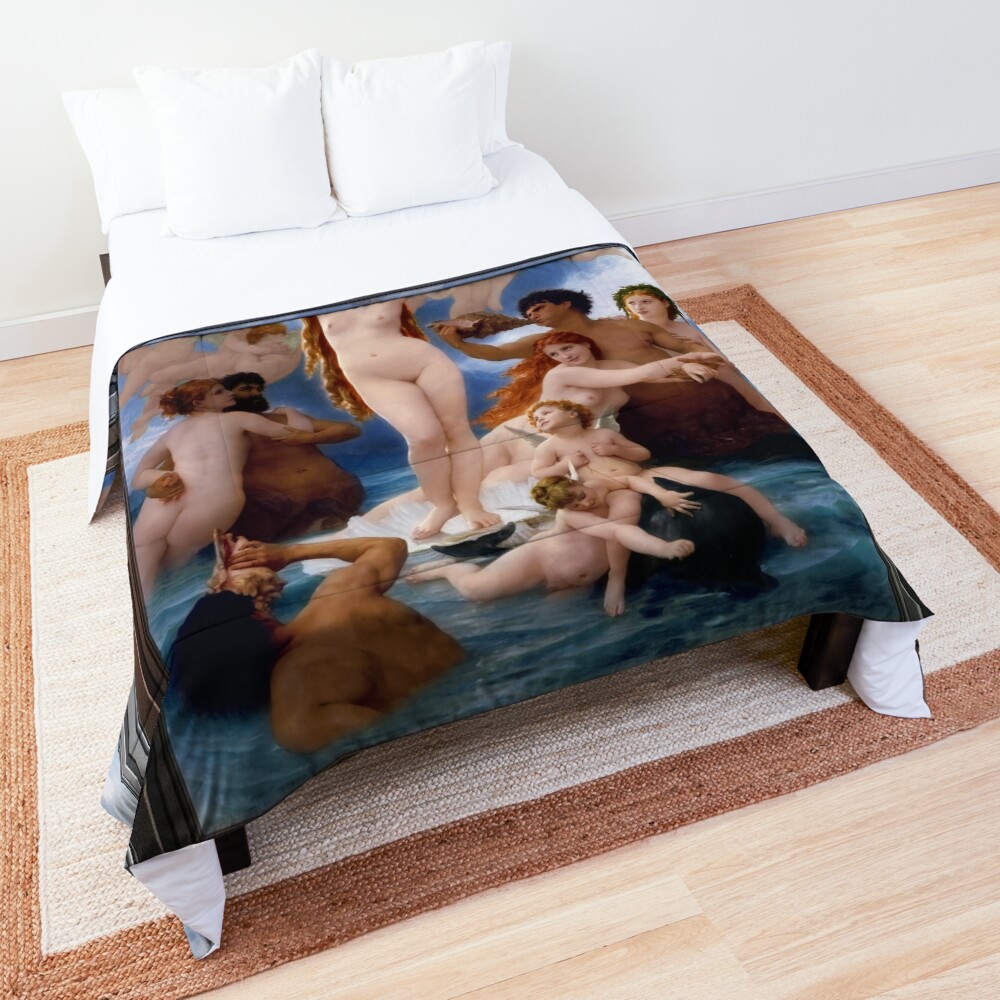
The Birth Of Venus c1879 by French Painter William-Adolphe Bouguereau (1825 – 1905), stands as a quintessential example of Academic art, embodying the principles of idealized beauty and technical mastery prevalent in mid-19th century France. This large-scale oil painting draws heavily from classical mythology, depicting the arrival of the goddess Venus (Aphrodite to the Greeks) upon the shores of Cyprus. ach, Bouguereau’s interpretation is far removed from earlier depictions; instead of a dramatic or tempestuous emergence, he presents a scene of serene grace and gentle unfolding.
Clár na nÁbhar
Struchtúr Comhdhéanta & Sreabhadh Narrative
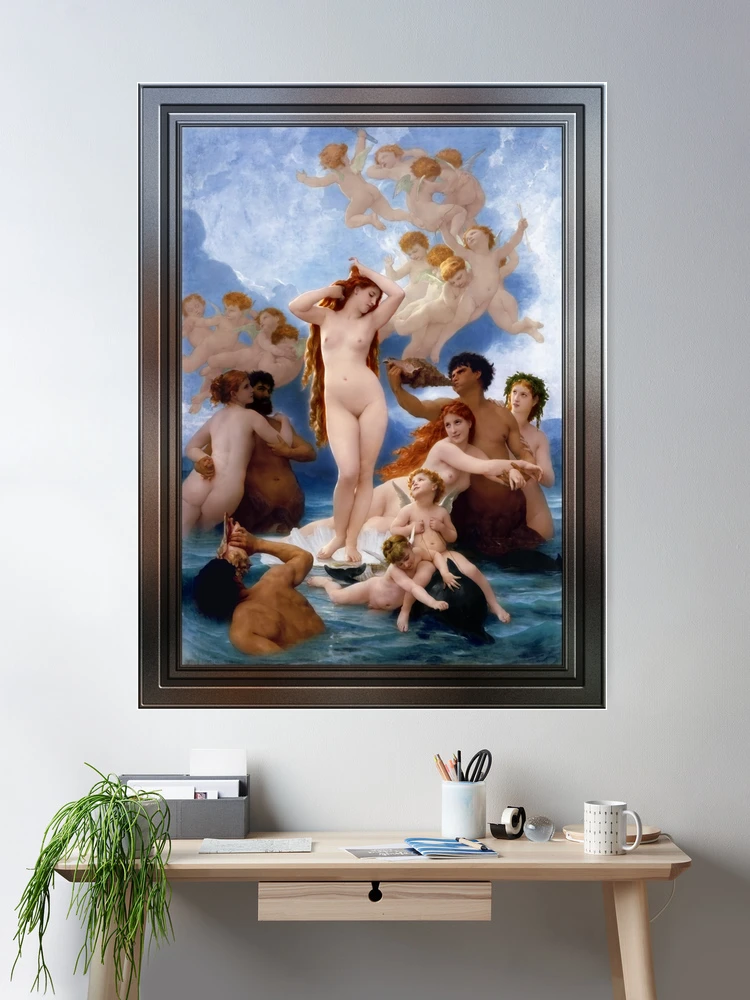
The composition is meticulously structured around Venus herself, positioned centrally within the canvas. She stands upon a massive scallop shell, which serves as her floating pedestal, gently approaching the shoreline. The arrangement isn’t haphazard; it’s carefully orchestrated to guide the viewer’s eye. To her left, a figure representing Zephyr, the west wind, and his consort Chloris, blow Venus towards the shore, their bodies intertwined in a dynamic pose that conveys movement and gentle force. Ar dheis, a nymph, likely Hora, awaits with a floral garland, ready to welcome the goddess. The figures surrounding Venus are not merely decorative; they contribute to the narrative flow, illustrating the forces that brought her into being and the welcoming reception she receives.
Anatomical Precision & Idealized Form
Bouguereau’s reputation rested on his exceptional skill in depicting the human form with anatomical accuracy. I “Breith Véineas,” this is evident in every curve and contour of the figures. The bodies are rendered with a smooth, almost porcelain-like quality, showcasing an idealized beauty that adheres to classical standards. There’s no attempt at realism in the sense of portraying imperfections; ina ionad, Bouguereau elevates the human form to a state of perfect harmony and proportion. Venus’s pose is particularly striking – she stands with one foot slightly raised, creating a sense of poised elegance and effortless grace. The subtle modeling of her flesh, achieved through delicate gradations of light and shadow, further enhances the illusion of three-dimensionality and tactile realism.
Pailéad Dathanna & Éifeachtaí Atmaisféir
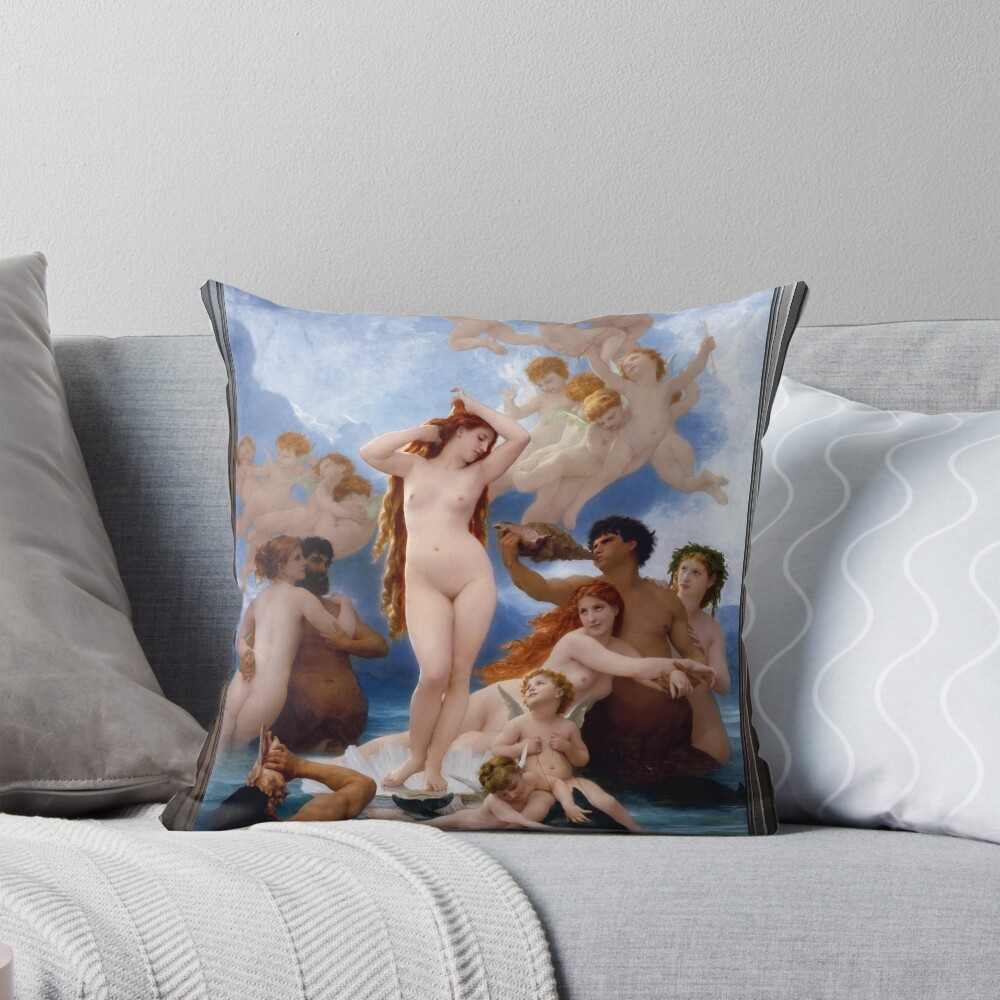
The color palette employed in “Breith Véineas” is predominantly soft and harmonious. Pale blues and greens dominate the seascape, creating a sense of tranquility and ethereal beauty. The sky is rendered with swirling clouds, suggesting a gentle breeze and an atmosphere of otherworldly calm. Venus’s skin tones are luminous, contrasting beautifully with her flowing auburn hair, which cascades down her shoulders in loose waves. The warm hues of the flesh tones are balanced by the cooler colors of the surrounding environment, creating a visually pleasing contrast that draws attention to the central figure. Bouguereau masterfully uses light and shadow to create depth and volume, enhancing the overall sense of realism and beauty.
siombalachas & Classical Allusions
Beyond its aesthetic appeal, “Breith Véineas” is rich in symbolism and classical allusions. The scallop shell upon which Venus stands is a recurring motif associated with her birth in mythology – born from sea foam (Greek: aphros), hence her name Aphrodite. Zephyr and Chloris represent the gentle forces of nature that guide Venus’s arrival, while Hora symbolizes welcome and celebration. The floral garland offered by the nymph signifies beauty and fertility. These symbolic elements contribute to the painting’s overall meaning, reinforcing its connection to classical mythology and celebrating the goddess as a symbol of love, áilleacht, agus athnuachan.
Bouguereau’s Artistic Legacy & Academic Tradition
Bouguereau was a leading figure in the Academic art movement, a leag béim ar scil theicniúil, idealized forms, and adherence to established artistic conventions. “Breith Véineas” exemplifies these principles perfectly. The painting’s popularity during its time reflects the public’s appreciation for classical themes and the mastery of traditional techniques. While later generations would critique Academic art for its perceived lack of originality and emotional depth, Bouguereau’s work remains admired for its technical brilliance and enduring beauty. “Breith Véineas” continues to captivate viewers with its serene atmosphere, idealized forms, and celebration of classical mythology. It stands as a testament to the power of artistic skill and the enduring appeal of timeless themes.
Ealaíontóir Bio cúirtéise Wikipedia.org
Rugadh William-Adolphe Bouguereau i La Rochelle, An Fhrainc, ar 30 Samhain 1825, isteach i dteaghlach ceannaithe fíona agus ola olóige.[4] Mac Théodore Bouguereau (rugadh é 1800) agus Marie Bonnin (1804), ar a dtugtar Adeline, Caitliceach a tógadh William. Bhí deartháir níos sine aige, Alfred, agus deirfiúr níos óige, Marie (ar a dtugtar Hanna), a fuair bás nuair a bhí sí seacht.
Bhog an teaghlach go Saint-Martin-de-Ré i 1832. Rugadh siblín eile i 1834, Kitty. Ag aois 12, Chuaigh Bouguereau go Mortagne chun fanacht lena uncail Eugène, sagart agus d’fhorbair sé grá don dúlra, reiligiún agus litríocht.
I 1839, cuireadh chun staidéir don tsagartacht é i gcoláiste Caitliceach i Pons. Anseo mhúin Louis Sage é a tharraingt agus a phéinteáil, a bhí tar éis staidéar a dhéanamh faoi Ingres. D’fhág Bouguereau go drogallach a chuid staidéir chun filleadh ar a theaghlach, ina gcónaí anois i Bordeaux.
Ansin bhuail sé le healaíontóir áitiúil, Charles Marionneau, agus cuireadh tús leis sa Scoil Bardasach Líníochta agus Péinteála i mí na Samhna 1841. D'oibrigh Bouguereau mar chúntóir siopa freisin, lithographs a dhathú le lámh agus pictiúir bheaga a dhéanamh a atáirgeadh ag úsáid crómatagrafaíochta.
Ba ghearr go raibh sé ar an dalta ab fhearr ina rang, agus shocraigh sé a bheith ina ealaíontóir i bPáras. Chun an t-aistriú a mhaoiniú, dhíol sé portráidí - 33 olaí i dtrí mhí. Níor síníodh gach ceann acu agus níor rianaíodh ach ceann amháin. Tháinig sé go Páras in aois 20 i mí an Mhárta 1846.
Comhionannas roimh bhás (Comhionannas Roimh Bhás), 1848, ola ar chanbhás, 141 × 269 cm (55.5 × 105.9 in), Músaem Orsay, Páras. Is é an comhionannas an chéad phéintéireacht mhór ag Bouguereau, a táirgeadh tar éis dhá bhliain ag an École des Beaux-Arts de Paris ag aois a 23.
Tháinig Bouguereau mar mhac léinn ag an École des Beaux-Arts.[4] Chun cur lena oiliúint fhoirmiúil i líníocht, d’fhreastail sé ar dhíscaoilte anatamaíocha agus rinne sé staidéar ar fheistis stairiúla agus ar sheandálaíocht.
Glacadh leis i stiúideo François-Édouard Picot, áit a ndearna sé staidéar ar phéintéireacht sa stíl acadúil. Dante agus Virgil i Ifreann (1850) sampla luath dá shaothair nua-chlasaiceacha.
Chuir péintéireacht acadúil an stádas is airde ar ábhair stairiúla agus mhiotaseolaíochta, agus bheartaigh Bouguereau an Prix de Rome a bhuachan, a gheobhadh áit chónaithe trí bliana dó sa Villa Medici sa Róimh, An Iodáil, áit i dteannta le ceachtanna foirmiúla d’fhéadfadh sé staidéar pearsanta a dhéanamh ar ealaíontóirí an Renaissance agus a gcuid sárshaothair, chomh maith leis an nGréigis, Etruscan, agus seaniarsmaí Rómhánacha.
The Birth Of Venus is a retouched digital art old masters reproduction of a public domain image that is available online as a priontáil chanbhás rollta.