

The Bookworm c1851
“El Bookworm,” pintat a 1851 by the German painter Carl Spitzweg (1808 – 1885), is one of the finest examples of the genre of Romanticism with a touch of humor, encant, and intellectual depth. He is considered to be one of the most important artist of the Biedermeier (1815 – 1848) era.
This painting captures a moment in time when the subject, a scholarly, solitary man, engrosses himself in the world of books. Known for his keen sense of humor and detailed renderings of everyday life, Spitzweg’s works often feature individuals absorbed in their passions, isolated from the hustle and bustle of society. En “The Bookworm,” the artist explores the life of a learned man whose dedication to literature has led him to a state of both mental and physical entrapment within the pages of his books.
Taula de continguts
Tema principal: The Bookworm
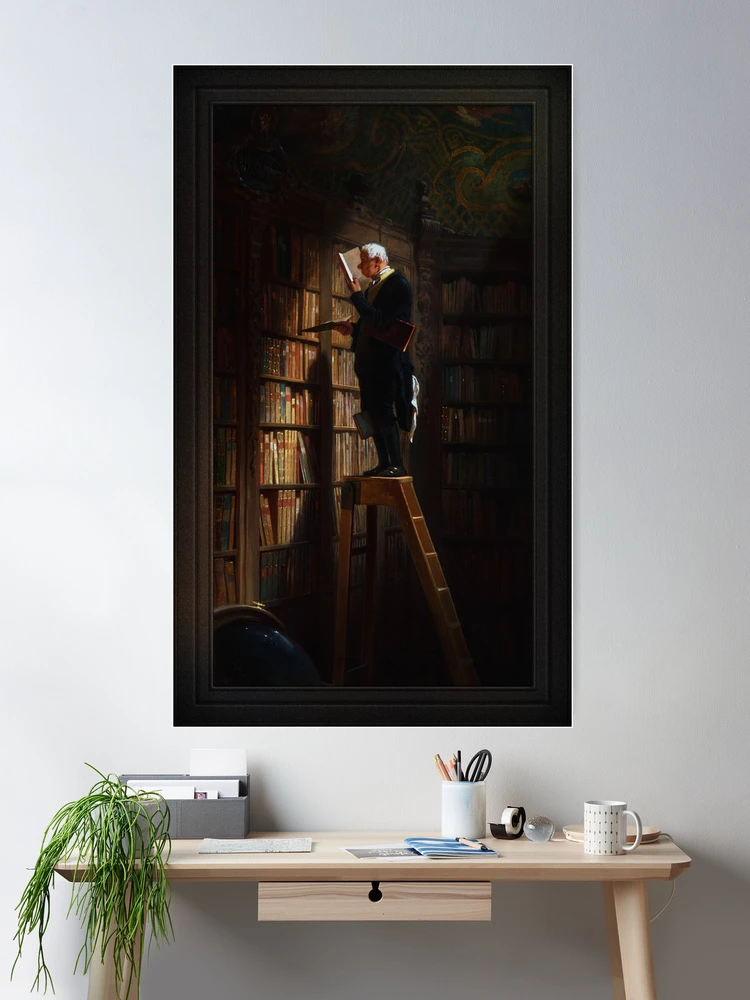
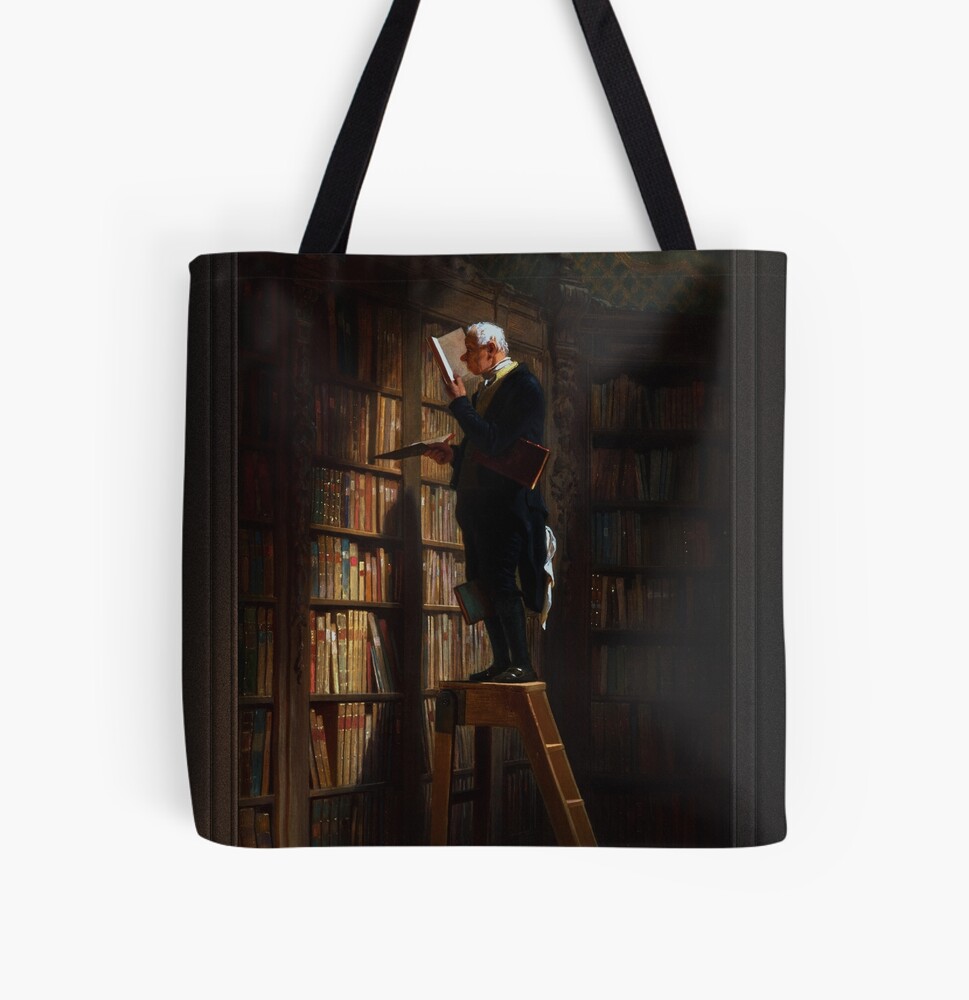
The central figure of the artwork is a middle-aged man, likely a scholar or a book collector, dressed in formal, albeit somewhat outdated attire. He stands precariously on a wooden step ladder, engrossed in a book he holds with both hands, raised to his face as if he’s reading intently.
The man’s countenance is solemn, his expression distant, suggesting deep concentration and perhaps a detachment from his immediate surroundings. His graying hair and the faint wrinkles on his face indicate an individual who has spent many years in the pursuit of knowledge.
This solitary figure, characterized by his quiet immersion in literature, is the epitome of intellectual passion. Despite the apparent chaos of his surroundings, bookshelves stacked to the ceiling with what seems to be an overwhelming number of books, the figure remains calm, focusing entirely on his current reading. This tension between the man’s orderliness and the overwhelming disorder of the books around him speaks to the paradox of human curiosity: the more we seek to know, the more we are confronted with the vastness of the unknown.
Objectes i ambientació
The scene is set in a massive, ornate library, with towering bookshelves that stretch from the floor to the ceiling. The bookshelves are densely packed, revealing the wealth of knowledge contained within them. The books themselves are old and slightly worn, a testament to their age and the passage of time.
Their colors range from faded browns and reds to ochres and golds, creant un calor, almost sepia-toned atmosphere. The endless rows of books create an impression of abundance, but also a sense of claustrophobia, with no room left for anything else in the small, cramped space.
The ladders, which are the main piece of furniture in the room, symbolize both the physical and intellectual ascent that one must undertake to acquire knowledge. The man is positioned near the top of the ladder, suggesting that he is in the process of reaching higher levels of understanding or perhaps digging deeper into the depths of intellectual pursuit.
His precarious perch on the ladder, with one hand clutching the book and the other steadying himself on the rung, symbolizes the balance that must be maintained between physical existence and intellectual endeavor.
Around the man, objects like a globe and a small table with scattered books further emphasize the scholarly environment. The globe, though subtly placed in the foreground, suggests the broader world outside the library, a world that remains distant to the man, who is entirely absorbed in the pursuit of knowledge.
The lighting in the scene is also worth noting, suau i càlid, casting gentle shadows and highlighting the man’s figure and the shelves of books behind him. This use of light adds a dreamlike quality to the scene, evoking a sense of nostalgia for a time when intellectual pursuits were highly revered.
Estil i tècnica
Carl Spitzweg’s style is characterized by fine attention to detail, a warm color palette, and a subtle use of light to create mood. En “The Bookworm,” the technique is highly refined, amb pinzellades delicades que creen textura i profunditat. Els plecs de la roba de l'home estan meticulosament rendits, i els llibres de les prestatgeries es representen amb un realisme que convida l'espectador a imaginar-se allargar-los i tocar-los.. La capacitat de Spitzweg per capturar l'essència dels seus temes, ja sigui per la seva aparença o pel seu entorn, dóna a la pintura una sensació d'intimitat i una visió de la vida del personatge.
El suau joc de llums i ombres a la pintura confereix a la peça una qualitat gairebé teatral. La resplendor de la llum sembla centrar-se en l'home, elevant el seu compromís solitari amb els seus llibres al centre de la narració. Aquest ús de la llum contrasta amb la foscor de la biblioteca circumdant, which is dimly lit except for the areas immediately around the scholar. This not only draws the viewer’s attention to the figure but also symbolizes how knowledge, though often surrounded by uncertainty and obscurity, can shine a light in the darkness.
Tema i estat d’ànim
The dominant theme of “The Bookworm” is intellectual pursuit and the solitary nature of scholarly life. The painting captures a moment where the subject has isolated himself in pursuit of knowledge, his environment becoming cluttered and chaotic as a result of his obsession.
The library, a symbol of wealth in information, becomes a physical manifestation of the scholar’s intellectual journey. As the man climbs the ladder, surrounded by a mountain of books, his focus on the written word suggests that he is lost in a never-ending quest for learning, una que el porta a cotes cada cop més precàries.
L'estat d'ànim de la pintura és alhora contemplatiu i lleugerament humorístic. Mentre que l'expressió seriosa del subjecte transmet un profund compromís amb els seus estudis, les aclaparadores piles de llibres i l'espai reduït evoquen la sensació de l'absurd d'una recerca així.
L'aïllament físic de la figura en el vast, La biblioteca excessivament farcida convida a reflexionar sobre la relació entre la solitud i la passió intel·lectual, i el cost potencial d'una set insaciable de coneixement.
Al mateix temps, l'escena porta una calor subtil, com els tons càlids dels llibres, la il·luminació, i la roba de l'home afegeix una sensació de comoditat i intimitat a l'entorn aïllat. Malgrat la seva existència solitària, l'espectador sent que l'erudit troba una gran alegria i realització en la recerca del coneixement, suggerint que la vida intel·lectual, mentre és solitari, també pot ser immensament gratificant.
Conclusió
“The Bookworm” de Carl Spitzweg és una representació magistral de la devoció intel·lectual, combinant l'humor amb la serietat de les activitats erudites. A través del seu estil detallat i expressiu, Spitzweg convida l'espectador a reflexionar sobre la condició humana, les alegries i els perills de buscar coneixement, i l'equilibri entre l'ambició intel·lectual i el benestar personal. El quadre es troba en una biblioteca plena de gent, la posició solitària de l'estudiós, i el tema d'una recerca interminable de comprensió s'uneixen per crear una obra que sorprengui visualment i estimula intel·lectualment..
Additional Info About The Artwork
This is the second of three version of this piece that he created; the first being done in 1850. With this second version having more dynamic shadows and lighting as the book worm stands on a rolling ladder reading through different books he has in in hands, between his legs and underneath his left arm. The third version is believed to have been painted in 1854 and is currently in a private collection.
The Bookworm is a retouched digital art old masters reproduction of a public domain image.
Artista Bio
Informació a continuació de Wikipedia.org
Spitzweg was born in Unterpfaffenhofen, near Munich, Baviera, the second of three sons of Franziska (née Schmutzer) and Simon Spitzweg. El seu pare, a wealthy merchant, had Carl trained as a pharmacist. He attained his qualification from the University of Munich but, while recovering from an illness, he took up painting.
Spitzweg va ser autodidacta com a artista, començant per copiar les obres dels mestres flamencs. Va col·laborar amb el seu primer treball a revistes satíriques. En rebre l'herència a 1833, va poder dedicar-se a la pintura.
Més tard, Spitzweg va visitar centres d'art europeus a Praga, Venècia, París, Londres, i Bèlgica estudiant les obres de diversos artistes i perfeccionant la seva tècnica i estil. Les seves pintures i dibuixos posteriors són sovint obres de gènere humorístic. Moltes de les seves pintures representen excèntrics marcadament caracteritzats, per exemple The Bookworm (1850) i L'Hipocondríac (c. 1865, a la Neue Pinakothek, Munic).