

El Petó

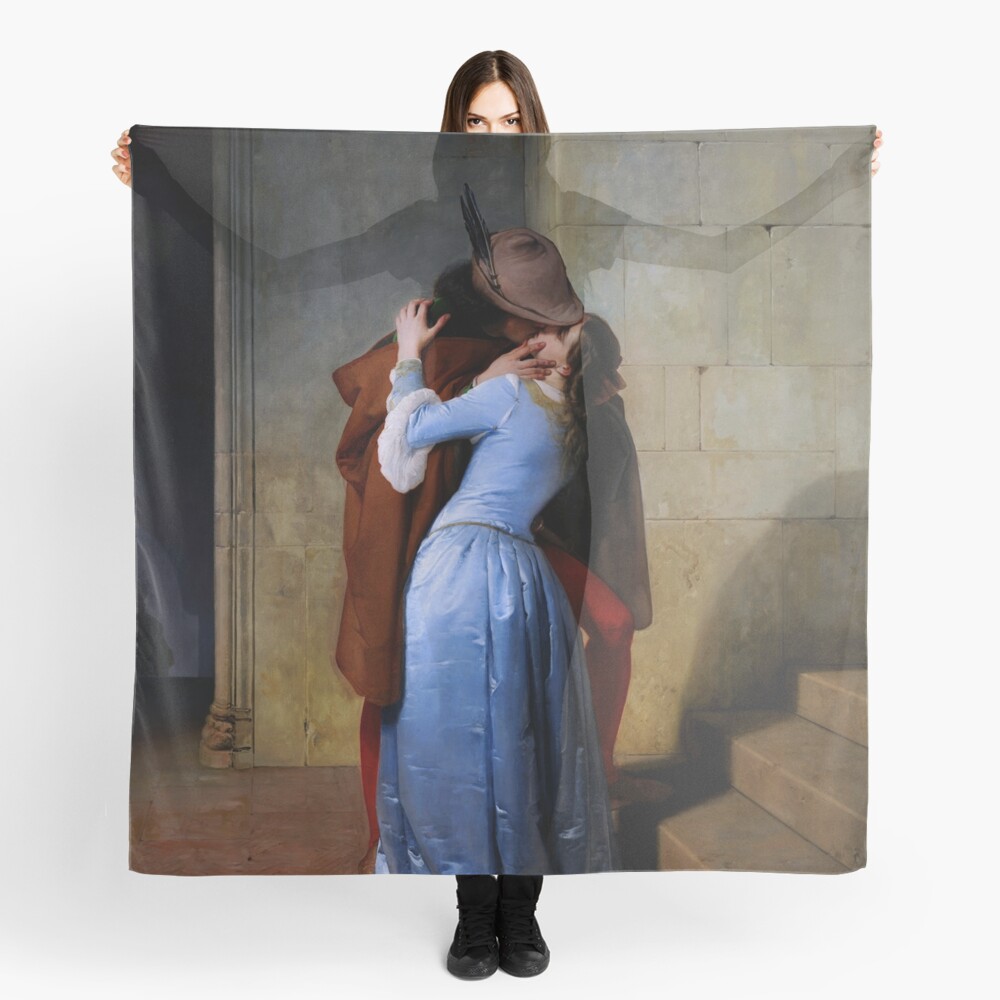
El Petó (El Beso) c1859 by Italian Painter Francesco Hayez (1791 – 1882); Va ser considerat com el pintor principal del període del Romanticisme a mitjans del segle XIX a Milà, Itàlia. Era conegut per les seves grans pintures històriques, al·legories polítiques i retrats excepcionals.
“El Kiss” is a powerful and evocative painting by the renowned Italian artist Francesco Hayez, creat a 1859. The artwork is a stunning example of Romanticism, a movement that was characterized by an emphasis on intense emotion, individualisme, I el sublim. Hayez’s portrayal of an intimate and passionate kiss between two figures is not just a romantic gesture but a deep, symbolic act reflecting the political and social turmoil of 19th-century Italy.
En aquesta peça, the central focus is the kiss shared between a man and a woman, each dressed in period-specific attire, their bodies entwined in a tender yet fervent embrace. The lovers’ faces, captured at the moment of their kiss, convey an overwhelming sense of passion and longing. L'home, dressed in a reddish-brown cloak, holds the woman with one hand, while his other hand grips a green object, possibly symbolizing life or hope. His face is partially obscured by his hat, but the tension in his posture reveals both his deep affection for the woman and the sense of urgency that seems to pervade the scene.
La dona, clothed in a flowing blue gown, stands close to him, her body pressed against his in a stance that signifies emotional and physical closeness. La seva llarga, flowing hair is partially visible, her face bathed in the soft light that seems to emanate from the left, highlighting her delicate features. The deep emotional intensity in her expression, coupled with the almost sacred nature of the kiss, suggests that this moment is one of profound importance for both characters. The sensuality of the kiss is palpable, yet it is underscored by a sense of melancholy, as if this act of love must be performed in secrecy, or perhaps as a final farewell.
The setting of the artwork is crucial to understanding the deeper layers of its meaning. The scene takes place in an open, stone-walled interior, with towering, almost monolithic walls that loom over the lovers. These walls are not merely a backdrop but symbolize the oppression and constraints of the era, particularly in the context of Italy’s political situation. The rough, unfinished stone surfaces hint at a time of transition and struggle.
The archway in the background frames the lovers, emphasizing their isolation in the moment and their vulnerability to the outside world. The positioning of the couple in front of the stone walls may also allude to the notion of love as a fortress in a time of uncertainty or political strife, where their embrace provides a form of protection from the harsh reality beyond.
The colors in the painting are rich and symbolic. The warm tones of the man’s cloak contrast with the cooler blues and whites of the woman’s gown, signifying a balance between opposing forces—passion and purity, action and passivity. The use of light is also notable; the couple is illuminated from one side, casting shadows on their bodies and the environment around them. This creates a sense of intimacy and draws the viewer’s attention solely to the couple, ensuring that the emotional intensity of their embrace remains the focal point of the composition.
Pel que fa als materials, the painting is executed with oil on canvas, a traditional medium that allows Hayez to achieve a remarkable level of detail and depth in his figures and surroundings. The texture of the canvas is almost palpable, with the brushstrokes contributing to the tactile nature of the painting. The artist’s skillful manipulation of light and shadow gives the piece a three-dimensional quality, making it feel as though the viewer could step into the scene and experience the emotional weight of the kiss firsthand.
The overall theme of “El Petó” is one of passion, defiance, and longing. The moment captured is not simply a tender exchange between two lovers; it is an act of rebellion and a declaration of love against the backdrop of an oppressive society. At the time Hayez painted this work, Italy was undergoing significant political upheaval, as various regions were striving for unification and freedom from foreign domination.

The kiss, llavors, can be seen as a metaphor for the struggle for independence, with the lovers representing the spirit of resistance and the hope for a brighter, freer future. The kiss is not just an emotional act but a political statement, an expression of the deep desire for change that resonated with the people of Italy during the Romantic period.
The mood of the painting is complex and multi-layered. While it captures the intense passion of the lovers, it also evokes a sense of sorrow and longing. The lovers are caught in a moment of transcendence, but there is a sense that this moment is fleeting.
The raw emotion conveyed through their embrace suggests that their love is either forbidden or destined to end, making the act of kissing both a sweet and painful experience. The viewer is left to ponder whether the kiss signifies the beginning of a relationship, a final farewell, or a stolen moment in a turbulent world.
En conclusió, Francesco Hayez’s “El Petó” is not just a beautiful depiction of love and romance; it is a rich, symbolic painting that speaks to the political, social, and emotional climate of its time. The work’s exquisite use of light, color, i composició, combined with its deep thematic resonance, makes it a timeless masterpiece that continues to captivate viewers. It invites reflection on the nature of love, the power of passion, and the struggles that shape our world, all while celebrating the profound connection between two individuals caught in the midst of history.
The Kiss is a retouched digital art old masters reproduction of a public domain image that is available as an acrylic, metall, fusta, rolled and Impressió de tela en línia.
Informació a continuació de Wikipedia.org
Francesco Hayez era d'una família relativament pobra de Venècia. El seu pare, Giovanni, era d'origen francès mentre la seva mare, Chiara Torcella, era de Murano. Francesco era el petit de cinc fills.
Va ser criat per la germana de la seva mare, que s'havia casat amb Giovanni Binasco, un armador acomodat i col·leccionista d'art. Hayez va mostrar una predisposició per dibuixar des de la infància. El seu oncle, havent notat el seu talent precoç, el va fer aprenent d'un restaurador d'art a Venècia. Més tard, Hayez esdevindrà alumne del pintor Francesco Maggiotto amb qui va continuar els seus estudis durant tres anys..
Va ser admès al curs de pintura de la Nova Acadèmia de Belles Arts de Venècia 1806, on va estudiar amb Teodoro Matteini. En 1809 va guanyar un concurs de l'Acadèmia de Venècia per a una residència d'un any a l'Accademia di San Luca de Roma.
Va romandre a Roma fins a 1814, després es va traslladar a Nàpols, on va rebre l'encàrrec de Joachim Murat de pintar una obra important que representés Ulisses a la cort d'Alcino.. A mitjan dècada de 1830 va assistir al Saló Maffei de Milà, a càrrec de Clara Maffei. El marit de Maffei més tard encarregaria a Hayez un retrat de la seva dona. En 1850 Hayez va ser nomenat director de l'Acadèmia Brera.
Al llarg d’una llarga carrera, Hayez va demostrar ser particularment prolífic. La seva producció va incloure pintures històriques dissenyades per atreure la sensibilitat patriòtica dels seus patrons, així com obres que reflecteixen el desig d’acompanyar un estil neoclàssic als grans temes., ja sigui de literatura bíblica o clàssica.
També va pintar escenes de presentacions teatrals. Consistentment absent de la seva obra, malgrat això, són retaules – possiblement a causa de les invasions napoleòniques que van desconsacrar moltes esglésies i convents al nord d’Itàlia. L'historiador de l'art Corrado Ricci va descriure Hayez com un classicista que després va evolucionar cap a un estil de tumult emocional. Francesco Hayez, El Petó (1859)
Els seus retrats tenen la intensitat d'Ingres i del moviment natzarè. Sovint assegut, Els súbdits de Hayez solen vestir-se d'austeritat, roba en blanc i negre, amb poc o cap equipament. Mentre que Hayez feia retrats per a la noblesa, també va explorar altres temes com els companys artistes i músics. Al final de la seva carrera, se sap que va treballar amb fotografies.
Un dels temes preferits de Hayez era l’dalisca semi vestit que evocava temes orientals, un tema preferit dels pintors romàntics.[3] Les representacions d’harems i les seves dones permetien als artistes la possibilitat de pintar escenes que d’altra manera no eren acceptables a la societat. Fins i tot la Maria Magdalena de Hayez té més sensualitat que fervor religiós.
La pintura de Hayez El petó va ser considerada una de les seves millors obres pels seus contemporanis, i és possiblement el seu esforç més conegut. L’anònim, el gest de la parella no afectat no requereix coneixement del mite ni de la literatura per interpretar, i apel·la a una mirada moderna.
Una avaluació científica de la carrera de Hayez s’ha complicat pel seu proclivisme per no signar ni datar les seves obres. Sovint les dates de les seves pintures indiquen quan es va adquirir o vendre l'obra, no el moment de la seva creació. A més, sovint pintava les mateixes composicions diverses vegades amb variacions mínimes, si n’hi havia cap.
Entre els seus alumnes de l'Acadèmia Brera hi havia Carlo Belgioioso, Amanzio Cattaneo, Alessandro Focosi, Giovanni Battista Lamperti, Ovelles Livo, Angelo Pietrasanta, Antonio Silo, Carlo Antonio Tavella, Ismaele Teglio Milla i Francesco Valaperta.
Hayez va morir a Milà, edat 91. El seu estudi a l'Acadèmia Brera està marcat amb un plat.