

The Bookworm c1851
“Det Bogorm,” malet i 1851 by the German painter Carl Spitzweg (1808 – 1885), is one of the finest examples of the genre of Romanticism with a touch of humor, charm, and intellectual depth. He is considered to be one of the most important artist of the Biedermeier (1815 – 1848) æra.
This painting captures a moment in time when the subject, a scholarly, solitary man, engrosses himself in the world of books. Known for his keen sense of humor and detailed renderings of everyday life, Spitzweg’s works often feature individuals absorbed in their passions, isolated from the hustle and bustle of society. I “The Bookworm,” the artist explores the life of a learned man whose dedication to literature has led him to a state of both mental and physical entrapment within the pages of his books.
Indholdsfortegnelse
Hovedemne: The Bookworm
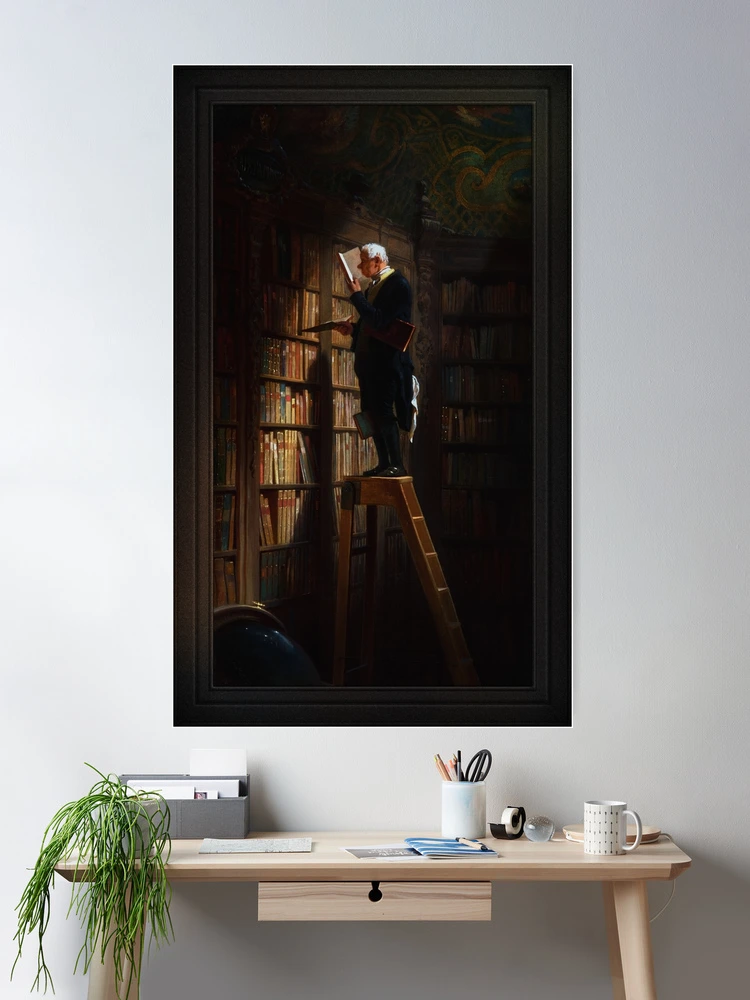
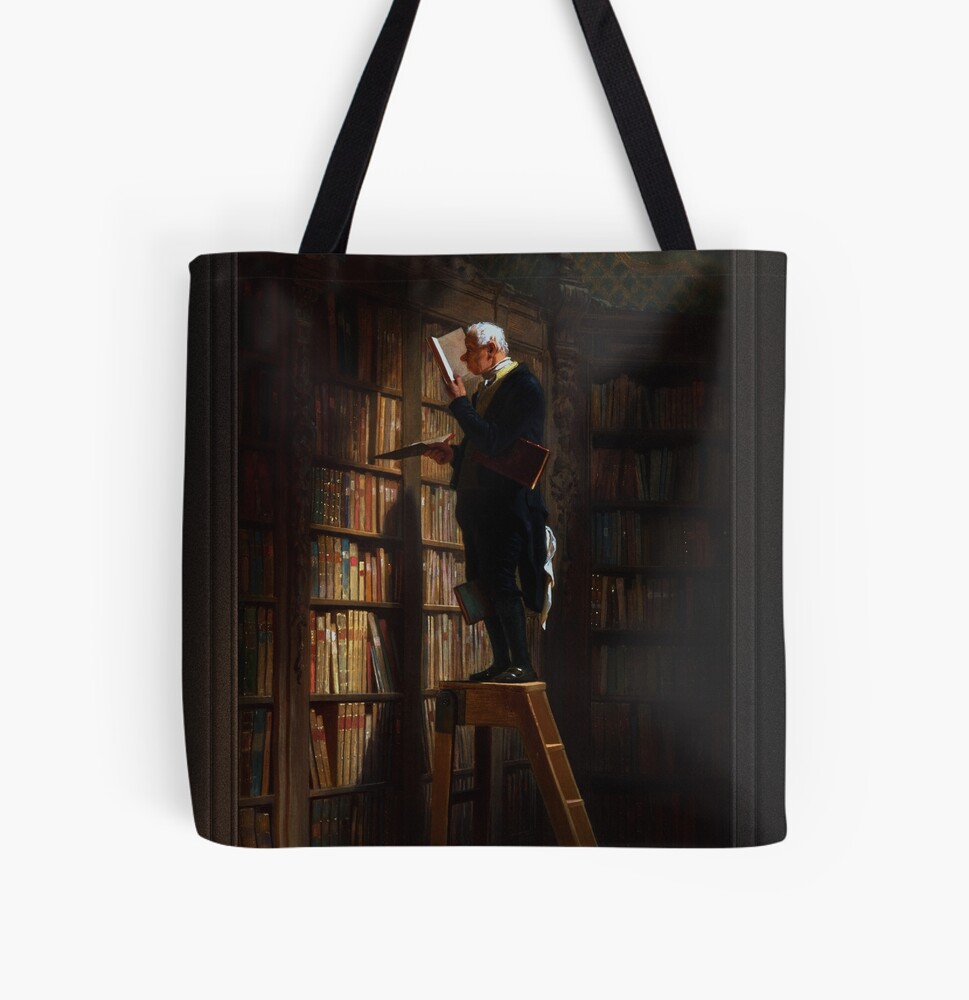
The central figure of the artwork is a middle-aged man, likely a scholar or a book collector, dressed in formal, albeit somewhat outdated attire. He stands precariously on a wooden step ladder, engrossed in a book he holds with both hands, raised to his face as if he’s reading intently.
The man’s countenance is solemn, his expression distant, suggesting deep concentration and perhaps a detachment from his immediate surroundings. His graying hair and the faint wrinkles on his face indicate an individual who has spent many years in the pursuit of knowledge.
This solitary figure, characterized by his quiet immersion in literature, is the epitome of intellectual passion. Despite the apparent chaos of his surroundings, bookshelves stacked to the ceiling with what seems to be an overwhelming number of books, the figure remains calm, focusing entirely on his current reading. This tension between the man’s orderliness and the overwhelming disorder of the books around him speaks to the paradox of human curiosity: the more we seek to know, the more we are confronted with the vastness of the unknown.
Objects and Setting
The scene is set in a massive, ornate library, with towering bookshelves that stretch from the floor to the ceiling. The bookshelves are densely packed, revealing the wealth of knowledge contained within them. The books themselves are old and slightly worn, a testament to their age and the passage of time.
Their colors range from faded browns and reds to ochres and golds, skabe en varm, almost sepia-toned atmosphere. The endless rows of books create an impression of abundance, but also a sense of claustrophobia, with no room left for anything else in the small, cramped space.
The ladders, which are the main piece of furniture in the room, symbolize both the physical and intellectual ascent that one must undertake to acquire knowledge. The man is positioned near the top of the ladder, suggesting that he is in the process of reaching higher levels of understanding or perhaps digging deeper into the depths of intellectual pursuit.
His precarious perch on the ladder, with one hand clutching the book and the other steadying himself on the rung, symbolizes the balance that must be maintained between physical existence and intellectual endeavor.
Around the man, objects like a globe and a small table with scattered books further emphasize the scholarly environment. The globe, though subtly placed in the foreground, suggests the broader world outside the library, a world that remains distant to the man, who is entirely absorbed in the pursuit of knowledge.
The lighting in the scene is also worth noting, soft and warm, casting gentle shadows and highlighting the man’s figure and the shelves of books behind him. This use of light adds a dreamlike quality to the scene, evoking a sense of nostalgia for a time when intellectual pursuits were highly revered.
Stil og teknik
Carl Spitzweg’s style is characterized by fine attention to detail, a warm color palette, and a subtle use of light to create mood. I “The Bookworm,” the technique is highly refined, with delicate brushstrokes that create texture and depth. The folds of the man’s clothing are meticulously rendered, and the books on the shelves are depicted with a realism that invites the viewer to imagine reaching out and touching them. Spitzweg’s ability to capture the essence of his subjects, whether through their appearance or through their environment, gives the painting a sense of intimacy and insight into the character’s life.
The soft interplay of light and shadow in the painting gives the piece an almost theatrical quality. The glow of the light seems to focus on the man, elevating his solitary engagement with his books to the center of the narrative. This use of light contrasts with the darkness of the surrounding library, which is dimly lit except for the areas immediately around the scholar. This not only draws the viewer’s attention to the figure but also symbolizes how knowledge, though often surrounded by uncertainty and obscurity, can shine a light in the darkness.
Tema og humør
The dominant theme of “The Bookworm” is intellectual pursuit and the solitary nature of scholarly life. The painting captures a moment where the subject has isolated himself in pursuit of knowledge, his environment becoming cluttered and chaotic as a result of his obsession.
The library, a symbol of wealth in information, becomes a physical manifestation of the scholar’s intellectual journey. As the man climbs the ladder, surrounded by a mountain of books, his focus on the written word suggests that he is lost in a never-ending quest for learning, one that leads him to increasingly precarious heights.
The mood of the painting is both contemplative and slightly humorous. While the subject’s serious expression conveys deep engagement with his studies, the overwhelming piles of books and the cramped space evoke a sense of the absurdity of such a pursuit.
The figure’s physical isolation in the vast, overstuffed library invites reflection on the relationship between solitude and intellectual passion, and the potential cost of an insatiable thirst for knowledge.
At the same time, the scene carries a subtle warmth, as the warm tones of the books, the lighting, and the man’s clothing add a sense of comfort and intimacy to the otherwise isolated setting. Despite his solitary existence, the viewer senses that the scholar finds great joy and fulfillment in the pursuit of knowledge, suggesting that the intellectual life, while solitary, can also be immensely rewarding.
Konklusion
“The Bookworm” by Carl Spitzweg is a masterful depiction of intellectual devotion, blending humor with the earnestness of scholarly pursuits. Through his detailed and expressive style, Spitzweg invites the viewer to reflect on the human condition, the joys and perils of seeking knowledge, and the balance between intellectual ambition and personal well-being. The painting’s setting in an overcrowded library, the scholar’s solitary position, and the theme of a never-ending quest for understanding all come together to create a work that is both visually striking and intellectually stimulating.
Additional Info About The Artwork
Dette er den anden af tre versioner af dette stykke, han skabte; det første bliver gjort i 1850. Med denne anden version med mere dynamiske skygger og belysning, da bogormen står på en rullende stige og læser gennem forskellige bøger, han har i hænderne, mellem hans ben og under hans venstre arm. Den tredje version menes at have været malet ind 1854 og er i øjeblikket i en privat samling.
Bogormen er en retoucheret digital kunst gamle mestre gengivelse af et offentligt image.
Kunstner Bio
Info nedenfor fra Wikipedia.org
Spitzweg blev født i Unterpfaffenhofen, nær München, Bayern, den anden af tre sønner af Franziska (f. Schmutzer) og Simon Spitzweg. Hans far, en velhavende købmand, havde Carl uddannet sig til farmaceut. Han opnåede sin uddannelse fra universitetet i München, men, mens han kom sig efter en sygdom, han begyndte at male.
Spitzweg var autodidakt som kunstner, startede med at kopiere flamske mestreværker. Han bidrog med sit første værk til satiriske blade. Ved modtagelse af en arv i 1833, han var i stand til at dedikere sig til at male.
Senere, Spitzweg besøgte europæiske kunstcentre i Prag, Venedig, Paris, London, og Belgien studerer forskellige kunstneres værker og forfiner hans teknik og stil. Hans senere malerier og tegninger er ofte humoristiske genreværker. Mange af hans malerier skildrer skarpt karakteriserede excentriker, for eksempel Bogormen (1850) og Hypokonderne (c. 1865, i Neue Pinakothek, München).