

Kysset

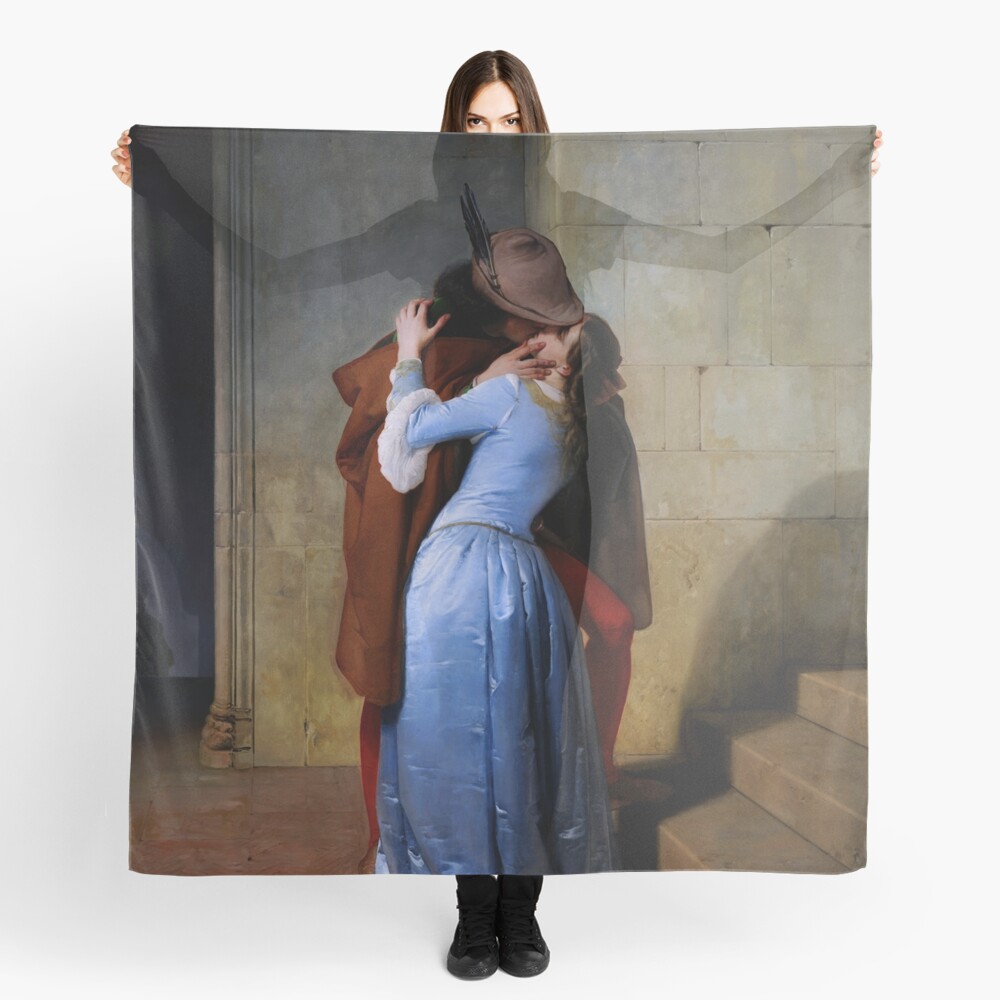
Kysset (El Beso) c1859 by Italian Painter Francesco Hayez (1791 – 1882); was viewed as the leading painter of the Romanticism Period in the mid 19th Century in Milan Italy. He was well known for his grand historical paintings, political allegories and exceptional fine portraits.
“Det Kiss” is a powerful and evocative painting by the renowned Italian artist Francesco Hayez, oprettet i 1859. The artwork is a stunning example of Romanticism, a movement that was characterized by an emphasis on intense emotion, individualisme, og det sublime. Hayez’s portrayal of an intimate and passionate kiss between two figures is not just a romantic gesture but a deep, symbolic act reflecting the political and social turmoil of 19th-century Italy.
I dette stykke, the central focus is the kiss shared between a man and a woman, each dressed in period-specific attire, their bodies entwined in a tender yet fervent embrace. The lovers’ ansigter, captured at the moment of their kiss, convey an overwhelming sense of passion and longing. The man, dressed in a reddish-brown cloak, holds the woman with one hand, while his other hand grips a green object, possibly symbolizing life or hope. His face is partially obscured by his hat, but the tension in his posture reveals both his deep affection for the woman and the sense of urgency that seems to pervade the scene.
Kvinden, clothed in a flowing blue gown, stands close to him, her body pressed against his in a stance that signifies emotional and physical closeness. Hendes lange, flowing hair is partially visible, her face bathed in the soft light that seems to emanate from the left, highlighting her delicate features. The deep emotional intensity in her expression, coupled with the almost sacred nature of the kiss, suggests that this moment is one of profound importance for both characters. The sensuality of the kiss is palpable, yet it is underscored by a sense of melancholy, as if this act of love must be performed in secrecy, or perhaps as a final farewell.
The setting of the artwork is crucial to understanding the deeper layers of its meaning. The scene takes place in an open, stone-walled interior, with towering, almost monolithic walls that loom over the lovers. These walls are not merely a backdrop but symbolize the oppression and constraints of the era, particularly in the context of Italy’s political situation. The rough, unfinished stone surfaces hint at a time of transition and struggle.
The archway in the background frames the lovers, emphasizing their isolation in the moment and their vulnerability to the outside world. The positioning of the couple in front of the stone walls may also allude to the notion of love as a fortress in a time of uncertainty or political strife, where their embrace provides a form of protection from the harsh reality beyond.
The colors in the painting are rich and symbolic. The warm tones of the man’s cloak contrast with the cooler blues and whites of the woman’s gown, signifying a balance between opposing forces—passion and purity, action and passivity. The use of light is also notable; the couple is illuminated from one side, casting shadows on their bodies and the environment around them. This creates a sense of intimacy and draws the viewer’s attention solely to the couple, ensuring that the emotional intensity of their embrace remains the focal point of the composition.
In terms of materials, the painting is executed with oil on canvas, a traditional medium that allows Hayez to achieve a remarkable level of detail and depth in his figures and surroundings. The texture of the canvas is almost palpable, with the brushstrokes contributing to the tactile nature of the painting. The artist’s skillful manipulation of light and shadow gives the piece a three-dimensional quality, making it feel as though the viewer could step into the scene and experience the emotional weight of the kiss firsthand.
The overall theme of “Kysset” is one of passion, defiance, og længsel. The moment captured is not simply a tender exchange between two lovers; it is an act of rebellion and a declaration of love against the backdrop of an oppressive society. At the time Hayez painted this work, Italy was undergoing significant political upheaval, as various regions were striving for unification and freedom from foreign domination.

The kiss, derefter, can be seen as a metaphor for the struggle for independence, with the lovers representing the spirit of resistance and the hope for a brighter, freer future. The kiss is not just an emotional act but a political statement, an expression of the deep desire for change that resonated with the people of Italy during the Romantic period.
The mood of the painting is complex and multi-layered. While it captures the intense passion of the lovers, it also evokes a sense of sorrow and longing. The lovers are caught in a moment of transcendence, but there is a sense that this moment is fleeting.
The raw emotion conveyed through their embrace suggests that their love is either forbidden or destined to end, making the act of kissing both a sweet and painful experience. The viewer is left to ponder whether the kiss signifies the beginning of a relationship, a final farewell, or a stolen moment in a turbulent world.
Afslutningsvis, Francesco Hayez’s “Kysset” is not just a beautiful depiction of love and romance; it is a rich, symbolic painting that speaks to the political, social, and emotional climate of its time. The work’s exquisite use of light, farve, og sammensætning, combined with its deep thematic resonance, makes it a timeless masterpiece that continues to captivate viewers. It invites reflection on the nature of love, the power of passion, and the struggles that shape our world, all while celebrating the profound connection between two individuals caught in the midst of history.
The Kiss is a retouched digital art old masters reproduction of a public domain image that is available as an acrylic, metal, træ, rolled and lærred print online.
Info nedenfor fra Wikipedia.org
Francesco Hayez var fra en relativt fattig familie fra Venedig. Hans far, Giovanni, var af fransk oprindelse, mens hans mor, Chiara Torcella, var fra Murano. Francesco var den yngste af fem sønner.
Han blev opdraget af sin mors søster, der havde giftet sig med Giovanni Binasco, en velhavende skibsreder og kunstsamler. Hayez viste en disposition for at tegne siden barndommen. Hans onkel, efter at have lagt mærke til hans tidlige talent, lærte ham til en kunstgenopretter i Venedig. Hayez blev senere elev af maleren Francesco Maggiotto, som han fortsatte sine studier med i tre år.
Han blev optaget på malerkurset på Det Nye Kunstakademi i Venedig i 1806, hvor han studerede under Teodoro Matteini. I 1809 han vandt en konkurrence fra Akademiet i Venedig om et års ophold på Accademia di San Luca i Rom.
Han blev i Rom indtil 1814, flyttede derefter til Napoli, hvor han blev bestilt af Joachim Murat til at male et større værk, der forestiller Ulysses ved hoffet i Alcinous. I midten af 1830'erne deltog han i Maffei-salonen i Milano, vært af Clara Maffei. Maffeis mand ville senere bestilte Hayez et portræt af sin kone. I 1850 Hayez blev udnævnt til direktør for Brera Academy.
I løbet af en lang karriere, Hayez viste sig at være særlig produktiv. Hans produktion omfattede historiske malerier designet til at appellere til den patriotiske følsomhed hos hans lånere samt værker, der afspejlede ønsket om at ledsage en nyklassisk stil til store temaer, either from biblical or classical literature.
He also painted scenes from theatrical presentations. Conspicuously absent from his oeuvre, imidlertid, are altarpieces – possibly due to the Napoleonic invasions that deconsecrated many churches and convents in Northern Italy. Art historian Corrado Ricci described Hayez as a classicist who then evolved into a style of emotional tumult. Francesco Hayez, Kysset (1859)
His portraits have the intensity of Ingres and the Nazarene movement. Often sitting, Hayez’s subjects are often dressed in austere, black and white clothing, with little to no accoutrements. While Hayez made portraits for the nobility, he also explored other subjects like fellow artists and musicians. Late in his career, he is known to have worked using photographs.
Et af Hayez' yndlingstemaer var halvpåklædt Odalisque, der tænkte på orientalske temaer - et yndet emne for romantiske malere.[3] Afbildningerne af haremmer og deres kvinder gav kunstnere mulighed for at male scener, der ellers ikke var acceptable i samfundet. Selv Hayezs Maria Magdalene har mere sanselighed end religiøs glød.
Hayez' maleri Kysset blev betragtet som et af hans bedste værker af hans samtidige, og er muligvis hans mest kendte indsats. Den anonyme, upåvirket gestus af parret kræver ikke viden om myter eller litteratur at fortolke, og appellerer til et moderne blik.
En videnskabelig vurdering af Hayez' karriere er blevet kompliceret af hans tilbøjelighed til ikke at underskrive eller datere hans værker. Often dates in his paintings indicate when the work was acquired or sold, not the time of its creation. Desuden, he often painted the same compositions several times with minimal variations if any at all.
Among his pupils from the Brera Academy were Carlo Belgioioso, Amanzio Cattaneo, Alessandro Focosi, Giovanni Battista Lamperti, Livo Pecora, Angelo Pietrasanta, Antonio Silo, Carlo Antonio Tavella, Ismaele Teglio Milla and Francesco Valaperta.
Hayez died in Milan, age 91. His studio at the Brera Academy is marked with a plate.