

La hija de Herodías Salomé recibe la cabeza de Juan el Bautista
In the haunting engraving titled “La hija de Herodías; Salomé recibiendo la cabeza de Juan el Bautista,” created by the British engraver Thomas Holloway in 1798, we witness a pivotal moment drawn from the Bible, specifically Matthew 14:10-11. This stark and dramatic scene captures the tragic culmination of the beheading of John the Baptist.
Holloway’s meticulous craftsmanship evokes the emotional intensity and weight of the moment, blending both the grotesque and the regal. The engraving portrays Salome, the daughter of Herodias, holding the severed head of the prophet John, an act prompted by her mother’s desire for vengeance.
Tabla de contenido
The Main Subject and Theme
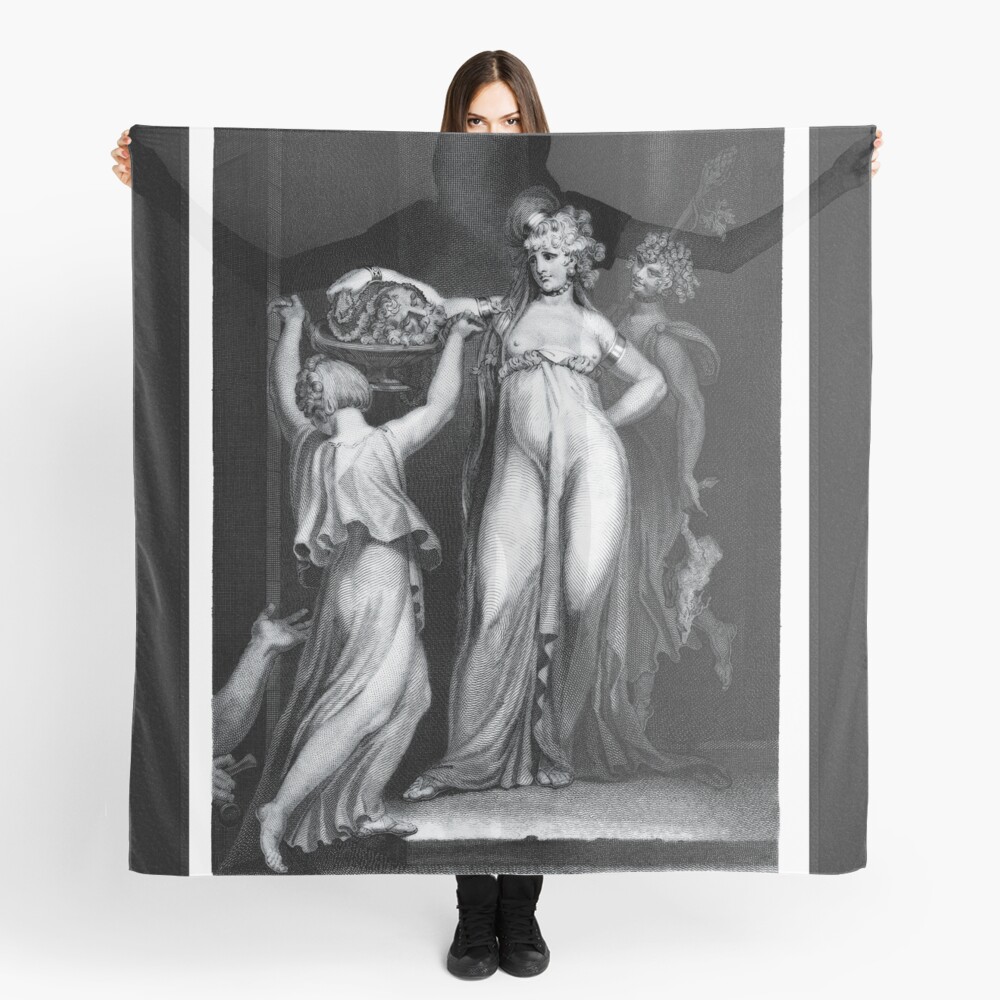
At the heart of Holloway’s engraving stands the female figure of Salome, her expression a curious mix of satisfaction and cold indifference as she receives the gruesome head of John the Baptist. Salome is depicted with long flowing hair, dressed in an elegant yet understated gown that flows to the floor. Her posture is poised, almost regal, despite the grim nature of the event. Her delicate yet firm grasp of the dish holding the severed head of John reflects the disturbing calmness of the scene.
The head of John the Baptist is eerily centered in the image, placed on a silver platter. His features are still discernible, though his eyes are shut in death, adding to the horror of the scene. His decapitated head is an unsettling contrast to the elegant appearance of the figures around it. Behind Salome stands a smaller male figure who seems to assist in the ceremonial transfer of the head, while another figure, draped in a flowing robe, completes the scene. These secondary characters underscore the ritualistic aspect of the narrative and their submission to the will of Herodias.
The theme of the artwork revolves around the notion of vengeance and betrayal, as well as the imbalance of power. Salome’s act is one of obedience to her mother, yet there is a calculated detachment in her demeanor that speaks to the complex emotional and moral implications of her actions. Holloway portrays the moment with an intensity that transcends the physical violence of the scene, offering viewers a glimpse into the darker realms of human nature and the consequences of unchecked power.
Materiales y técnica
Thomas Holloway’s engraving is a masterwork of the intaglio process, a technique that involves incising an image onto a surface, which is then inked and pressed onto paper to create an impression. This traditional method allows for remarkable detail and tonal gradation, and Holloway’s skillful use of light and shadow brings the composition to life. The texture of the engraving, from the intricate folds of Salome’s gown to the delicate portrayal of the severed head, exhibits an exceptional level of detail characteristic of the neoclassical era. The depth of emotion is underscored by the expert contrast between light and dark, which emphasizes the drama of the moment.
The image is rendered in black and white, a stark yet powerful choice that reinforces the gravity of the scene. The contrast between the white of Salome’s skin and gown and the deep shadows of the background lends an almost theatrical quality to the image. This use of chiaroscuro – the contrast between light and dark – is particularly effective in drawing attention to the central figures, allowing their expressions and poses to dominate the composition.
Escenario y objetos
The setting of the artwork is minimalistic but purposeful. The figures are placed in a semi-darkened space, hinting at a chamber or a palace, though no specific architectural details are given. This lack of specificity enhances the sense of timelessness, allowing the narrative to be universal rather than tied to a specific location or period. The dim lighting surrounding the figures suggests a scene shrouded in secrecy or ritual, contributing to the overall somber and foreboding mood of the piece.
The dish holding John the Baptist’s severed head is one of the most critical objects in the scene. Its presence is almost ceremonial, a stark juxtaposition of death and reverence. The head, severed from the body, conveys the brutality of the execution, yet the treatment of the dish elevates it to an almost sacred object, as though the head itself is now part of a macabre offering or tribute. The blood that would naturally accompany such an event is deliberately omitted from the image, making the scene even more surreal and unsettling. It is as though the severed head is merely a symbol of the act rather than a true representation of its grisly reality.
Estado de ánimo e impacto emocional
The overall mood of the engraving is one of darkness, suspense, and moral ambiguity. The cold detachment of Salome, juxtaposed with the violent symbolism of John the Baptist’s death, creates a tense atmosphere. The lack of empathy displayed by Salome in this moment, while her expression reveals no sign of remorse or distress, calls attention to the inhumanity that often accompanies the pursuit of power. Holloway masterfully captures the eerie calmness of the scene, leaving the viewer with an unsettling sense of foreboding.
The engraved figures are imbued with a quiet stillness, but it is a stillness laced with an undercurrent of violence and intrigue. The sense of detachment from the horror of the act may provoke discomfort in the viewer, challenging them to consider the cost of vengeance and the complex nature of moral judgment. Salome’s role as the instrument of her mother’s revenge places her at the intersection of innocence and guilt, and Holloway’s work invites contemplation of the consequences of blind obedience.
Conclusión
Thomas Holloway’s “La hija de Herodías; Salomé recibiendo la cabeza de Juan el Bautista” is a striking representation of a dark and tragic biblical moment. Through his expert use of engraving techniques and the careful rendering of light and shadow, Holloway brings an age-old story to life with vivid detail and emotional intensity. The scene is both beautiful and horrifying, offering a compelling reflection on the themes of power, vengeance, y complejidad moral.
La hija de Herodías; Salomé recibiendo la cabeza de Juan el Bautista, Mateo 14:10-11 c1798 por el grabador británico Thomas Holloway (1748 – 1827), de una pintura del pintor suizo Henry Fuseli (741 – 1825); conocido por especializarse en la creación de obras de arte que ahondaron en lo sobrenatural; quien también fue un dibujante consumado, Escritor y titular del cargo de Catedrático de Pintura y Guardián de la Real Academia.
Este grabado de Thomas Holloway se basa en una pintura de Henry Fuseli que muestra a la hija del rey Herodías, Salomé aceptando la cabeza cortada de Juan el Bautista en el patio del palacio.
La hija de Herodías Salomé recibiendo la cabeza de Juan Bautista es una reproducción retocada de viejos maestros de arte digital de una imagen de dominio público que está disponible para su compra en línea como lienzo enrollado.

Biografía del artista de Wikipedia.org
Holloway fue aprendiz de un grabador de sellos llamado Stent a una edad temprana.. Continuó sus estudios de grabado en la Royal Academy comenzando en 1773, durante el cual residió en 11 Fila de playas, cerca de Charles Square, Hoxton, y expuso retratos al pastel en la Sociedad de Artistas de 1777.
Más tarde vivió en Orme House en Hampton., Edgefield, Norfolk, y Coltishall, Norfolk. Se convirtió en grabador de la corte en 1792.
Nacido en Broad Street, Londres, era el hijo mayor de un comerciante que fue uno de los primeros seguidores de John Wesley; el retrato de su madre fue pintado por John Russell.
Fue articulado a un grabador de sellos llamado Stent, por quien se empleó principalmente en la talla de adornos de acero. Posteriormente asistió a las escuelas de la Royal Academy, y en 1773 apareció por primera vez en la Royal Academy como expositor de sellos y gemas grabadas. Más tarde y hasta 1792 fue colaborador de miniaturas y retratos en óleos y crayones.
La dirección principal de Holloway fue el grabado de líneas. Sus primeras planchas publicadas fueron pequeños retratos para revistas., principalmente de ministros inconformistas. Posteriormente realizó una edición de los Ensayos sobre fisonomía de Johann Kaspar Lavater, traducido por Henry Hunter, 5 vols., 1789–98.
La obra fue ilustrada con aproximadamente 800 placas ejecutadas por el propio Holloway, Francesco Bartolozzi, William Blake, y otros grabadores, bajo la dirección de Henry Fuseli.
Sus retratos incluyeron los de Charles Howard., 11º Duque de Norfolk, después de Robert Edge Pine, y de Timothy Priestley, 1792, y Richard precio, Después de Benjamín West, 1793.
También trabajó en las ilustraciones de Shakespeare de John Boydell., Historia de Inglaterra de Robert Bowyer, y el Teatro Británico de Bell.
Holloway se destaca por sus arduos grabados de caricaturas de Raphael en el Castillo de Windsor en 1800, en el que trabajó para 30 años. Este ambicioso proyecto fue un fracaso financiero. Los cartones ya habían sido grabados por Nicolas Dorigny.
A través de la influencia de Benjamin West, Holloway obtuvo permiso para grabar a gran escala las siete caricaturas de Rafael en Windsor, y a esta tarea se dedicó el resto de su vida.
Contrató como ayudantes a sus antiguos alumnos, R. slann y t. S. Webb, cada uno de los cuales se casó con una sobrina de Holloway, junto con Joseph Thomson, un artista que murió joven. Trabajaron juntos en Windsor hasta 1814, cuando las caricaturas se trasladaron a Hampton Court.
Al finalizar el primer plato, Pablo predicando en Atenas, en 1806, el rey nombró a Holloway su grabador histórico; el segundo, El encargo de Cristo a Pedro, apareció en 1810; El tercero, La muerte de Ananías, en 1816; y el cuarto, Elymas, en 1820.
En ese año se terminaron todos los dibujos preliminares, y Holloway se retiró con sus asociados a Edgefield en Norfolk, y luego a Coltishall, cerca de Norwich, para continuar su trabajo en las planchas, de los cuales el quinto, La corriente milagrosa de peces, fue emitido en 1824. Este fue el último que Holloway vivió para completar.
El sexto plato, Pablo y Bernabé en Listra, estaba casi terminado en 1827, y el séptimo, Pedro y Juan en la Puerta Hermosa, comenzado.
El primero apareció al año siguiente, 1828, pero la finalización de este último se retrasó hasta 1839, cuando se publicó con una dedicatoria a la Reina, y como el resto llevaba los nombres de Holloway, Slann, y Webb como grabadores y editores.