

Herodias Salomeren alaba Joan Bataiatzailearen burua jasotzen
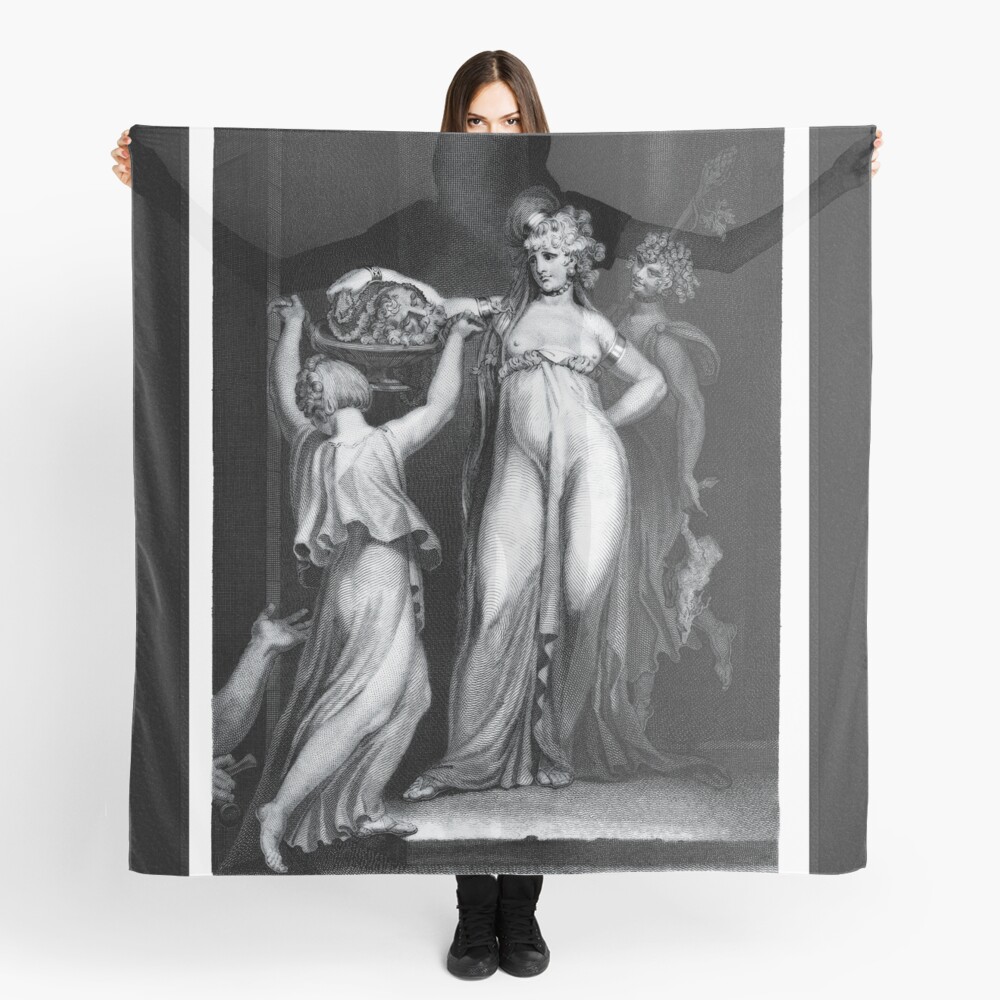
Tituludun grabatu hunkigarrian “Herodiasen alaba; Salome Joan Bataiatzailearen burua jasotzen,” urtean Thomas Holloway grabatzaile britainiarrak sortua 1798, Bibliatik ateratako momentu funtsezko baten lekuko gara, zehazki Mateo 14:10-11. Eszena zorrotz eta dramatiko honek Joan Bataiatzailearen burua moztearen gailur tragikoa jasotzen du.
Hollowayren eskulan zorrotzak momentuko intentsitate emozionala eta pisua pizten ditu, groteskoa eta erregea nahastuz. Grabatuak Salome erretratatzen du, Herodiasen alaba, Joan profetaren buru moztua helduz, amaren mendeku nahiak bultzatutako ekintza.
Edukien taula
The Main Subject and Theme
At the heart of Holloway’s engraving stands the female figure of Salome, her expression a curious mix of satisfaction and cold indifference as she receives the gruesome head of John the Baptist. Salome is depicted with long flowing hair, dressed in an elegant yet understated gown that flows to the floor. Bere jarrera orekatua dago, almost regal, despite the grim nature of the event. Her delicate yet firm grasp of the dish holding the severed head of John reflects the disturbing calmness of the scene.
The head of John the Baptist is eerily centered in the image, placed on a silver platter. His features are still discernible, though his eyes are shut in death, adding to the horror of the scene. His decapitated head is an unsettling contrast to the elegant appearance of the figures around it. Behind Salome stands a smaller male figure who seems to assist in the ceremonial transfer of the head, while another figure, draped in a flowing robe, completes the scene. These secondary characters underscore the ritualistic aspect of the narrative and their submission to the will of Herodias.
The theme of the artwork revolves around the notion of vengeance and betrayal, as well as the imbalance of power. Salome’s act is one of obedience to her mother, yet there is a calculated detachment in her demeanor that speaks to the complex emotional and moral implications of her actions. Holloway portrays the moment with an intensity that transcends the physical violence of the scene, offering viewers a glimpse into the darker realms of human nature and the consequences of unchecked power.
Materialak eta Teknika
Thomas Holloway’s engraving is a masterwork of the intaglio process, a technique that involves incising an image onto a surface, which is then inked and pressed onto paper to create an impression. This traditional method allows for remarkable detail and tonal gradation, and Holloway’s skillful use of light and shadow brings the composition to life. The texture of the engraving, from the intricate folds of Salome’s gown to the delicate portrayal of the severed head, exhibits an exceptional level of detail characteristic of the neoclassical era. The depth of emotion is underscored by the expert contrast between light and dark, which emphasizes the drama of the moment.
The image is rendered in black and white, a stark yet powerful choice that reinforces the gravity of the scene. The contrast between the white of Salome’s skin and gown and the deep shadows of the background lends an almost theatrical quality to the image. This use of chiaroscuro – the contrast between light and dark – is particularly effective in drawing attention to the central figures, allowing their expressions and poses to dominate the composition.
Setting and Objects
Artelanaren ezarpena minimalista baina xedea da. Irudiak erdi ilunpeko espazio batean kokatzen dira, ganbera edo jauregi bat iradokiz, nahiz eta xehetasun arkitektoniko zehatzik ematen ez den. Zehaztasun falta honek denborarik gabeko sentimendua areagotzen du, kontakizuna unibertsala izatea ahalbidetuz, toki edo garai zehatz bati lotuta egon beharrean. Irudiak inguratzen dituen argi apalak sekretu edo erritualetan inguratutako eszena bat iradokitzen du, piezaren aldarte ilun eta iragarki orokorrari lagunduz.
Joan Bataiatzailearen burua moztua duen platera eszenako objekturik kritikoenetako bat da. Bere presentzia ia zeremoniala da, heriotzaren eta begirunearen uztartze zorrotza. Burua, gorputzetik moztuta, exekuzioaren basakeria adierazten du, hala ere, plateraren tratamenduak objektu ia sakratu izatera igotzen du, burua bera orain eskaintza edo omenaldi makabro baten parte balitz bezala. Horrelako gertaera batekin naturalki lagunduko lukeen odola nahita ezabatzen da iruditik, eszena are surrealista eta kezkagarriagoa bihurtuz. Moztutako burua ekintzaren sinbolo bat besterik ez balitz bezala da, bere errealitate lazgarriaren benetako irudikapena baino..
Aldarte eta eragin emozionala
Grabatuaren aldarte orokorra iluntasuna da, suspense, eta anbiguotasun morala. Salomeren hotza, Joan Bataiatzailearen heriotzaren sinbolismo bortitzarekin uztartuta, tentsio giroa sortzen du. Salomek une honetan erakusten duen enpatia falta, bere espresioak, berriz, damurik edo atsekabearen zantzurik ez du erakusten, calls attention to the inhumanity that often accompanies the pursuit of power. Holloway masterfully captures the eerie calmness of the scene, leaving the viewer with an unsettling sense of foreboding.
The engraved figures are imbued with a quiet stillness, but it is a stillness laced with an undercurrent of violence and intrigue. The sense of detachment from the horror of the act may provoke discomfort in the viewer, challenging them to consider the cost of vengeance and the complex nature of moral judgment. Salome’s role as the instrument of her mother’s revenge places her at the intersection of innocence and guilt, and Holloway’s work invites contemplation of the consequences of blind obedience.
Bukaera
Thomas Holloway’s “Herodiasen alaba; Salome Joan Bataiatzailearen burua jasotzen” is a striking representation of a dark and tragic biblical moment. Through his expert use of engraving techniques and the careful rendering of light and shadow, Holloway brings an age-old story to life with vivid detail and emotional intensity. The scene is both beautiful and horrifying, offering a compelling reflection on the themes of power, vengeance, and moral complexity.
Herodiasen alaba; Salome Receiving the Head of John the Baptist, Matthew 14:10-11 c1798 by British Engraver Thomas Holloway (1748 – 1827), from a painting by Swiss Painter Henry Fuseli (741 – 1825); known for specializing in creating artwork that delved into the supernatural; who was also an accomplished Draughtsman, Writer and holder of the position of Professor of Painting and Keeper at the Royal Academy.
This engraving by Thomas Holloway is based on a painting done Henry Fuseli which shows the daughter of King Herodias, Salome accepting the severed head of John The Baptist in the palace court.
The Daughter of Herodias Salome Receiving the Head of John the Baptist is a retouched digital art old masters reproduction of a public domain image that is available for purchase online as a ijetzitako mihise inprimatua.

Artistaren biografia Wikipedia.org
Holloway was apprenticed to a seal engraver named Stent at a young age. He went on to study engraving at the Royal Academy beginning in 1773, during which time he resided at 11 Beaches Row, near Charles Square, Hoxton, and exhibited pastel portraits at the Society of Artists in 1777.
He later lived in Orme House in Hampton, Edgefield, Norfolk, and Coltishall, Norfolk. He became a court engraver in 1792.
Born in Broad Street, Londres, he was eldest son of a merchant who was an early follower of John Wesley; his mother’s portrait was painted by John Russell.
He was articled to a seal-engraver named Stent, by whom he was mainly employed in carving steel ornaments. He subsequently attended the Royal Academy schools, eta barruan 1773 first appeared at the Royal Academy as an exhibitor of seals and engraved gems. Later and up to 1792 he was a contributor of miniatures and portraits in oils and crayons.
Holloway’s main direction was line engraving. His earliest published plates were small portraits for magazines, chiefly of nonconformist ministers. He later undertook an edition of Johann Kaspar Lavater’s Essays on Physiognomy, translated by Henry Hunter, 5 vols., 1789–98.
The work was illustrated with about 800 plates executed by Holloway himself, Francesco Bartolozzi, William Blake, and other engravers, under the direction of Henry Fuseli.
His portraits included those of Charles Howard, 11th Duke of Norfolk, after Robert Edge Pine, and of Timothy Priestley, 1792, and Richard Price, after Benjamin West, 1793.
He was also employed on the illustrations to John Boydell’s Shakespeare, Robert Bowyer’s History of England, and Bell’s British Theatre.
Holloway is noted for his arduous engravings of cartoons by Raphael at Windsor Castle in 1800, on which he worked for 30 urteak. This ambitious project was a financial failure. The cartoons had already been engraved by Nicolas Dorigny.
Through the influence of Benjamin West, Holloway obtained permission to engrave on a large scale the seven Raphael cartoons at Windsor, and to this task the remainder of his life was devoted.
He engaged as assistants his former pupils, R. Slann and T. S. Webb, each of whom married a niece of Holloway, together with Joseph Thomson, an artist who died young. They worked together at Windsor until 1814, when the cartoons were moved to Hampton Court.
On the completion of the first plate, Paul preaching at Athens, urtean 1806, the king appointed Holloway his historical engraver; the second, Christ’s Charge to Peter, appeared in 1810; the third, The Death of Ananias, urtean 1816; and the fourth, Elymas, urtean 1820.
In that year all the preliminary drawings were finished, and Holloway retired with his associates to Edgefield in Norfolk, and later to Coltishall, near Norwich, to pursue their work on the plates, of which the fifth, The Miraculous Draught of Fishes, was issued in 1824. This was the last that Holloway lived to complete.
The sixth plate, Paul and Barnabas at Lystra, was almost finished in 1827, and the seventh, Peter and John at the Beautiful Gate, begun.
The former appeared in the following year, 1828, but the completion of the latter was delayed until 1839, when it was published with a dedication to the Queen, and like the rest bore the names of Holloway, Slann, and Webb as the engravers and publishers.