

The Eavesdropper
“The Eavesdropper,” creatu in 1906 by the Italian painter Eugen von Blaas (1843–1931), is a striking depiction of a young woman caught in a moment of curiosity and intrigue. The work exemplifies the artist’s skill in portraying both the innocence and subtle emotional complexity of his subjects.
Set against a rustic background of muted earth tones, the painting is an elegant blend of realism and intimate narrative. The young woman, with her head turned towards a partially opened door, gazes with focused attention, as though she is listening to something on the other side. The composition captures a quiet yet suspenseful moment, perfectly suited to the genre of genre painting for which von Blaas is renowned.
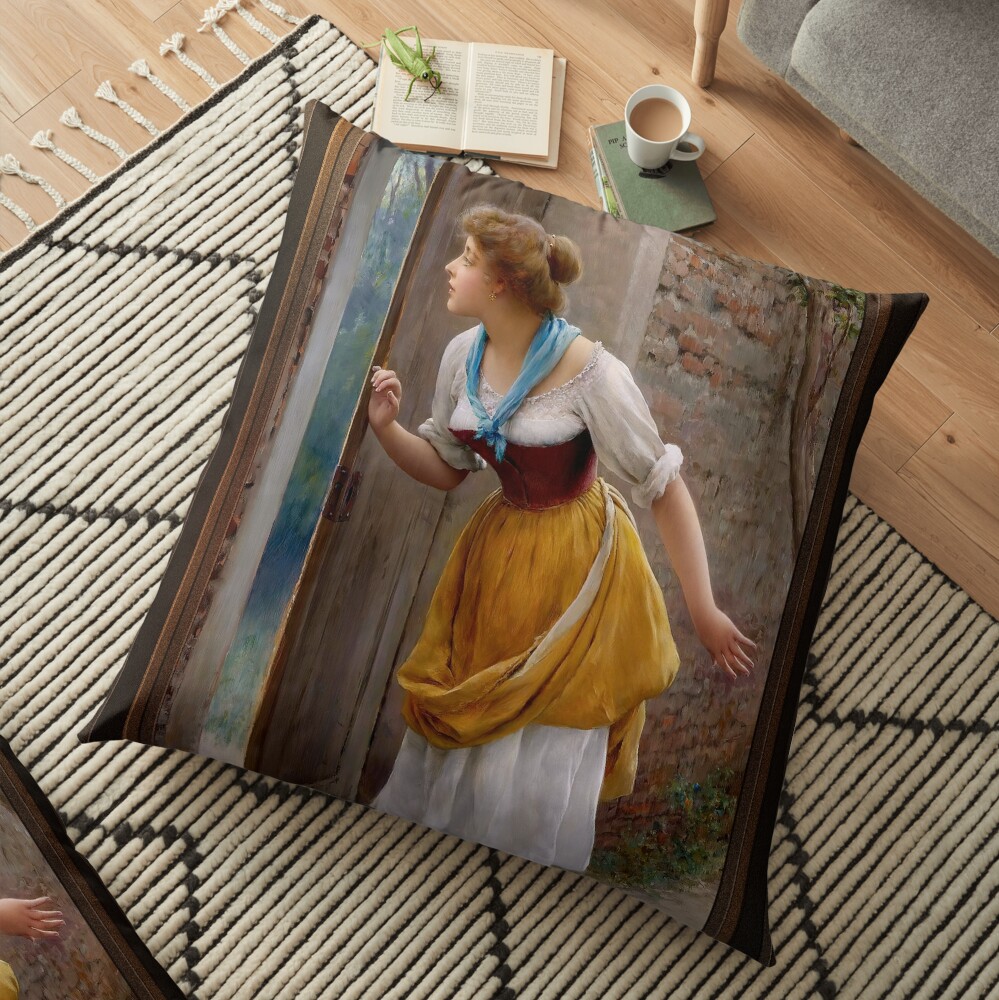
Table of Contents
Sugettu principale
At the heart of this work is the young woman, her delicate form framed by the weathered doorway. She is dressed in a traditional European peasant outfit, a combination of earthy tones that contrasts sharply with the vibrancy of her striking blue scarf and soft white blouse. U vestitu di a donna, her bodice tight and crimson, skirt flowing with a yellow hue, imbues her with both humility and grace.
The soft folds of her skirt and apron suggest that she is likely a domestic worker or a figure of modest social standing. Her posture is one of anticipation, her body angled towards the door, a slight tilt of the head giving the impression of listening intently to something she is not meant to hear.
Her hand is poised delicately on the door, as if she’s about to pull it open wider, ma ferma sospesa in un mumentu di indecisione. A figura hè messa in muvimentu da u so muvimentu è a qualità di vita chì von Blaas hà captu. U sguardu di a donna hè diretta ghjustu oltre l'orlu di a porta, a so spressione presa trà a curiosità è l'esitazione, i so ochji apparentemente cercanu indizi, cercandu a fonte di ciò chì hà attiratu a so attenzione. U focu annantu à a so espressione faciale aghjunghje à l'intriga, lascendu u visore chì si dumanda ciò chì hà intesu o intravistu.
Objects and Details
A prisenza di a donna in a scena hè fatta ancu più impressiunanti da l'ambienti circundante. L'ambientazione hè stretta, vicolo rusticu o cortile, evidente da a pietra grossa tagliata è a ricca texture di u muru di brique daretu à ella. L'architettura è u terrenu di stu sfondate revelanu assai di u periodu di tempu è di l'ambienti suciale. U muru hè invechjatu è invechjatu, dà à a scena un sensu di storia, cum'è s'è stu mumentu d'intercettazione hè accadutu in un spaziu chì hà vistu parechji scontri privati prima.
A porta stessu hè ancu un elementu chjave in a cumpusizioni, u so legnu scuru è invechjatu, mostra segni visibili di usura. Un manicu di metallo arrugginitu cuntrasta cù e ricche texture di i mattoni, purtendu un livellu di realismu à l'opera d'arte. A manu di a donna hè quasi in cuntattu direttu cù questu manicu, enfatizendu a fragilità di u mumentu, ella si trova nantu à a cuspide di qualcosa scunnisciutu, un cunfini trà ciò chì hè publicu è privatu.
Natura, ancu, ghjucà un rolu essenziale in a pittura. In u cantonu superiore manca, a small tree or shrub grows beside the stone wall, a gentle hint of greenery that adds a touch of life to an otherwise neutral-toned environment. The plants, though sparse, help to temper the rigid, industrial feel of the brickwork, bringing warmth and organic balance to the composition.
Stile è tecnica
Eugen von Blaas was known for his meticulous attention to detail and his ability to create paintings that seemed to almost breathe with life. “The Eavesdropper” is a prime example of this. The artist’s technique is deeply rooted in the realist tradition, with an emphasis on natural light, struttura, and the precise rendering of human figures. The folds of the woman’s skirt and the fine fabric of her blouse are painted with great care, capturing every nuance of material and texture. U soffiu ghjocu di luce nantu à a so faccia è l'ombra intornu à a porta dà prufundità è dimensione, creendu un spaziu tridimensionale credibile.
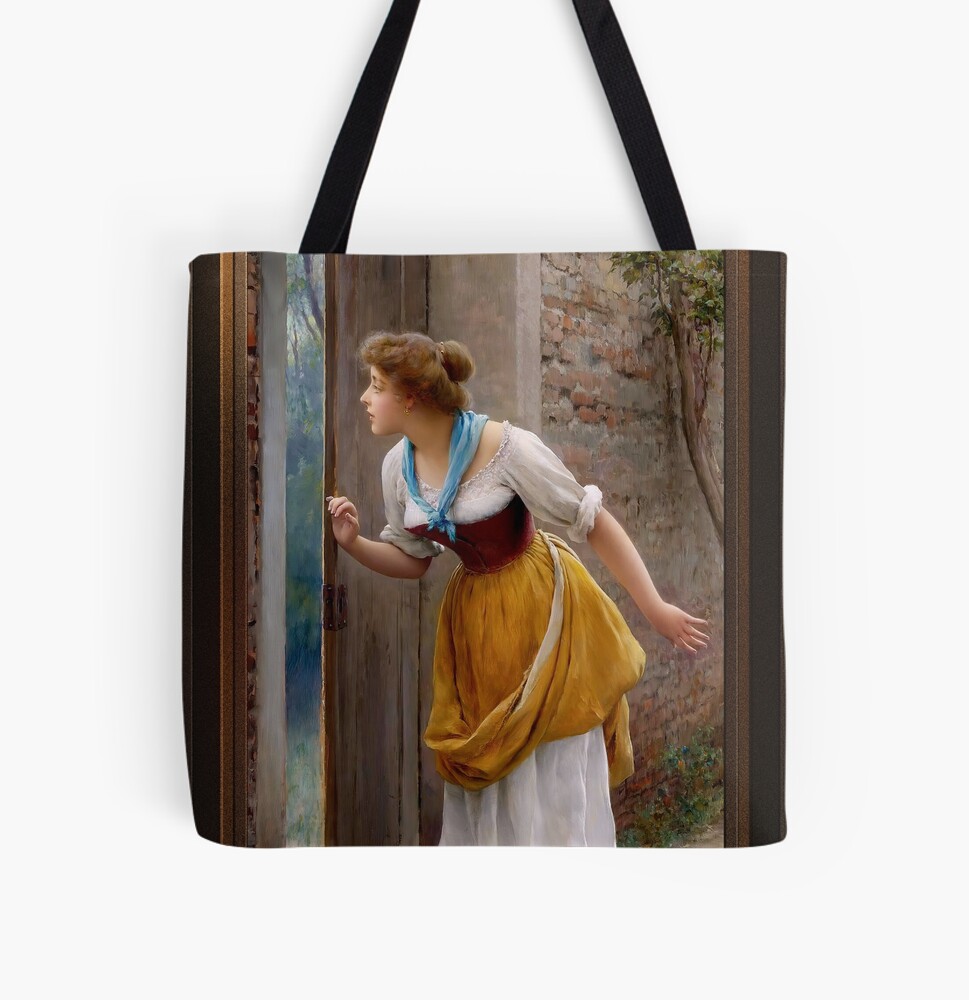
I culori in questu pezzu sò caldi ma ristretti, cù i toni terri di i brique è a robba di a donna chì formanu una paleta armoniosa. I gialli gialli è bianchi in u so vestitu cuntrastate cù i culori più muti di u fondu, criendu un puntu focu in a figura di a donna.
A sciarpa turchina, ligata à u so collu, serve cum'è un accentu visuale impressiunanti, attirà l'attenzione à a so faccia è aghjunghjendu un sensu di dolcezza è tranquillità. Stu cuntrastu di culore aumenta u tonu emutivu generale di u travagliu, contributing to the mood of quiet suspense.
The brushwork in “The Eavesdropper” is both precise and fluid. The artist’s handling of textures, from the rustic bricks to the delicate folds of fabric, is incredibly detailed. The face of the woman is rendered with a softness that invites the viewer to connect emotionally with her, emphasizing the realism that von Blaas sought to achieve. The painting has a photographic quality, capturing a fleeting moment with such clarity that it almost seems as though it could have been a real scene witnessed by the artist.
Tema è umore
U tema di “The Eavesdropper” is one of curiosity, suspense, and perhaps even secrecy. The woman’s actions imply a sense of eavesdropping—something forbidden or private that she is trying to uncover. This sense of voyeurism adds an element of psychological depth to the piece, drawing the viewer into a narrative of hidden knowledge and the consequences of discovering something that was never meant to be heard.
The mood of the painting is one of quiet tension. While there is no overt action, the woman’s body language and her gaze create a sense of suspense. There is an implicit suggestion of something unfolding just beyond the door, something that the woman cannot see fully, but is nonetheless drawn to. The muted background and the stillness of the moment heighten the suspense, allowing the viewer to project their own interpretation onto the scene.
Cunclusione
Eugen von Blaas’s “The Eavesdropper” is a masterful depiction of a fleeting moment in time, skillfully capturing the emotional nuances of curiosity and the tension between public and private spaces. U realismu è l'attenzione à i dettagli invitanu u visore à cuntemplà micca solu l'ambienti fisichi, ma ancu u mondu internu di u sughjettu.. In u so suspense tranquillu, a pittura parla di temi universali di a natura umana - u nostru desideriu di sapè ciò chì si trova oltre u limitu, è l'emozioni cumplessi chì venenu cù a scuperta di sicreti micca destinati à e nostre orecchie.
Questa hè una ripruduzzione di l'antichi maestri d'arte digitale rimasterizzata di una maghjina di duminiu publicu chì hè dispunibule cum'è a stampa su tela in linea.
Questa creazione d'arte digitale, cum'è cù tutte l'opere d'arte chì ponu esse truvate nantu à u situ web di Xzendor7 hè dispunibule per cumprà in linea in una varietà di formati di materiale cumprese stampe di tela., stampe acriliche, stampe metalliche, stampe di lignu, stampe in cornice, manifesti, è cum'è stampe su tela rolled in una varietà di dimensioni da 12 centimetri à 72 centimetri secondu a dimensione di l'opera d'arte attuale è a stampa nantu à a tenda chì sceglite di cumprà l'arte da.
L'opera d'arte hè ancu dispunibule nantu à una larga gamma di vestiti di l'omi è di e donne, mugs, tote, sciarpe, quaderni è ghjurnali è parechji prudutti di decoru di casa.
Biografia di l'artista
Info sottu Derivatu da Wikipedia.org
Hè natu in Albanu, vicinu à Roma, à un babbu tirolese è mamma italiana. U so babbu Karl, ancu un pittore, era u so maestru. A so mamma, Agnesina Auda, era una donna rumana benestante. A famiglia si trasfirìu a Venezia quandu Karl divintò prufessore à l'Accademia di Venezia. Spessu pittò scene in Venezia, ma dinù ritratti è pitture religiose.
Frà e so opere sò a forma di matrimoniu in sacristia; Le bingo à Campielo à Venise; Una scena di burattini in un educanciatu; è a Ninetta. Le critique d'art Luigi Chirtani, Quandu u Pittura hè stata mostrata à l'Esposizione Naziunale di Venezia, l'hà descrittu cum'è Bella, lusinghi, bellucciu, accarezzatu, pulita, lucidatu, lavanderia in un dipintu di Mr. Vesica, u ritrattu predilettu di i grandi aristocratici veneziani, vestitu di satin di gala, gioielli brillanti, acconciature di i ricchi.
E so imagine culurite è piuttostu teatrali di a sucetà veneziana, p.e. Nantu à u Balcone (1877; Cullezzione privata), eranu assai diffirenti paragunatu à i pastelli delicati è incisioni di i cortili, balconi è canali di a Venezia muderna.
Eugène de Blaas’ i dipinti sò stati esposti à l'Accademia Reale, Società di Belle Arti, New Gallery è Arthur Tooth and Sons Gallery in Londra, è ancu à a Walker Art Gallery in Liverpool