

Y Clutwr
“Y Clutwr,” wedi'i greu yn 1906 by the Italian painter Eugene von Blas (1843–1931), is a striking depiction of a young woman caught in a moment of curiosity and intrigue. The work exemplifies the artist’s skill in portraying both the innocence and subtle emotional complexity of his subjects.
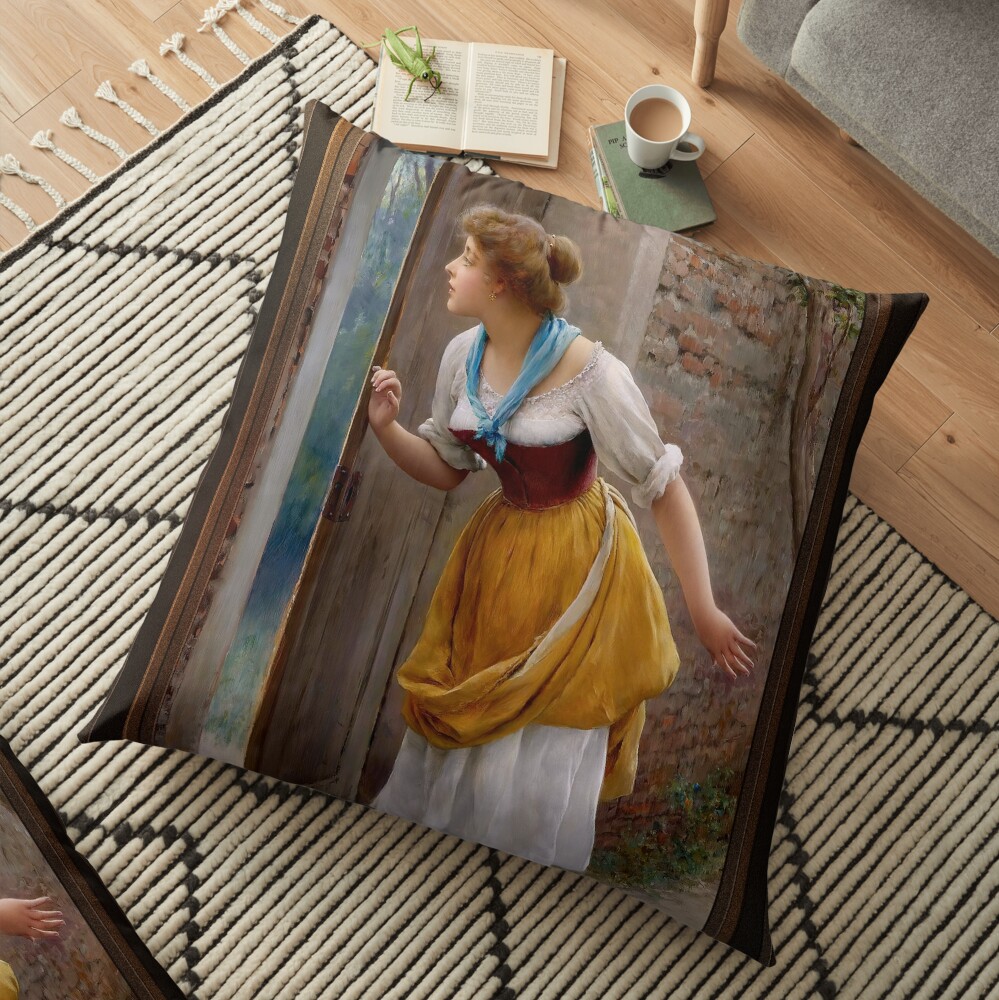
Set against a rustic background of muted earth tones, the painting is an elegant blend of realism and intimate narrative. The young woman, with her head turned towards a partially opened door, gazes with focused attention, as though she is listening to something on the other side. The composition captures a quiet yet suspenseful moment, perfectly suited to the genre of genre painting for which von Blaas is renowned.
Tabl Cynnwys
Prif Bwnc
At the heart of this work is the young woman, her delicate form framed by the weathered doorway. She is dressed in a traditional European peasant outfit, a combination of earthy tones that contrasts sharply with the vibrancy of her striking blue scarf and soft white blouse. Gwisg y wraig, her bodice tight and crimson, skirt flowing with a yellow hue, imbues her with both humility and grace.
The soft folds of her skirt and apron suggest that she is likely a domestic worker or a figure of modest social standing. Her posture is one of anticipation, her body angled towards the door, a slight tilt of the head giving the impression of listening intently to something she is not meant to hear.
Her hand is poised delicately on the door, as if she’s about to pull it open wider, but remains suspended in a moment of indecision. The figure is set in motion by her movement and the life-like quality that von Blaas has captured. The gaze of the woman is directed just beyond the edge of the door, her expression caught between curiosity and hesitation, her eyes seemingly searching for clues, seeking the source of whatever caught her attention. The focus on her facial expression adds to the intrigue, leaving the viewer wondering what she has overheard or glimpsed.
Gwrthrychau a Manylion
The woman’s presence in the scene is made even more striking by the surrounding environment. The setting is a narrow, rustic alleyway or courtyard, evident from the rough-hewn stonework and the rich texture of the brick wall behind her. The architecture and terrain of this backdrop reveal much about the time period and social setting. The wall is aged and weathered, lending the scene a sense of history, as though this moment of eavesdropping is taking place within a space that has witnessed many such private encounters before.
The door itself is also a key element in the composition, its wood dark and aged, showing visible signs of wear. A rusty metal handle contrasts with the rich textures of the bricks, bringing a level of realism to the artwork. The woman’s hand is almost in direct contact with this handle, emphasizing the fragility of the moment, she stands on the cusp of something unknown, a boundary between what is public and private.
Natur, hefyd, plays an essential role in the painting. Yn y gornel chwith uchaf, a small tree or shrub grows beside the stone wall, a gentle hint of greenery that adds a touch of life to an otherwise neutral-toned environment. Y planhigion, though sparse, help to temper the rigid, industrial feel of the brickwork, bringing warmth and organic balance to the composition.
Arddull a Thechneg
Eugen von Blaas was known for his meticulous attention to detail and his ability to create paintings that seemed to almost breathe with life. “Y Clutwr” is a prime example of this. The artist’s technique is deeply rooted in the realist tradition, with an emphasis on natural light, gwead, and the precise rendering of human figures. The folds of the woman’s skirt and the fine fabric of her blouse are painted with great care, capturing every nuance of material and texture. The soft play of light across her face and the shadows around the door give depth and dimension, creating a believable three-dimensional space.
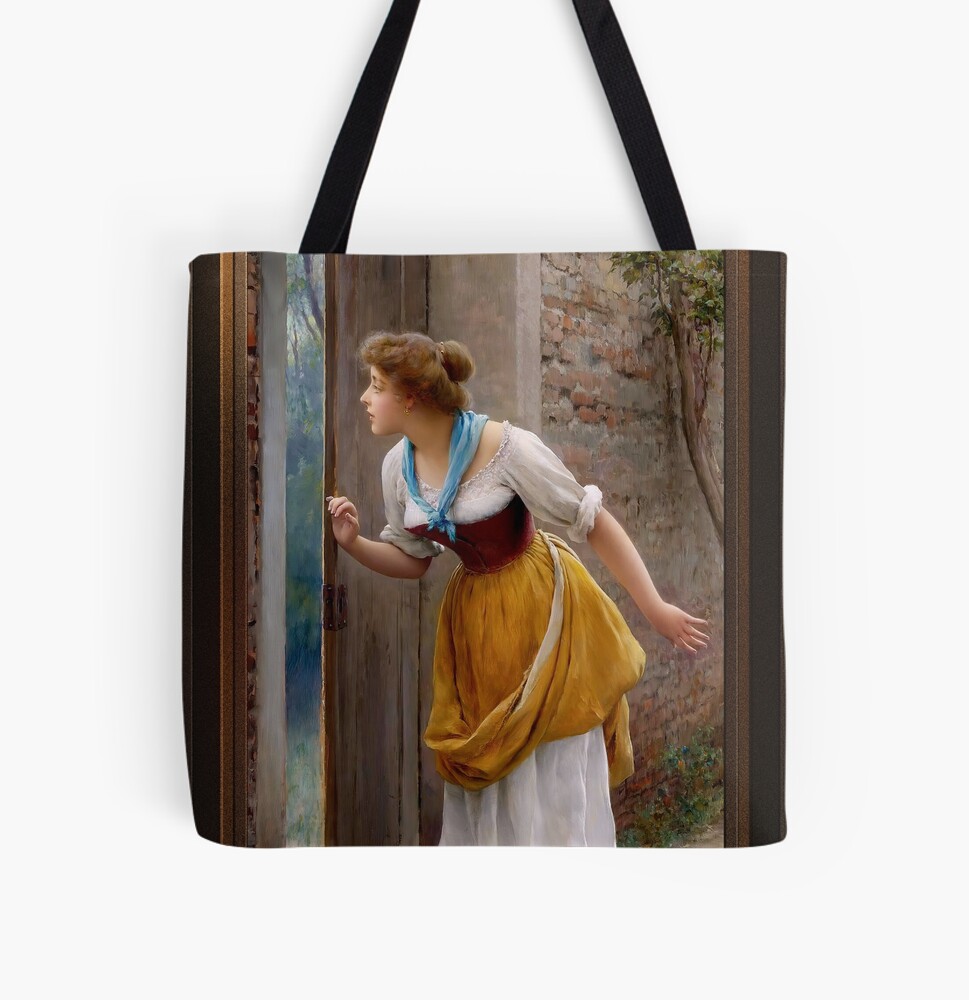
The colors in this piece are warm yet restrained, with the earthy tones of the bricks and the woman’s clothing forming a harmonious palette. The soft yellows and whites in her attire contrast with the more muted colors of the background, creating a focal point in the figure of the woman.
The blue scarf, tied around her neck, serves as a striking visual accent, drawing attention to her face and adding a sense of softness and tranquility. This color contrast enhances the overall emotional tone of the work, contributing to the mood of quiet suspense.
The brushwork in “Y Clutwr” is both precise and fluid. The artist’s handling of textures, from the rustic bricks to the delicate folds of fabric, is incredibly detailed. The face of the woman is rendered with a softness that invites the viewer to connect emotionally with her, emphasizing the realism that von Blaas sought to achieve. The painting has a photographic quality, capturing a fleeting moment with such clarity that it almost seems as though it could have been a real scene witnessed by the artist.
Thema a Hwyliau
Mae thema “Y Clutwr” is one of curiosity, suspense, and perhaps even secrecy. The woman’s actions imply a sense of eavesdropping—something forbidden or private that she is trying to uncover. This sense of voyeurism adds an element of psychological depth to the piece, drawing the viewer into a narrative of hidden knowledge and the consequences of discovering something that was never meant to be heard.
The mood of the painting is one of quiet tension. While there is no overt action, the woman’s body language and her gaze create a sense of suspense. There is an implicit suggestion of something unfolding just beyond the door, something that the woman cannot see fully, but is nonetheless drawn to. The muted background and the stillness of the moment heighten the suspense, allowing the viewer to project their own interpretation onto the scene.
Nghasgliad
Eugen von Blaas’s “Y Clutwr” is a masterful depiction of a fleeting moment in time, skillfully capturing the emotional nuances of curiosity and the tension between public and private spaces. The realism and attention to detail invite the viewer to contemplate not only the physical setting but also the internal world of the subject. In its quiet suspense, the painting speaks to universal themes of human nature—our desire to know what lies beyond the threshold, and the complex emotions that come with uncovering secrets not meant for our ears.
Mae hwn yn atgynhyrchiad hen feistri celf ddigidol wedi'i ailfeistroli o ddelwedd parth cyhoeddus sydd ar gael fel a argraffu cynfas ar-lein.
Y greadigaeth gelfyddyd ddigidol hon, fel gyda'r holl waith celf sydd i'w gael ar wefan Xzendor7 ar gael i'w brynu ar-lein mewn amrywiaeth o fformatau deunydd gan gynnwys printiau cynfas, printiau acrylig, printiau metel, printiau pren, printiau wedi'u fframio, posteri, ac fel printiau cynfas wedi'u rholio mewn amrywiaeth o feintiau o 12 modfedd i 72 modfeddi yn dibynnu ar faint y gwaith celf gwirioneddol a'r siop argraffu ar alw y byddwch yn dewis prynu'r celf ohoni.
Mae’r gwaith celf hefyd ar gael ar ystod eang o ddillad dynion a merched, mygiau, totes, sgarffiau, llyfrau nodiadau a chyfnodolion a llawer o gynhyrchion addurno cartref.
Bio artist
Gwybodaeth Islaw sy'n Deillio o Wikipedia.org
Ganwyd ef yn Albano, ger Rhufain, i dad o Tyrolean a mam Eidalaidd. Roedd ei dad Karl, hefyd peintiwr, oedd ei athraw. Ei fam, Agnesina Auda, roedd yn ddynes Rufeinig dda i wneud. Symudodd y teulu i Fenis pan ddaeth Karl yn Athro yn Academi Fenis. Byddai'n paentio golygfeydd yn Fenis yn aml, ond hefyd portreadau a phaentiadau crefyddol.
Ymhlith ei weithiau mae The nuptial form in the sacristy; Bingo yn Campielo yn Fenis; Golygfa bypedau mewn ysgol; a La Ninetta. Y beirniad celf Luigi Chirtani, pan gafodd y paentiad ei arddangos yn y Mostra Nazionale di Venezia, ei ddisgrifio fel Hardd, gwenieithus, pert, caressed, glanhau, caboledig, golchdy mewn darlun gan Mr. Bledren, hoff bortreadwr uchelwyr Fenisaidd mawr, gwisgo mewn satins gala, gemwaith disgleirio, steiliau gwallt y cyfoethog.
Ei ddelweddau cyfnod lliwgar a braidd yn theatraidd o gymdeithas Fenisaidd, e.e. Ar y Balconi (1877; Casgliad Preifat), yn dra gwahanol o gymharu â phasteli cain ac ysgythriadau o'r cyrtiau, balconi a chamlesi Fenis fodern.
Eugene de Blas’ arddangoswyd paentiadau yn yr Academi Frenhinol, Cymdeithas Celfyddyd Gain, Oriel Newydd ac Oriel Arthur Tooth and Sons yn Llundain, a hefyd yn Oriel Gelf Walker yn Lerpwl