

도청자
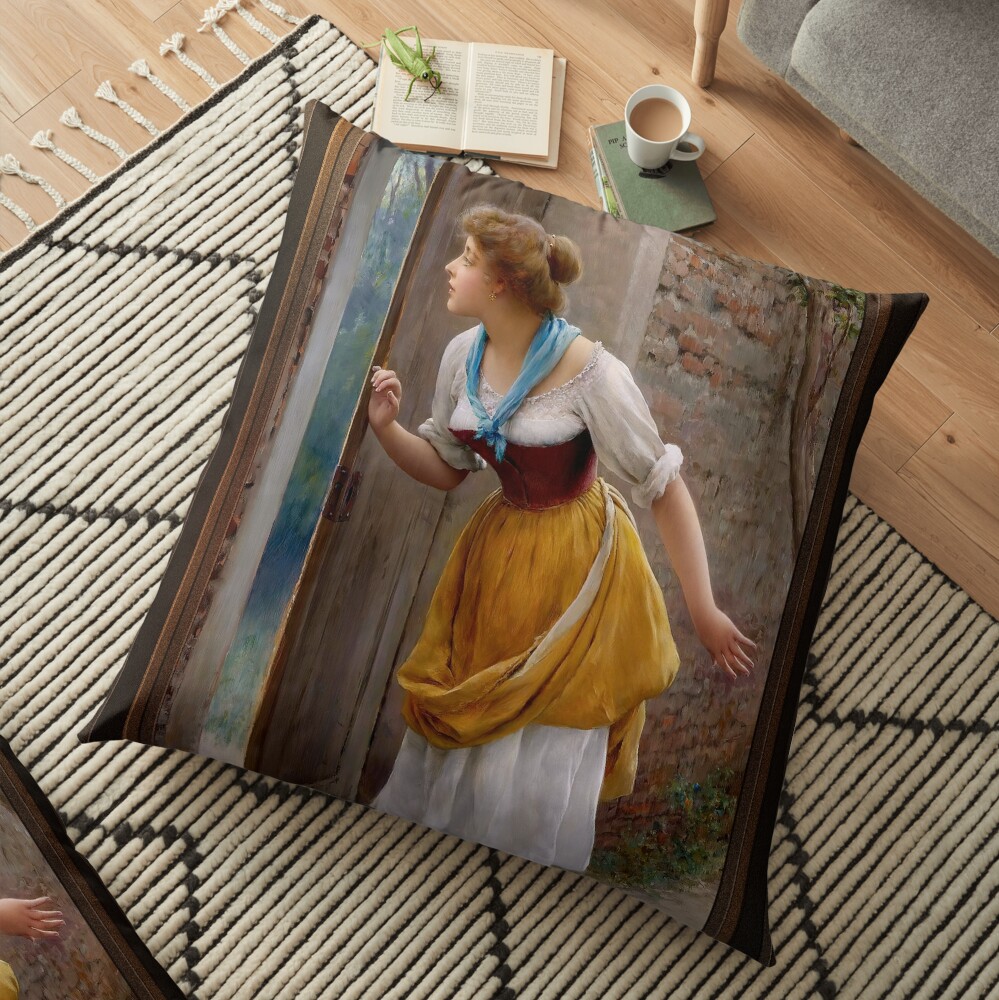
“도청자,” 다음에서 생성됨 1906 이탈리아 화가의 오이겐 폰 블라스 (1843-1931), 호기심과 호기심의 순간에 사로잡힌 젊은 여성의 모습을 인상적으로 묘사하고 있습니다.. 이 작품은 대상의 순수함과 미묘한 감정적 복잡성을 모두 묘사하는 예술가의 기술을 보여줍니다..
차분한 흙색 톤의 소박한 배경을 배경으로 설정, 그림은 사실주의와 친밀한 이야기의 우아한 조화입니다.. 젊은 여자, 부분적으로 열린 문 쪽으로 고개를 돌린 채, 집중적으로 시선을 보낸다, 마치 상대방의 말을 듣고 있는 것처럼. 조용하면서도 긴장감 넘치는 순간을 포착하는 구성, von Blaas가 유명한 풍속화 장르에 완벽하게 적합합니다..
목차
주제
At the heart of this work is the young woman, her delicate form framed by the weathered doorway. She is dressed in a traditional European peasant outfit, a combination of earthy tones that contrasts sharply with the vibrancy of her striking blue scarf and soft white blouse. The woman’s attire, her bodice tight and crimson, skirt flowing with a yellow hue, imbues her with both humility and grace.
The soft folds of her skirt and apron suggest that she is likely a domestic worker or a figure of modest social standing. Her posture is one of anticipation, her body angled towards the door, a slight tilt of the head giving the impression of listening intently to something she is not meant to hear.
Her hand is poised delicately on the door, as if she’s about to pull it open wider, but remains suspended in a moment of indecision. The figure is set in motion by her movement and the life-like quality that von Blaas has captured. The gaze of the woman is directed just beyond the edge of the door, her expression caught between curiosity and hesitation, her eyes seemingly searching for clues, seeking the source of whatever caught her attention. The focus on her facial expression adds to the intrigue, leaving the viewer wondering what she has overheard or glimpsed.
객체와 세부 사항
The woman’s presence in the scene is made even more striking by the surrounding environment. The setting is a narrow, rustic alleyway or courtyard, evident from the rough-hewn stonework and the rich texture of the brick wall behind her. The architecture and terrain of this backdrop reveal much about the time period and social setting. The wall is aged and weathered, lending the scene a sense of history, as though this moment of eavesdropping is taking place within a space that has witnessed many such private encounters before.
The door itself is also a key element in the composition, its wood dark and aged, showing visible signs of wear. A rusty metal handle contrasts with the rich textures of the bricks, bringing a level of realism to the artwork. The woman’s hand is almost in direct contact with this handle, emphasizing the fragility of the moment, she stands on the cusp of something unknown, a boundary between what is public and private.
자연, ~도, plays an essential role in the painting. In the upper left corner, a small tree or shrub grows beside the stone wall, a gentle hint of greenery that adds a touch of life to an otherwise neutral-toned environment. The plants, though sparse, help to temper the rigid, industrial feel of the brickwork, bringing warmth and organic balance to the composition.
스타일과 테크닉
Eugen von Blaas was known for his meticulous attention to detail and his ability to create paintings that seemed to almost breathe with life. “도청자” is a prime example of this. The artist’s technique is deeply rooted in the realist tradition, with an emphasis on natural light, 조직, and the precise rendering of human figures. The folds of the woman’s skirt and the fine fabric of her blouse are painted with great care, capturing every nuance of material and texture. The soft play of light across her face and the shadows around the door give depth and dimension, creating a believable three-dimensional space.
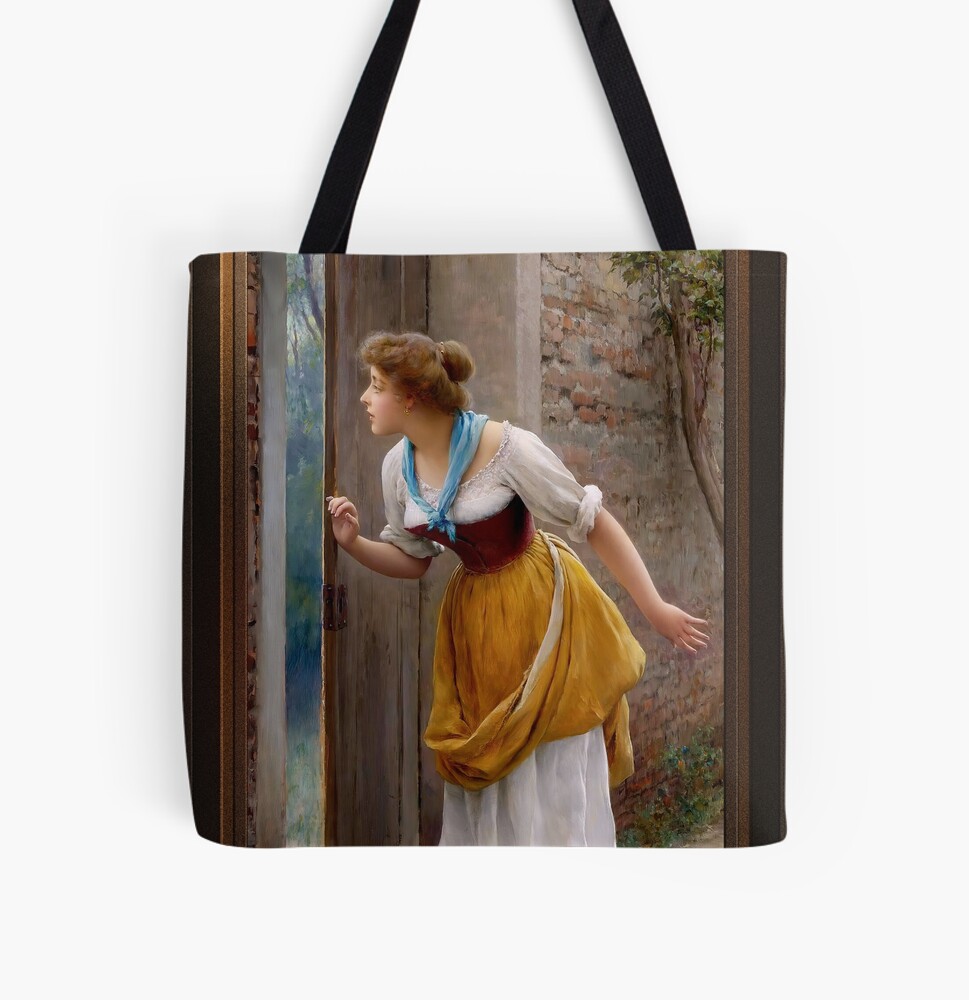
The colors in this piece are warm yet restrained, with the earthy tones of the bricks and the woman’s clothing forming a harmonious palette. The soft yellows and whites in her attire contrast with the more muted colors of the background, creating a focal point in the figure of the woman.
The blue scarf, tied around her neck, serves as a striking visual accent, drawing attention to her face and adding a sense of softness and tranquility. This color contrast enhances the overall emotional tone of the work, contributing to the mood of quiet suspense.
The brushwork in “도청자” is both precise and fluid. The artist’s handling of textures, from the rustic bricks to the delicate folds of fabric, is incredibly detailed. The face of the woman is rendered with a softness that invites the viewer to connect emotionally with her, emphasizing the realism that von Blaas sought to achieve. The painting has a photographic quality, capturing a fleeting moment with such clarity that it almost seems as though it could have been a real scene witnessed by the artist.
테마와 분위기
주제 “도청자” is one of curiosity, suspense, and perhaps even secrecy. The woman’s actions imply a sense of eavesdropping—something forbidden or private that she is trying to uncover. This sense of voyeurism adds an element of psychological depth to the piece, drawing the viewer into a narrative of hidden knowledge and the consequences of discovering something that was never meant to be heard.
The mood of the painting is one of quiet tension. While there is no overt action, the woman’s body language and her gaze create a sense of suspense. There is an implicit suggestion of something unfolding just beyond the door, something that the woman cannot see fully, but is nonetheless drawn to. The muted background and the stillness of the moment heighten the suspense, allowing the viewer to project their own interpretation onto the scene.
결론
Eugen von Blaas’s “도청자” is a masterful depiction of a fleeting moment in time, skillfully capturing the emotional nuances of curiosity and the tension between public and private spaces. The realism and attention to detail invite the viewer to contemplate not only the physical setting but also the internal world of the subject. In its quiet suspense, the painting speaks to universal themes of human nature—our desire to know what lies beyond the threshold, and the complex emotions that come with uncovering secrets not meant for our ears.
이것은 공개 도메인 이미지의 리마스터링된 디지털 아트 올드 마스터 복제입니다. Boucher는 Guay의 작품으로 일련의 그림을 그리고 Madame de Pompadour가 조각하여 호의를 받는 궁정에게 잘 묶인 책으로 배포했습니다..
이 디지털 아트 창작, Xzendor7 웹사이트에서 찾을 수 있는 모든 예술 작품과 마찬가지로 캔버스 인쇄를 포함한 다양한 재료 형식으로 온라인에서 구매할 수 있습니다., 아크릴 프린트, 금속 지문, 목판화, 액자 인쇄, 포스터, 그리고 압연 캔버스로 다양한 크기로 인쇄됩니다. 12 인치에 72 실제 작품의 크기와 작품을 구매하기로 선택한 주문형 인쇄소에 따라 인치.
이 작품은 다양한 남성복과 여성복에서도 볼 수 있습니다., 머그, 토트백, 스카프, 노트북, 저널 및 다양한 홈 데코 제품.
아티스트 약력
아래에서 파생 된 정보 Wikipedia.org
그는 알바노에서 태어났다., 로마 근처, 티롤인 아버지와 이탈리아인 어머니에게. 그의 아버지 칼, 역시 화가, 그의 선생님이었다. 그의 어머니, 아그네시나 아우다, 부유한 로마 여성이었다. 칼이 베니스 아카데미의 교수가 되었을 때 가족은 베니스로 이사했습니다.. 그는 종종 베니스에서 장면을 그렸습니다., 뿐만 아니라 초상화와 종교 그림.
그의 작품 중에는 성찬의 결혼식 형식이 있습니다.; 베니스 캄피엘로의 빙고; 학교의 인형극; 그리고 라니네타. 미술평론가 루이지 치르타니, 이 그림이 베네치아의 모스트라 나치오날레(Mostra Nazionale di Venezia)에 전시되었을 때, 아름답다고 표현했다, 유망한, 예쁜, 애무, 청소, 우아한, Mr.의 그림 속 세탁소. 방광, 베네치아의 위대한 귀족들이 가장 좋아하는 초상화가, 갈라 새틴을 입은, 빛나는 보석, 부자의 헤어스타일.
베네치아 사회에 대한 그의 화려하고 다소 연극적인 시대 이미지, 예를 들어. 발코니에서 (1877; 개인 소장품), 섬세한 파스텔과 안뜰의 에칭과는 사뭇 달랐다., 현대 베니스의 발코니와 운하.
유진 드 블라스’ 왕립 아카데미에서 그림이 전시되었습니다., 미술협회, 런던의 새로운 갤러리와 Arthur Tooth and Sons 갤러리, 리버풀의 Walker Art Gallery에서도