

The Fall of Phaeton
Titim Phaeton C1604 ag an bpéintéir Pléimeannach Peter Paul Rubens (1577 – 1640); is considered to be one of the most influential artist of the Flemish Baroque Tradition and was also painter of the Renaissance Period.
The Fall of Phaeton is the story of the son of the Sun God Helios who is granted the wish of riding Helios Chariot Across The Sky as proof that he is the father of Phaeton; an endeavor that not even Zeus would attempt.
This of course leads to problems as the young man can not control the four horses (Aethon, Eous, Phlegon and Pyrois) that drive the chariot and Phaeton begins to damage the earth by freezing and then burning it, creating the Nubian Desert as well as drying up lakes and rivers.
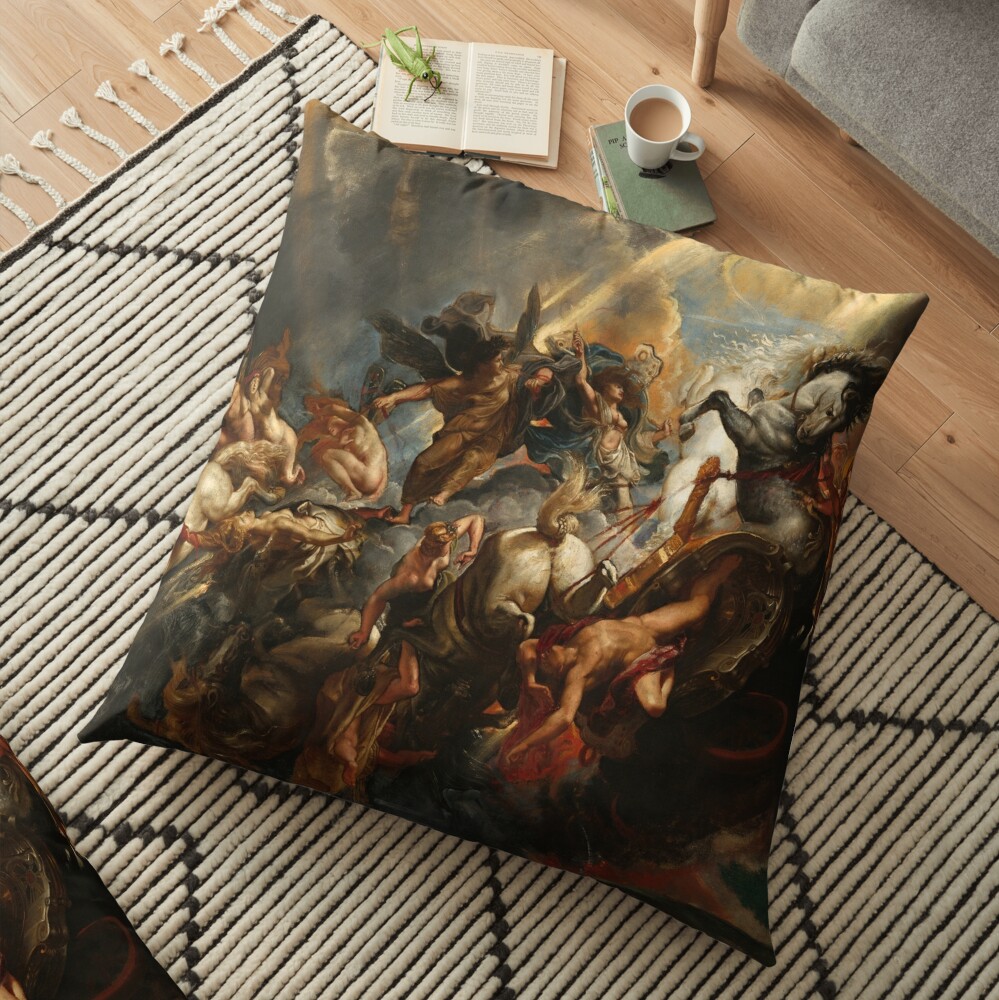
Zeus upon seeing this, decided to put an end to Phaetons escapade and unleashes a lightning bolt that strikes Phaeton sending his lifeless body plunging toward the earth and ending up in the Eriadanos River.
Is atáirgeadh ealaíne digiteach athshuiteáilte é The Fall of Phaeton d’íomhá fearainn phoiblí atá ar fáil ar líne mar cló chanbhás.
Thíos Eolas Ó Wikipedia.org
Sir Peter Paul Rubens (Meitheamh 28, 1577 – Bealtaine 30, 1640) ealaíontóir Pléimeannach agus taidhleoir ó Dhiúcacht Brabant i ndeisceart na hÍsiltíre a bhí ann (an Bheilg sa lá atá inniu ann).
Meastar gurb é an t-ealaíontóir is mó tionchair sa traidisiún Bharócach Pléimeannach. Déanann cumadóireacht ard-luchtaithe Rubens tagairt do ghnéithe erudite den stair chlasaiceach agus Chríostaí. Chuir a stíl Bharócach uathúil agus an-tóir uirthi béim ar ghluaiseacht, dath, agus sensuality, a lean an láithreach, stíl dhrámatúil ealaíne a cuireadh chun cinn sa Fhrith-Reifirméisean.
Rubens was a painter producing altarpieces, portráidí, tírdhreacha, and history paintings of miotaseolaíoch and allegorical subjects. He was also a prolific designer of cartoons for the Flemish tapestry workshops and of frontispieces for the publishers in Antwerp.
In addition to running a large workshop in Antwerp that produced paintings popular with nobility and art collectors throughout Europe, Rubens was a classically educated humanist scholar and diplomat who was knighted by both Philip IV of Spain and Charles I of England. Rubens was a prolific artist. The catalogue of his works by Michael Jaffé lists 1,403 píosaí, excluding numerous copies made in his workshop.
His commissioned works were mostly history paintings, which included religious and mythological subjects, and hunt scenes. He painted portraits, especially of friends, and self-portraits, and in later life painted several landscapes. Rubens designed tapestries and prints, as well as his own house.
He also oversaw the ephemeral decorations of the royal entry into Antwerp by the Cardinal-Infante Ferdinand of Austria in 1635. He wrote a book with illustrations of the palaces in Genoa, which was published in 1622 as Palazzi di Genova. The book was influential in spreading the Genoese palace style in Northern Europe.
Rubens was an avid art collector and had one of the largest collections of art and books in Antwerp. He was also an art dealer and is known to have sold an important number of art objects to George Villiers, 1st Duke of Buckingham.
He was one of the last major artists to make consistent use of wooden panels as a support medium, even for very large works, ach d’úsáid sé canbhás freisin, go háirithe nuair ba ghá an obair a sheoladh achar fada. Ar phíosaí altóra phéinteáil sé uaireanta ar scláta chun fadhbanna machnaimh a laghdú.