

The Farewell of Telemachus and Eucharis
The Farewell of Telemachus and Eucharis c1818 by French Painter Jacques-Louis David (1748 – 1825); considered to be the preeminent painter of the Neoclassical style.
This painting depicts the characters Telemachus and Eucharis from the c1699 novel Les Aventures de Télémaque by the French Archbishop of Combrai François de Salignac de la Mothe-Fénelon (1651 – 1715); which were inspired by Homer’s Odeyssey.
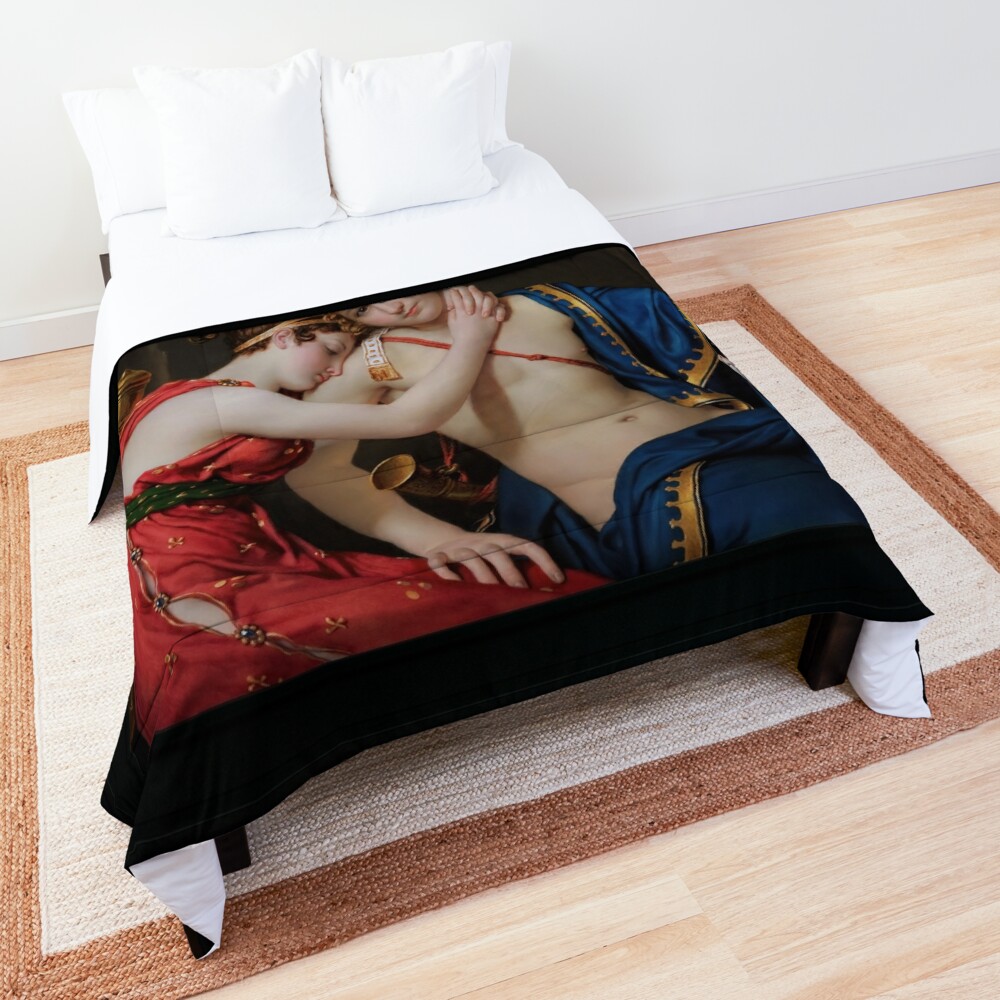
In Greek mythology Telemachus is the son of Odysseus and Penelope; while Eucharis who is not part of Greek mythology is one of the nymph Calypso’s attendants in Fénelon’s novel Les Aventures de Télémaque c1699.
Na pintura, Eucharis, que está usando um vestido com detalhes dourados avermelhados e uma faixa verde esmeralda com detalhes dourados em volta da cintura, uma faixa dourada em volta do cabelo e um cilindro de latão com o sobrenome do artista David nele.
Ela está abraçando Telêmaco; que está parcialmente vestido com um manto azul com detalhes em coroa dourada ao longo de seu perímetro e tem uma faixa branca com círculos dourados enrolada em sua cabeça.
Ele também tem uma corda amarrada no peito, da qual pende do lado direito uma trompa de latão com a data da obra e as letras BRVX gravadas nela., enquanto ele descansa a mão direita na coxa esquerda de Eucharis; enquanto segura uma lança com ponta de metal na mão esquerda com seu cachorro branco olhando para ele entre a lança e seu braço esquerdo.
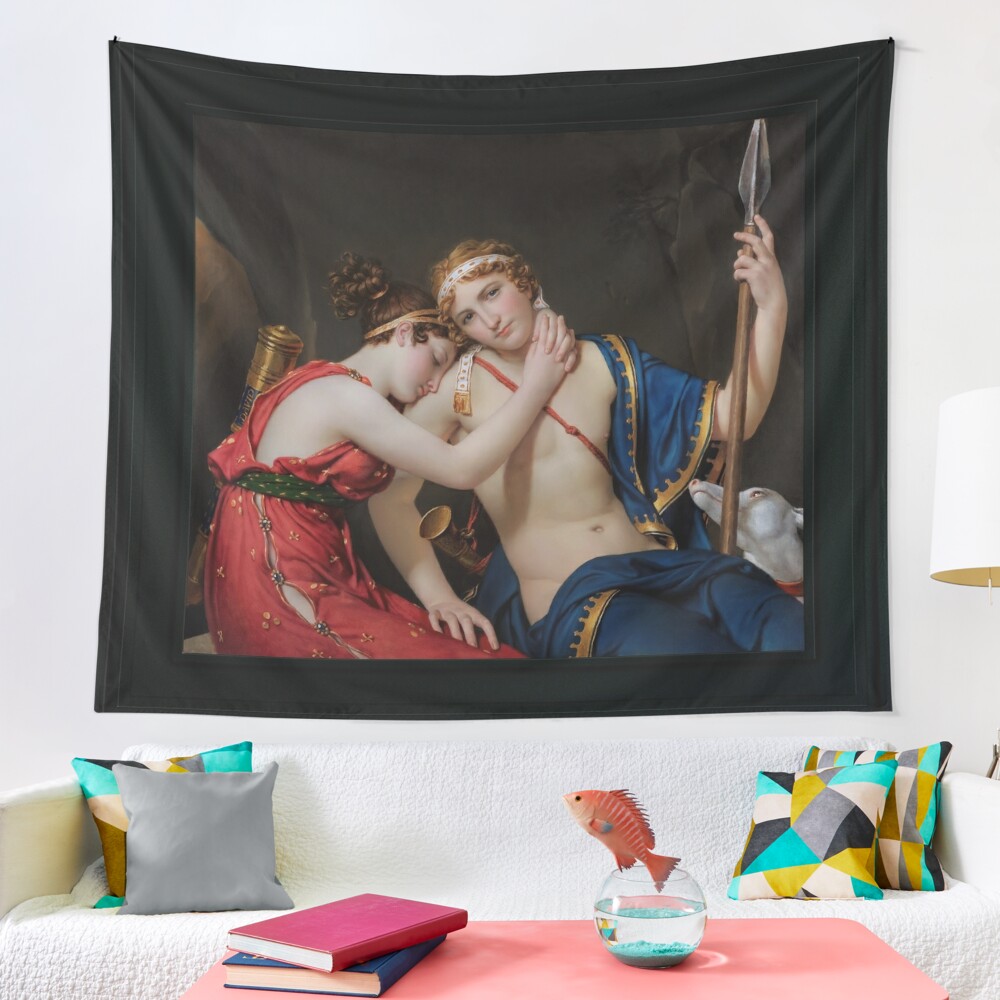
The Farewell of Telemachus and Eucharis is a remastered digital art old masters reproduction of a public domain image that is available as a canvas print online.
Informações abaixo derivadas de Wikipedia.org
Jacques was born in Paris, France on August 30, 1748 e na idade de 9 was sent to live with his uncles who architects, by is mother; after his father was killed in a duel.
His uncles saw to it that he received a first class education by sending him to the Collège des Quatre-Nations, University of Paris; but he found it difficult and never reached the level of other students that attended the school, and was more preoccupied with drawing.
Though his uncles and mother wanted Jacques to become an architect, he instead wanted to become a painter and was able to convince them in his course of action; which led him to study with the leading Rococo painter of the time François Boucher (1703 – 1770); who also happened to be a distant relative.
But has the taste of the Rococo style was transitioning to a more Classical style, Boucher sent him to study with his friend Joseph-Marie Vien (1716 – 1809); where he studied at the Académie Royale de Peinture et de Sculpture.
The academy held an annual competition, which awarded the winning student the prestigious Prix de Rome; which allowed students to stay in Rome for a period of 3 para 5 years funding their expensive as they studied the great works of the classical masters.
Though on his first three attempts Jacques failed to win, on his fourth attempt he took the prize with his painting Erasistratus Discovering the Cause of Antiochus’ Disease, e em 1775 journed to Italy with his mentor Joseph-Marie Vien, who had just been appointed director of the French Academy at Rome.