

The Judgment of Solomon
The Judgment of Solomon (1Kings 3_16-28) c1866 by French Painter Gustave Dore (1832 – 1883); tot i que va treballar principalment com a gravador en fusta, també era gravador, caricatures, artista de còmics, il·lustrador i escultor.
The Judgment of Solomon is an engraving that depicts the Biblical tale of King Solomon and the two mothers each claiming to be and fighting over an infant son; with both claiming to be the mother of the baby.
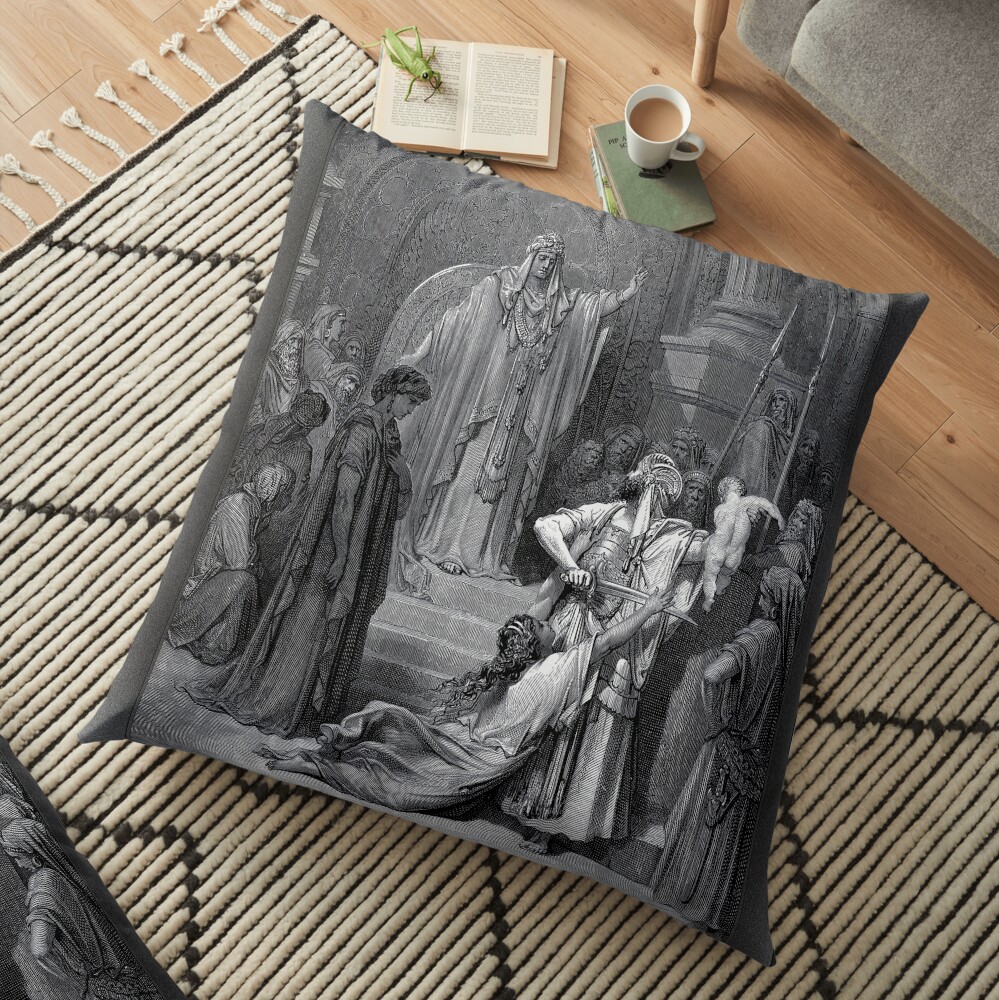
In order to solve this dilemma the women and the baby are brought before King Solomon to each plead their case; and to resolve this life altering dispute, King Solomon orders his soldier to cut the baby in half, and give each women a half of the baby.
Upon hearing this the true mother of the child tells the King that the other women can have the child and please not kill; and then Solomon orders the soldier to give the baby to the woman that is willing to give up the child to save its life, as this is the true mother of the baby.
The Judgment of Solomon scene shows the throne room with the members of the court and others along its perimeter and King Solomon standing in front of his throne dealing out the justice of his wisdom.
There at the front of the throne is a soldier holding the baby up in his left hand, and a sword in his right; while the true mother of the child is on her knees begging for the child’s life and the other woman just stands there looking down at her
The Judgment of Solomon is a remastered digital art old masters reproduction of a public domain image that is available as a Impressió de tela en línia.
Informació a continuació derivada de Wikipedia.org
Doré va néixer a Estrasburg, França i a l'edat de 5 va ser un artista nen prodigi; creant dibuixos madurs més enllà dels seus anys. Després a l'edat de 12, va començar a tallar en pedra, i per 15, va començar la seva carrera treballant com a caricaturista per al diari francès Le journal pour rire.
Al principi, el gravat en fusta va ser el seu principal mètode d'expressió artística a finals de la dècada de 1840 i principis de la dècada de 1850., fent diversos còmics de text, com Els treballs d'Hèrcules (1847), Tres artistes incompresos i descontents (1851), Inconvenients d'un viatge de plaer (1851) i La història de la Santa Rússia (1854).
Posteriorment, Doré va guanyar encàrrecs per representar escenes de llibres de Cervantes, Rabelais, Balzac, Milton, i Dante. També va il·lustrar “Gargàntua i Pantagruel” dins 1854; quan era just 22 anys.
En 1853 Se li va demanar a Doré que il·lustres les obres de Lord Byron; i aquest encàrrec va donar lloc a un treball addicional per als editors britànics, inclosa una nova Bíblia il·lustrada, i tres anys més tard produiria 12 il·lustracions mida foli de La llegenda del jueu errant, que va propagar opinions antisemites de l'època, per a un poema breu que Pierre-Jean de Béranger havia derivat d'una novel·la d'Eugène Sue de 1845.
Durant la dècada de 1860, Doré va il·lustrar una edició francesa del Quixot de Cervantes, i les seves representacions del cavaller i el seu escuder, Sancho Panza, s'han fet tan famosos que han influït en els lectors posteriors, artistes, i directors d'escena i cinema’ idees del físic “mira” dels dos personatges.
També va il·lustrar una edició de grans dimensions d'Edgar Allan Poe “El corb”, un esforç que li va valer 30,000 francs de l'editor Harper & Germans a dins 1883.
Les seves il·lustracions per a la Bíblia (1866) van tenir un gran èxit, i dins 1867 Doré va fer una gran exposició de la seva obra a Londres, que va portar a la fundació de la Galeria Doré a Bond Street, Londres. En 1869, Blanchard Jerrold, el fill de Douglas William Jerrold, va suggerir que treballessin junts per produir un retrat complet de Londres.
Jerrold havia obtingut la idea de The Microcosm of London produït per Rudolph Ackermann, William Pyne, i Thomas Rowlandson (publicat en tres volums de 1808 a 1810). Doré va signar un contracte de cinc anys amb l'editorial Grant & Això va suposar la seva estada a Londres tres mesos a l'any, i va rebre la gran suma de 10.000 lliures a l'any per al projecte.
Tot i que Doré va ser celebrat principalment per les seves pintures durant la seva època, i encara que segueixen sent mundialment coneguts fins avui, són les seves xilografies i gravats, com els que va fer per Jerrold, el que demostra és un talent artístic excepcional com a artista amb una visió individual.