

The Visit of the Queen of Sheba to King Solomon
The visit of the Queen of Sheba to King Solomon c1890 by British Painter Edward John Poynter (1836 – 1919); Pre-Raphaelite and prominent portrait painter and a leading writer of his time.
This is a stunning and opulent work of art that depicts the great wealth and power of King Solomon (990 – 931 BCE) during his reign estimated to be about 970 – 931 BCE.
The scene shows the palace court of King Solomon with massive doubled row columns adorned with gold from the base half way up, then a fiery red and with more gold on the ornamental upper portion of the column.
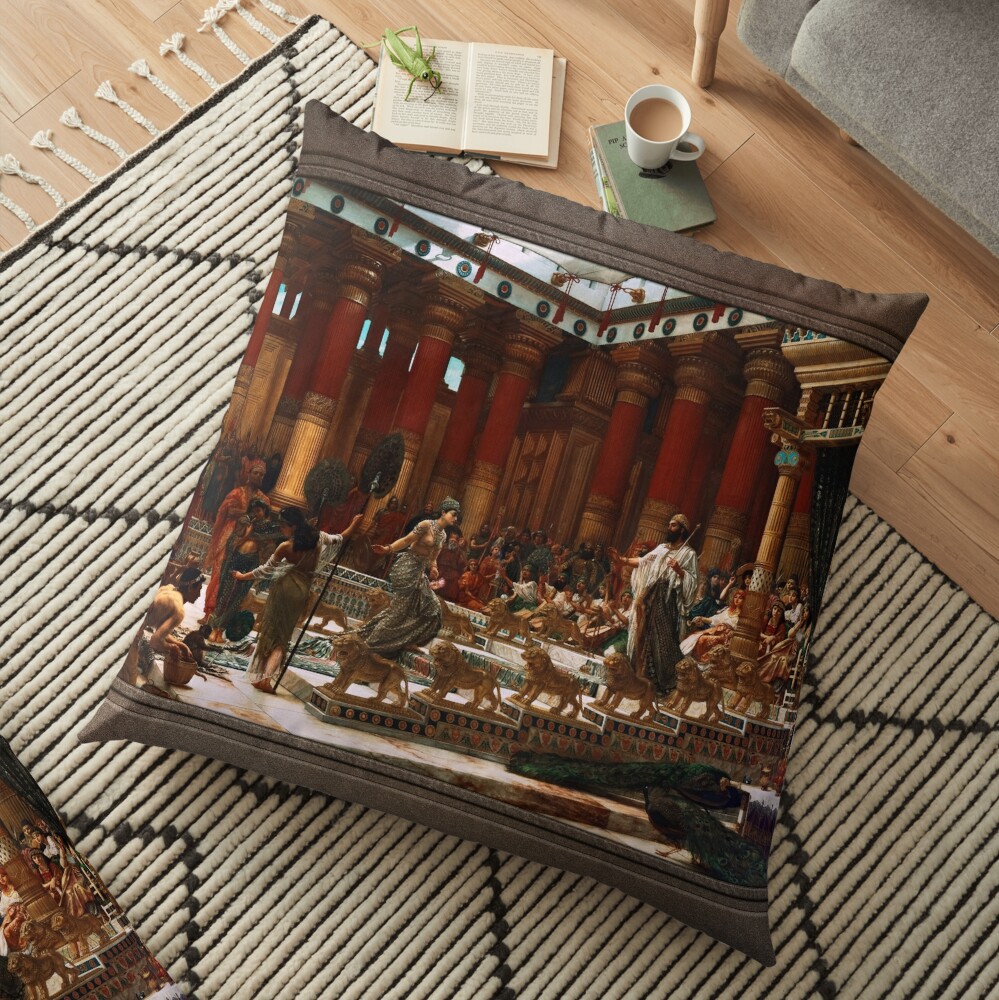
Along the perimeter of the court are a massive amount of dignitaries as well as soldiers from the lands that border his kingdom.
His throne is embellished with gold and has six marble steps that have golden lion statues on each landing on either side; with the landings also being adorned with gold and beautiful decorative art.
To the right of his throne we can see some of Solomon’s wives and below them are musicians comprised of four women and one man play some sort of a harp; while to the left of throne we see to large blue-green peacocks by a table that has grapes and other fruits being tended to by a woman.
On the fifth landing is King Solomon in white dress, gold cap grown, scepter in his left hand and a decorative cloth hanging from his left side; with his right hand extended forward, toward the Queen of Sheba who is on the second landing.
She is adorned with a cap of jewels and is wearing jewels as body jewelry on her exposed chest and waist, as well as a green silk garment that acts as a long skirt.
Behind her are two servant women holding tall peacock fan poles with an announcer behind one of them on the right and behind them in front of the steps are servants or slaves with food and drink; as well as a monkey that is holding a small peacock fan in its right hand.
The Visit of the Queen of Sheba to King Solomon is a remastered digital art old masters reproduction of a public domain image that is available as a metal, acrílic, fusta i Impressió de tela en línia.
Informació a continuació derivada de Wikipedia.org
Edward was born in Paris, França a Arquitecte Britànic i fundador de l'Institut d'Arquitectes Britànics (c1834) Ambrose Poynter (1796 – 1886) i Emma Forster (? – 1848); i poc després del seu naixement els seus pares van tornar a Gran Bretanya.
Edward va anar al Brighton College i l'escola d'Ipswich, però es va veure obligat a marxar aviat a causa de la mala salut; que el va portar a passar els seus hiverns a Madeira, Portugal i a Roma, Itàlia.
Quan ell era 17 anys, mentre que a Roma va conèixer el pintor britànic Frederick Leighton, i aquella reunió va causar una impressió important; de tal manera que quan va tornar a Londres es va matricular a la Leigh's Academy, que va ser fundada per James Mathews Leigh (1808 – 1860) i finalment es convertiria en la Heatherley School of Fine Art avui en dia; i també estudiaria a les escoles de la Royal Academy.
From there he went to Paris to study at the studio of Swiss Classicist Painter Marc Gabriel Charles Gleyre (1806 – 1874).
During his career Edward held a number of official post which included Slade Professor at University College London (1871 – 1875), principal of the National Art Training School (1875 – 1881) and director of the National Gallery (1894 – 1904); overseeing the opening of the Tate Gallery.
Edward was noted as a painter of large historical paintings throughout his career, with such works as Israel in Egypt c1867, followed by St George for England c1869, depicting St George and the Dragon and perhaps culminating with The visit of the Queen of Sheba to King Solomon c1884-90.