

U baciu
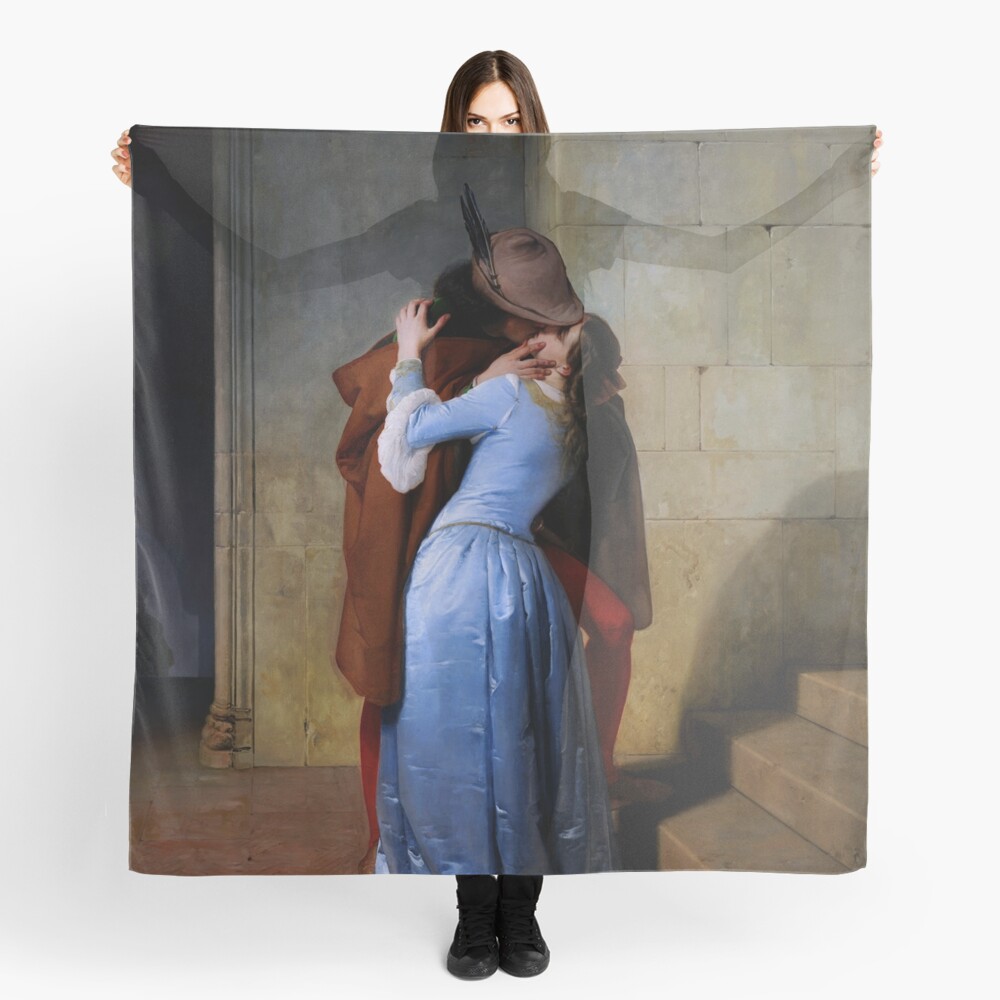
U baciu (U basgiu) c1859 par le peintre italien Francesco Hayez (1791 – 1882); Era vistu cum'è u pittore di punta di u Periudu di u Romantisimu à a mità di u 19u seculu in Milanu in Italia. Era ben cunnisciutu per i so grandi pitture storichi, allegorie politiche e ritratti eccezionali.
“U Basgiu” is a powerful and evocative painting by the renowned Italian artist Francesco Hayez, creatu in 1859. The artwork is a stunning example of Romanticism, a movement that was characterized by an emphasis on intense emotion, individualism, è u sublime. Hayez’s portrayal of an intimate and passionate kiss between two figures is not just a romantic gesture but a deep, symbolic act reflecting the political and social turmoil of 19th-century Italy.
In questu pezzu, the central focus is the kiss shared between a man and a woman, each dressed in period-specific attire, their bodies entwined in a tender yet fervent embrace. The lovers’ faces, captured at the moment of their kiss, convey an overwhelming sense of passion and longing. The man, dressed in a reddish-brown cloak, holds the woman with one hand, while his other hand grips a green object, possibly symbolizing life or hope. His face is partially obscured by his hat, but the tension in his posture reveals both his deep affection for the woman and the sense of urgency that seems to pervade the scene.
A donna, clothed in a flowing blue gown, stands close to him, her body pressed against his in a stance that signifies emotional and physical closeness. A so longa, flowing hair is partially visible, her face bathed in the soft light that seems to emanate from the left, highlighting her delicate features. The deep emotional intensity in her expression, coupled with the almost sacred nature of the kiss, suggests that this moment is one of profound importance for both characters. The sensuality of the kiss is palpable, yet it is underscored by a sense of melancholy, as if this act of love must be performed in secrecy, or perhaps as a final farewell.
The setting of the artwork is crucial to understanding the deeper layers of its meaning. The scene takes place in an open, stone-walled interior, with towering, almost monolithic walls that loom over the lovers. These walls are not merely a backdrop but symbolize the oppression and constraints of the era, particularly in the context of Italy’s political situation. The rough, unfinished stone surfaces hint at a time of transition and struggle.
The archway in the background frames the lovers, emphasizing their isolation in the moment and their vulnerability to the outside world. The positioning of the couple in front of the stone walls may also allude to the notion of love as a fortress in a time of uncertainty or political strife, where their embrace provides a form of protection from the harsh reality beyond.
The colors in the painting are rich and symbolic. The warm tones of the man’s cloak contrast with the cooler blues and whites of the woman’s gown, signifying a balance between opposing forces—passion and purity, action and passivity. The use of light is also notable; the couple is illuminated from one side, casting shadows on their bodies and the environment around them. This creates a sense of intimacy and draws the viewer’s attention solely to the couple, ensuring that the emotional intensity of their embrace remains the focal point of the composition.
In termini di materiali, the painting is executed with oil on canvas, a traditional medium that allows Hayez to achieve a remarkable level of detail and depth in his figures and surroundings. The texture of the canvas is almost palpable, with the brushstrokes contributing to the tactile nature of the painting. The artist’s skillful manipulation of light and shadow gives the piece a three-dimensional quality, making it feel as though the viewer could step into the scene and experience the emotional weight of the kiss firsthand.
The overall theme of “U baciu” is one of passion, defiance, and longing. The moment captured is not simply a tender exchange between two lovers; it is an act of rebellion and a declaration of love against the backdrop of an oppressive society. At the time Hayez painted this work, Italy was undergoing significant political upheaval, as various regions were striving for unification and freedom from foreign domination.

The kiss, tandu, can be seen as a metaphor for the struggle for independence, with the lovers representing the spirit of resistance and the hope for a brighter, freer future. The kiss is not just an emotional act but a political statement, an expression of the deep desire for change that resonated with the people of Italy during the Romantic period.
The mood of the painting is complex and multi-layered. While it captures the intense passion of the lovers, it also evokes a sense of sorrow and longing. The lovers are caught in a moment of transcendence, but there is a sense that this moment is fleeting.
The raw emotion conveyed through their embrace suggests that their love is either forbidden or destined to end, making the act of kissing both a sweet and painful experience. The viewer is left to ponder whether the kiss signifies the beginning of a relationship, a final farewell, or a stolen moment in a turbulent world.
In cunclusioni, Francesco Hayez’s “U baciu” is not just a beautiful depiction of love and romance; it is a rich, symbolic painting that speaks to the political, suciale, and emotional climate of its time. The work’s exquisite use of light, culore, è cumpusizioni, combined with its deep thematic resonance, makes it a timeless masterpiece that continues to captivate viewers. It invites reflection on the nature of love, the power of passion, and the struggles that shape our world, all while celebrating the profound connection between two individuals caught in the midst of history.
The Kiss is a retouched digital art old masters reproduction of a public domain image that is available as an acrylic, metallu, legnu, rotulatu è stampa su tela in linea.
Info sottu Da Wikipedia.org
Francesco Hayez era di una famiglia relativamente povera di Venezia. U so babbu, Giovanni, era di origine francese mentre a so mamma, Chiara Torcella, era di Muranu. Francescu era u più chjucu di cinque figlioli.
Hè statu criatu da a surella di a so mamma, qui avait épousé Giovanni Binasco, un armatore benestante è un cullezzione d'arte. Hayez hà mostratu una predisposizione per u disegnu da a zitiddina. U so ziu, avendu nutatu u so talentu precoce, L'apprentice à un restauratore d'arte in Venezia. Hayez devint plus tard l'élève du peintre Francesco Maggiotto avec lequel il poursuivit ses études pendant trois ans..
Hè ammissu à u cursu di pittura di a Nova Accademia di Belle Arti di Venezia in 1806, induve hà studiatu cù Teodoru Matteini. In 1809 il a gagné un concours de l'Académie de Venise pour une résidence d'un an à l'Accademia di San Luca à Rome.
Firmò in Roma finu à 1814, puis s'installe à Naples où il fut chargé par Joachim Murat de peindre une œuvre majeure représentant Ulisse à la cour d'Alcinous.. À a mità di l'anni 1830 hà assistitu à u Salone Maffei in Milanu, ospitata da Clara Maffei. U maritu di Maffei hà cumandatu dopu à Hayez un ritrattu di a so moglia. In 1850 Hayez hè statu numinatu direttore di l'Accademia di Brera.
In u cursu di una longa carriera, Hayez hà pruvatu à esse particularmente prolificu. A so pruduzzione includeva pitture storichi pensate per appellu à a sensibilità patriottica di i so patroni, è ancu opere chì riflettenu u desideriu di accumpagnà un stile neoclassicu à grandi temi., sia da letteratura biblica sia classica.
Hà pittatu ancu scene da presentazioni teatrali. Évidemment absent de son œuvre, però, sò retabuli – forsi per via di l'invasioni napuleoniche chì deconsacrà parechje chjese è cunventi in l'Italia di u Nordu. U storicu di l'arte Corrado Ricci hà descrittu Hayez cum'è un classicista chì poi evoluzione in un stile di tumultu emotivo. Francesco Hayez, U baciu (1859)
I so ritratti anu l'intensità di Ingres è di u muvimentu Nazarenu. Spessu à pusà, I sughjetti di Hayez sò spessu vestiti in austeru, vestiti bianchi è neri, cù pocu o micca accoutrements. Mentre Hayez facia ritratti per a nubiltà, hà ancu esploratu altri sugetti cum'è altri artisti è musicisti. Tardi in a so carriera, hè cunnisciutu per avè travagliatu cù e fotografie.
Unu di i temi prediletti di Hayez era l'Odalisca semi-vestita evocativa di temi orientali - un tema predilettu di i pittori romantichi.[3] E raffigurazioni di harem è di e so donne permettenu à l'artisti a capacità di pitture scene altrimenti micca accettabili in a sucità.. Ancu Maria Maddalena di Hayez hà più sensualità cà fervore religiosu.
A pittura di Hayez U Baciu hè stata cunsiderata trà u so megliu travagliu da i so cuntimpuranii, è hè forsi u so sforzu più cunnisciutu. L'anonimatu, u gestu micca affettatu di a coppia ùn hà micca bisognu di cunniscenza di u mitu o di a literatura per interpretà, è appellu à un sguardu mudernu.
Una valutazione scientifica di a carriera di Hayez hè stata cumplicata da a so propensione per ùn firmà o datate e so opere.. Spessu e date in i so pittura indicanu quandu l'opera hè stata acquistata o venduta, micca u tempu di a so creazione. In più, hà spessu pittatu e listessi cumpusizioni parechje volte cù variazioni minima s'ellu ci hè.
Parmi ses élèves de l'Académie de Brera figuraient Carlo Belgioioso, Amanzio Cattaneo, Alessandru Focosi, Giovanni Battista Lamperti, Livo Pecora, Angelu Pietrasanta, Antonio Shiloh, Carlo Antonio Tavella, Ismaele Teglio Milla et Francesco Valaperta.
Hayez hè mortu in Milanu, età 91. U so studiu à l'Academia di Brera hè marcatu cù un piattu.