

La Kiso

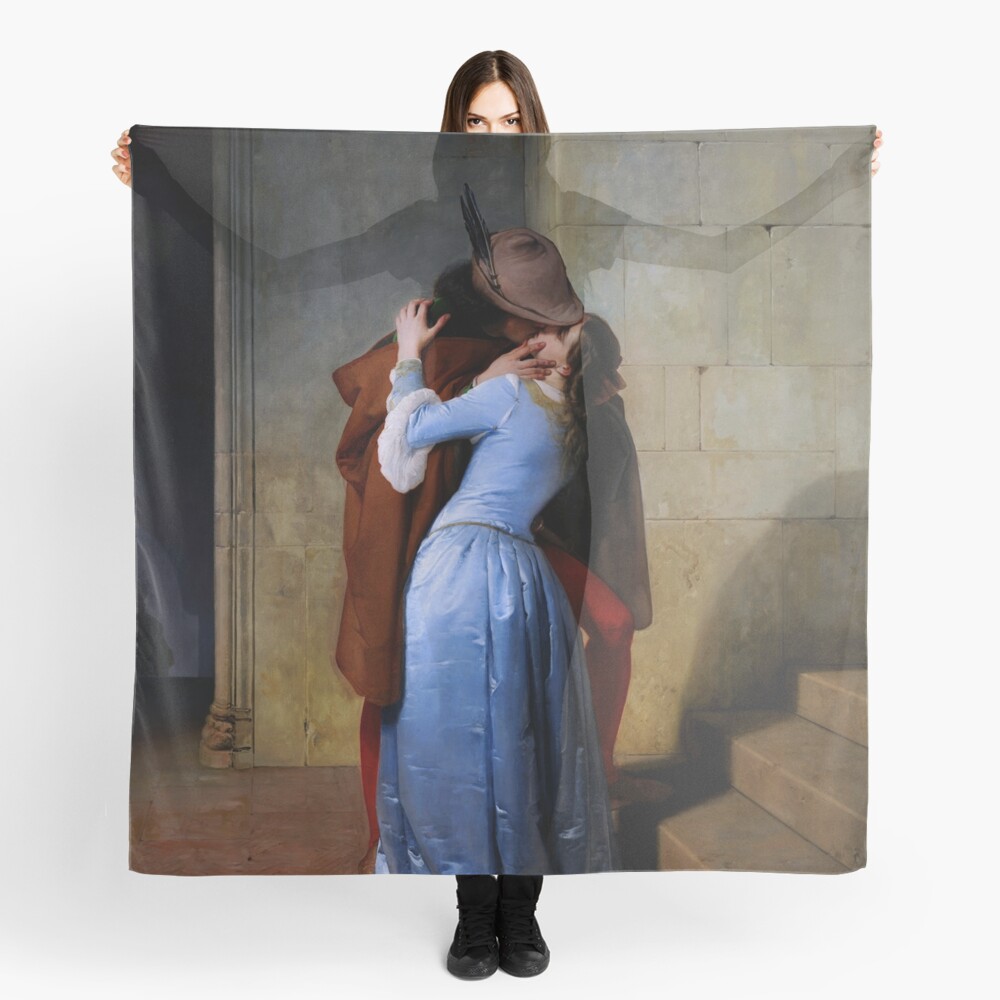
La Kiso (El Beso) c1859 by Italian Painter Francesco Hayez (1791 – 1882); was viewed as the leading painter of the Romanticism Period in the mid 19th Century in Milan Italy. He was well known for his grand historical paintings, political allegories and exceptional fine portraits.
“La Kiss” is a powerful and evocative painting by the renowned Italian artist Francesco Hayez, kreita en 1859. The artwork is a stunning example of Romanticism, a movement that was characterized by an emphasis on intense emotion, individuismo, kaj la sublima. Hayez’s portrayal of an intimate and passionate kiss between two figures is not just a romantic gesture but a deep, symbolic act reflecting the political and social turmoil of 19th-century Italy.
En ĉi tiu peco, the central focus is the kiss shared between a man and a woman, each dressed in period-specific attire, their bodies entwined in a tender yet fervent embrace. The lovers’ faces, captured at the moment of their kiss, convey an overwhelming sense of passion and longing. La viro, dressed in a reddish-brown cloak, holds the woman with one hand, while his other hand grips a green object, possibly symbolizing life or hope. His face is partially obscured by his hat, but the tension in his posture reveals both his deep affection for the woman and the sense of urgency that seems to pervade the scene.
La virino, clothed in a flowing blue gown, stands close to him, her body pressed against his in a stance that signifies emotional and physical closeness. Ŝi longe, flowing hair is partially visible, her face bathed in the soft light that seems to emanate from the left, highlighting her delicate features. The deep emotional intensity in her expression, coupled with the almost sacred nature of the kiss, suggests that this moment is one of profound importance for both characters. The sensuality of the kiss is palpable, yet it is underscored by a sense of melancholy, as if this act of love must be performed in secrecy, or perhaps as a final farewell.
The setting of the artwork is crucial to understanding the deeper layers of its meaning. The scene takes place in an open, stone-walled interior, with towering, almost monolithic walls that loom over the lovers. These walls are not merely a backdrop but symbolize the oppression and constraints of the era, particularly in the context of Italy’s political situation. The rough, unfinished stone surfaces hint at a time of transition and struggle.
The archway in the background frames the lovers, emphasizing their isolation in the moment and their vulnerability to the outside world. The positioning of the couple in front of the stone walls may also allude to the notion of love as a fortress in a time of uncertainty or political strife, where their embrace provides a form of protection from the harsh reality beyond.
The colors in the painting are rich and symbolic. The warm tones of the man’s cloak contrast with the cooler blues and whites of the woman’s gown, signifying a balance between opposing forces—passion and purity, action and passivity. The use of light is also notable; the couple is illuminated from one side, casting shadows on their bodies and the environment around them. This creates a sense of intimacy and draws the viewer’s attention solely to the couple, ensuring that the emotional intensity of their embrace remains the focal point of the composition.
Koncerne materialojn, the painting is executed with oil on canvas, a traditional medium that allows Hayez to achieve a remarkable level of detail and depth in his figures and surroundings. The texture of the canvas is almost palpable, with the brushstrokes contributing to the tactile nature of the painting. The artist’s skillful manipulation of light and shadow gives the piece a three-dimensional quality, making it feel as though the viewer could step into the scene and experience the emotional weight of the kiss firsthand.
The overall theme of “La Kiso” is one of passion, defiance, kaj sopiro. The moment captured is not simply a tender exchange between two lovers; it is an act of rebellion and a declaration of love against the backdrop of an oppressive society. At the time Hayez painted this work, Italy was undergoing significant political upheaval, as various regions were striving for unification and freedom from foreign domination.

The kiss, then, can be seen as a metaphor for the struggle for independence, with the lovers representing the spirit of resistance and the hope for a brighter, freer future. The kiss is not just an emotional act but a political statement, an expression of the deep desire for change that resonated with the people of Italy during the Romantic period.
The mood of the painting is complex and multi-layered. While it captures the intense passion of the lovers, it also evokes a sense of sorrow and longing. The lovers are caught in a moment of transcendence, but there is a sense that this moment is fleeting.
The raw emotion conveyed through their embrace suggests that their love is either forbidden or destined to end, making the act of kissing both a sweet and painful experience. The viewer is left to ponder whether the kiss signifies the beginning of a relationship, a final farewell, or a stolen moment in a turbulent world.
Konklude, Francesco Hayez’s “La Kiso” is not just a beautiful depiction of love and romance; it is a rich, symbolic painting that speaks to the political, social, and emotional climate of its time. The work’s exquisite use of light, koloro, kaj komponado, combined with its deep thematic resonance, makes it a timeless masterpiece that continues to captivate viewers. It invites reflection on the nature of love, the power of passion, and the struggles that shape our world, all while celebrating the profound connection between two individuals caught in the midst of history.
The Kiss is a retouched digital art old masters reproduction of a public domain image that is available as an acrylic, metalo, Ligno, rulita kaj tolo presaĵo rete.
Informoj Malsupre De Vikipedio.org
Francesco Hayez estis de relative malriĉa familio de Venecio. Lia patro, Giovanni, estis de franca origino dum lia patrino, Chiara Torcella, estis el Murano. Francesco estis la plej juna de kvin filoj.
Li estis edukita fare de la fratino de sia patrino, kiu edziĝis al Giovanni Binasco, bonhava ŝipposedanto kaj artaĵkolektanto. Hayez montris dispozicion por desegnado ekde infanaĝo. Lia onklo, rimarkinte lian frumaturan talenton, lernantigis lin ĉe arta restaŭristo en Venecio. Hayez poste iĝus lernanto de la farbisto Francesco Maggiotto kun kiu li daŭrigis siajn studojn dum tri jaroj..
Li estis akceptita al la pentraĵokurso de la Nova Akademio de Belartoj en Venecio en 1806, kie li studis sub Teodoro Matteini. En 1809 li gajnis konkurson de la Akademio de Venecio por unujara loĝejo ĉe la Accademia di San Luca en Romo.
Li restis en Romo ĝis 1814, tiam proponite al Napolo kie li estis komisiita fare de Joachim Murat por pentri gravan laboron prezentantan Uliseson en la tribunalo de Alcinous.. En la mez-1830-aj jaroj li sekvis la Maffei Salonon en Milano, gastigita fare de Clara Maffei. La edzo de Maffei poste komisius al Hayez portreton de sia edzino. En 1850 Hayez estis nomumita direktoro de la Brera Akademio.
Dum longa kariero, Hayez pruvis esti precipe produktiva. Lia produktaĵo inkludis historiajn pentraĵojn dizajnitajn por alparoli la patriota sentemo de liaj patronoj same kiel verkoj reflektantaj la deziron akompani Neoklasikstilon al grandiozaj temoj., ĉu el biblia aŭ klasika literaturo.
Li ankaŭ pentris scenojn de teatraj prezentoj. Evidente forestanta de lia verko, tamen, estas retabloj – eble pro la napoleonaj invadoj kiuj malkonsekris multajn preĝejojn kaj monaĥejojn en Norda Italio. Arthistoriisto Corrado Ricci priskribis Hayez kiel klasikiston kiu tiam evoluis en stilon de emocia tumulto. Francesco Hayez, La Kiso (1859)
Liaj portretoj havas la intensecon de Ingres kaj la nazarena movado. Ofte sidante, La temoj de Hayez ofte estas vestitaj en severa, nigra kaj blanka vesto, kun malmultaj al neniuj ekipaĵoj. Dum Hayez faris portretojn por la nobelaro, li ankaŭ esploris aliajn temojn kiel kolegaj artistoj kaj muzikistoj. Malfrue en lia kariero, oni scias, ke li laboris uzante fotojn.
Unu el la plej ŝatataj temoj de Hayez estis duonvestita Odalisque elvokiva de orientaj temoj - ŝattemo de Romantikaj farbistoj.[3] La bildigoj de haremoj kaj iliaj virinoj permesis al artistoj la kapablon pentri scenojn alie ne akcepteblajn ene de socio.. Eĉ Maria Magdalena de Hayez havas pli da sensualeco ol religia fervoro.
La pentraĵo de Hayez La Kiso estis konsiderita inter lia plej bona laboro fare de liaj samtempuloj, kaj estas eble lia plej konata klopodo. La anonimulo, netuŝita gesto de la paro ne postulas scion pri mito aŭ literaturo por interpreti, kaj apelacias al moderna rigardo.
Scienca takso de la kariero de Hayez malfaciliĝis pro lia emo por ne subskribi aŭ datigi liajn verkojn.. Ofte datoj en liaj pentraĵoj indikas kiam la laboro estis akirita aŭ vendita, ne la tempo de ĝia kreado. Cetere, li ofte pentris la samajn kunmetaĵojn plurajn fojojn kun minimumaj varioj se entute.
Inter liaj lernantoj de la Brera Akademio estis Carlo Belgioioso, Amanzio Cattaneo, Alessandro Focosi, Giovanni Battista Lamperti, Livo Pecora, Angelo Pietrasanta, Antonio Silo, Carlo Antonio Tavella, Ismaele Teglio Milla kaj Francesco Valaperta.
Hayez mortis en Milano, aĝo 91. Lia studio ĉe la Brera Akademio estas markita per telero.