

A ’Phòg

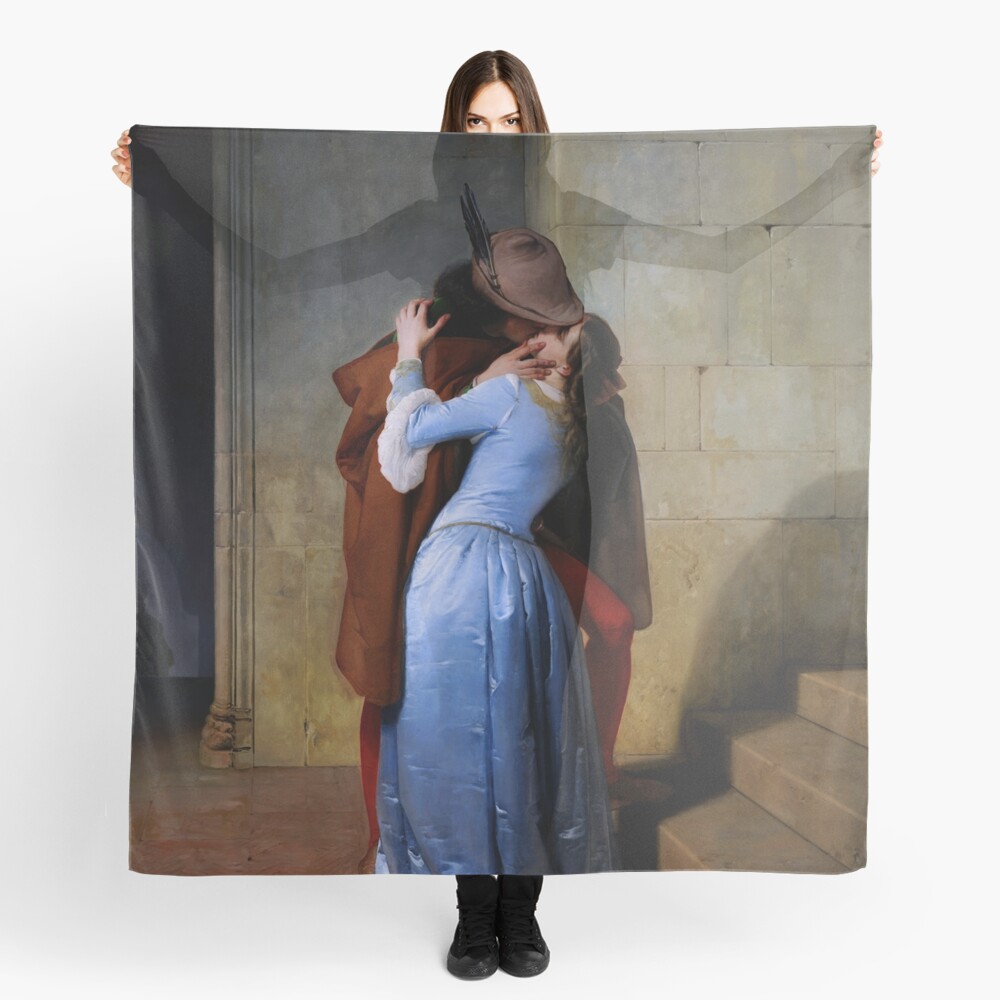
A ’Phòg (A ’phòg) c1859 leis a ’pheantair Eadailteach Francesco Hayez (1791 – 1882); bha e air fhaicinn mar phrìomh pheantair an Linn Romansachd ann am meadhan na 19mh linn ann am Milan san Eadailt. Bha e ainmeil airson na dealbhan mòra eachdraidheil aige, allegories poilitigeach agus dealbhan fìor mhath.
“Tha an Pòg” is a powerful and evocative painting by the renowned Italian artist Francesco Hayez, air a chruthachadh a-steach 1859. The artwork is a stunning example of Romanticism, a movement that was characterized by an emphasis on intense emotion, aonranachd, agus an sublime. Hayez’s portrayal of an intimate and passionate kiss between two figures is not just a romantic gesture but a deep, symbolic act reflecting the political and social turmoil of 19th-century Italy.
Anns a 'phìos seo, the central focus is the kiss shared between a man and a woman, each dressed in period-specific attire, their bodies entwined in a tender yet fervent embrace. The lovers’ aghaidhean, captured at the moment of their kiss, convey an overwhelming sense of passion and longing. An duine, dressed in a reddish-brown cloak, holds the woman with one hand, while his other hand grips a green object, possibly symbolizing life or hope. His face is partially obscured by his hat, but the tension in his posture reveals both his deep affection for the woman and the sense of urgency that seems to pervade the scene.
Am boireannach, clothed in a flowing blue gown, stands close to him, her body pressed against his in a stance that signifies emotional and physical closeness. A h-o chionn fhada, flowing hair is partially visible, her face bathed in the soft light that seems to emanate from the left, highlighting her delicate features. The deep emotional intensity in her expression, coupled with the almost sacred nature of the kiss, suggests that this moment is one of profound importance for both characters. The sensuality of the kiss is palpable, yet it is underscored by a sense of melancholy, as if this act of love must be performed in secrecy, or perhaps as a final farewell.
The setting of the artwork is crucial to understanding the deeper layers of its meaning. The scene takes place in an open, stone-walled interior, with towering, almost monolithic walls that loom over the lovers. These walls are not merely a backdrop but symbolize the oppression and constraints of the era, particularly in the context of Italy’s political situation. An garbh, unfinished stone surfaces hint at a time of transition and struggle.
The archway in the background frames the lovers, emphasizing their isolation in the moment and their vulnerability to the outside world. The positioning of the couple in front of the stone walls may also allude to the notion of love as a fortress in a time of uncertainty or political strife, where their embrace provides a form of protection from the harsh reality beyond.
The colors in the painting are rich and symbolic. The warm tones of the man’s cloak contrast with the cooler blues and whites of the woman’s gown, signifying a balance between opposing forces—passion and purity, action and passivity. The use of light is also notable; the couple is illuminated from one side, casting shadows on their bodies and the environment around them. This creates a sense of intimacy and draws the viewer’s attention solely to the couple, ensuring that the emotional intensity of their embrace remains the focal point of the composition.
A thaobh stuthan, the painting is executed with oil on canvas, a traditional medium that allows Hayez to achieve a remarkable level of detail and depth in his figures and surroundings. The texture of the canvas is almost palpable, with the brushstrokes contributing to the tactile nature of the painting. The artist’s skillful manipulation of light and shadow gives the piece a three-dimensional quality, making it feel as though the viewer could step into the scene and experience the emotional weight of the kiss firsthand.
An cuspair iomlan a “A ’Phòg” is one of passion, defiance, agus fadal. The moment captured is not simply a tender exchange between two lovers; it is an act of rebellion and a declaration of love against the backdrop of an oppressive society. At the time Hayez painted this work, Italy was undergoing significant political upheaval, as various regions were striving for unification and freedom from foreign domination.

The kiss, an uairsin, can be seen as a metaphor for the struggle for independence, with the lovers representing the spirit of resistance and the hope for a brighter, freer future. The kiss is not just an emotional act but a political statement, an expression of the deep desire for change that resonated with the people of Italy during the Romantic period.
The mood of the painting is complex and multi-layered. While it captures the intense passion of the lovers, it also evokes a sense of sorrow and longing. The lovers are caught in a moment of transcendence, but there is a sense that this moment is fleeting.
The raw emotion conveyed through their embrace suggests that their love is either forbidden or destined to end, making the act of kissing both a sweet and painful experience. The viewer is left to ponder whether the kiss signifies the beginning of a relationship, a final farewell, or a stolen moment in a turbulent world.
Ann an co-dhùnadh, Francesco Hayez’s “A ’Phòg” is not just a beautiful depiction of love and romance; it is a rich, symbolic painting that speaks to the political, sòisealta, and emotional climate of its time. The work’s exquisite use of light, dath, agus co-sgrìobhadh, combined with its deep thematic resonance, makes it a timeless masterpiece that continues to captivate viewers. It invites reflection on the nature of love, the power of passion, and the struggles that shape our world, all while celebrating the profound connection between two individuals caught in the midst of history.
The Kiss is a retouched digital art old masters reproduction of a public domain image that is available as an acrylic, meatailt, fiodh, rolled and clò-bhualadh canabhas air-loidhne.
Fiosrachadh gu h-ìosal bho Wikipedia.org
Bha Francesco Hayez bho theaghlach caran bochd à Venice. Athair, Giovanni, bha e bho thùs Frangach fhad ‘s a bha a mhàthair, Chiara Torcella, bha e à Murano. B ’e Francesco am fear ab’ òige de chòignear mhac.
Chaidh a thogail le piuthar a mhàthar, a bha air Giovanni Binasco a phòsadh, neach-seilbh shoithichean agus neach-cruinneachaidh ealain. Sheall Hayez predisposition airson tarraing bho òige. Bràthair athar, air mothachadh dha tàlant ro-innseach, chaidh e na phreantas ri ath-nuadhachadh ealain ann am Venice. Bhiodh Hayez a-rithist na sgoilear aig a ’pheantair Francesco Maggiotto leis an do lean e air le fhoghlam airson trì bliadhna.
Chaidh a leigeil a-steach gu cùrsa peantaidh Acadamaidh Ùr nan Ealan Fine ann am Venice ann an 1806, far an do rinn e sgrùdadh fo Teodoro Matteini. Ann an 1809 bhuannaich e farpais bho Acadamaidh Venice airson bliadhna air mhuinntireas aig an Accademia di San Luca san Ròimh.
Dh'fhuirich e anns an Ròimh gus 1814, ghluais e an uairsin gu Napoli far an deach a bharantachadh le Joachim Murat gus obair mhòr a pheantadh a ’sealltainn Ulysses aig cùirt Alcinous. Ann am meadhan na 1830an chaidh e gu Salon Maffei ann am Milan, air aoigheachd le Clara Maffei. Bhiodh an duine aig Maffei an uairsin a ’coimiseanadh dealbh de a bhean dha Hayez. Ann an 1850 Chaidh Hayez ainmeachadh mar stiùiriche Acadamaidh Brera.
Thar cùrsa-beatha fada, Bha Hayez air leth torrach. Bha an toradh aige a’ toirt a-steach dealbhan eachdraidheil air an dealbhadh gus a bhith tarraingeach do mhothachadh gràdhach a luchd-taic a bharrachd air obraichean a’ nochdadh a’ mhiann a bhith an cois stoidhle Neoclassic gu cuspairean mòra., an dara cuid bho litreachas a’ Bhìobaill neo clasaigeach.
Pheant e seallaidhean bho thaisbeanaidhean theatar cuideachd. Gu follaiseach neo-làthaireach bhon oeuvre aige, ge-tà, nan altarach – 's dòcha mar thoradh air na h-ionnsaighean Napoleon a dhì-thìodhlaiceadh mòran eaglaisean agus taighean-cràbhaidh ann an ceann a tuath na h-Eadailt. Thug an neach-eachdraidh ealain Corrado Ricci cunntas air Hayez mar chlasaigiche a thàinig gu bhith an uairsin ann an stoidhle buaireadh tòcail. Francesco Hayez, A ’Phòg (1859)
Tha na dealbhan aige cho dian sa tha Ingres agus an gluasad Nazarene. Gu tric a ’suidhe, Bidh cuspairean Hayez gu tric air an sgeadachadh ann an aodach cruaidh, aodach dubh is geal, le glè bheag gun accoutrements. Fhad ‘s a rinn Hayez dealbhan dha na h-uaislean, rannsaich e cuideachd cuspairean eile mar luchd-ealain agus luchd-ciùil. Anmoch na dhreuchd, tha fios gun do dh ’obraich e a’ cleachdadh dhealbhan.
B ’e aon de na cuspairean a b’ fheàrr le Hayez leth-aodach Odalisque cuimhneachail air cuspairean oirthireach - cuspair a b ’fheàrr le peantairean romansach.[3] Thug dealbhan de gheàrran agus na boireannaich aca cothrom do luchd-ealain seallaidhean a pheantadh nach gabhadh iad taobh a-staigh a ’chomainn-shòisealta. Tha eadhon barrachd mothachaidh aig eadhon Hayez’s Mary Magdalene na spionnadh creideimh.
Bha dealbh Hayez The Kiss air a mheas am measg na h-obrach as fheàrr leis na co-aoisean aige, agus is dòcha gur e an oidhirp as ainmeil aige. An gun urra, chan fheum gluasad-bodhaig gun bhuaidh a’ chàraid eòlas air uirsgeulan no litreachas airson a mhìneachadh, agus tarraingeach do shealladh ùr-nodha.
Tha measadh saidheansail air cùrsa-beatha Hayez air a dhèanamh iom-fhillte leis cho duilich ‘s a tha e airson gun a bhith a’ soidhnigeadh no a ’dol leis na h-obraichean aige. Gu math tric tha cinn-latha anns na dealbhan aige a 'sealltainn cuin a chaidh an obair fhaighinn no a reic, chan e àm a chruthachaidh. A bharrachd air sin, bhiodh e tric a’ peantadh na h-aon sgrìobhaidhean grunn thursan le glè bheag de dh’ atharrachaidhean, ma tha idir idir.
Am measg nan sgoilearan aige bho Acadamaidh Brera bha Carlo Belgioioso, Amanzio Cattaneo, Alessandro Focosi, Giovanni Battista Lamperti, Caoraich Livo, Angelo Pietrasanta, Antonio Silo, Carlo Antonio Tavella, Ismaele Teglio Milla agus Francesco Valaperta.
Bhàsaich Hayez ann am Milan, aois 91. Tha an stiùidio aige aig Acadamaidh Brera air a chomharrachadh le truinnsear.