

Gutuna
Gabriel Ferrier margolari frantsesaren gutuna (1847-1914); orientalista eta erretratugilea
Artelana, du izenburua Gutuna, eszena lasai eta liluragarria aurkezten du, erromantizismo eta dotorezia klasikoaren zentzua gogoraraziz. Irudian pentsamenduetan sakonki murgilduta dagoen emakume gazte bat ageri da, astiro-astiro, luma bati helduta, pergaminoaren gainean jarrita. Ezarpenak betikoa dirudi, isiltasuna areagotzen duen hondo leun baina atmosferiko aberatsarekin, eszenaren izaera islatzailea. Aingeru delikatua, hegoak zabalduta, sorbaldaren gainean doa, konposizioari ukitu ia etereoa eskainiz.
Emakumea da artelanaren gai nagusia. Azoka batekin irudikatzen da, portzelanazko azal leuna eta, uhin leunetan kaskada soltean jauzitako ile gorri kolorekoa, aurpegia markatuz. Bere begiak dira piezaren ardatza, kontenplazioa eta ilusioa uztartzen dituen esamoldearekin, hausnarketa pertsonaleko momentu batean galduta dagoela edo sakon hunkigarria den zerbait idazteko zorian dagoela iradokiz.
Lasai esertzen da, oraindik modu orekatua, jarioz jantzita, oihal berde zeharrargitsua, sorbaldetan eta besoetan zehar dotore jartzen dena. Ehunaren tolesdura leunek eta distira sotilek artistak ehundura delikatuak eta argia harrapatzen duen maisutasuna erakusten dute..
Bere eskua, ederki eutsita aurpegiaren aurrean, kokotsa onartzen du, besteak, berriz, luma bat dauka, bere aurrean papera seinalatuz. Papera tinta aztarna apalez estalita dago, baliteke gutun baten edo mezu poetiko baten hasieran iradokitzea, intimoari gehituz, eszenaren izaera ia isilpekoa. Ezarpena, leunki lausotu bitartean, hints at an indoor environment, likely a study or drawing room, characterized by a dark, warm-toned backdrop. The light is gentle, illuminating the woman’s face and the details of the soft, floral bouquet resting on the table.
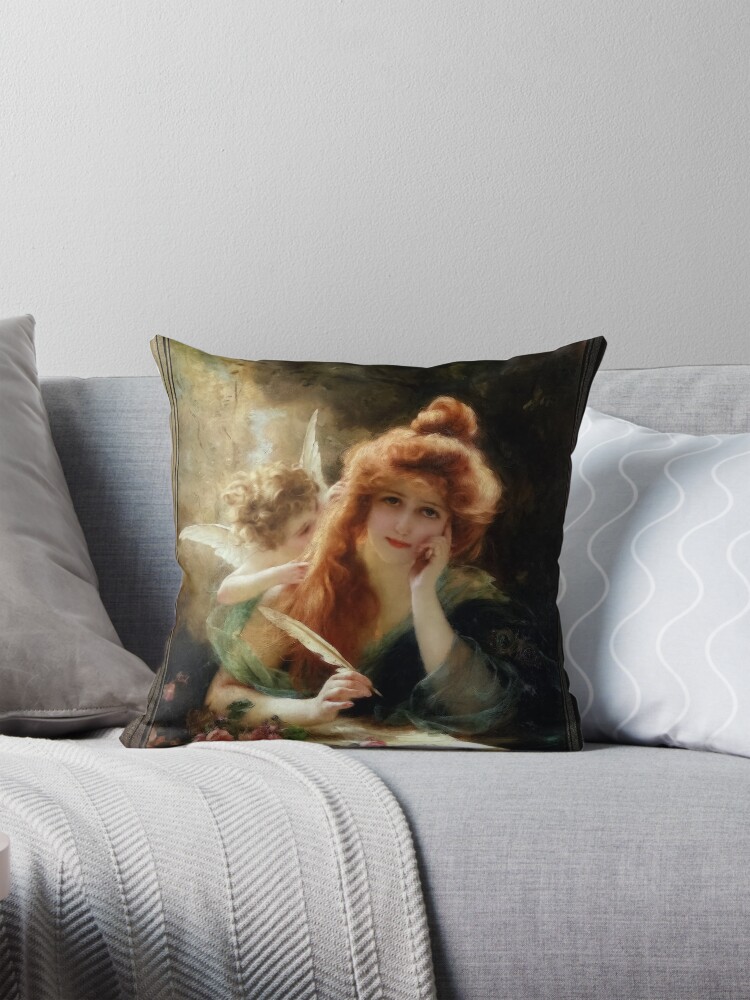
Haren ondoan, a soft pink and white bouquet of roses can be seen resting on the surface of the table. Arrosak, painted with care, convey a sense of romance and timeless beauty, further enhancing the emotional tone of the piece. The soft interplay of colors, from the muted green of her attire to the subtle shades of pink in the roses, evokes a sense of calmness and grace. The color palette overall remains delicate, with a harmonious mix of soft pastel hues and deep shadows.
In the upper-left corner, an angel-like figure appears, floating gently behind the woman. The angel’s wings, depicted with delicate brushstrokes, are soft and almost translucent. The figure’s youthful form, with an innocent and almost mischievous expression, adds a layer of mystical charm to the composition. The angel appears to be whispering or playing a role of guidance, which infuses the scene with a sense of divine intervention or inspiration.
The mood of the painting is soft, barneratzailea, and infused with a sense of romanticism. It evokes a timeless moment of quiet solitude, where the viewer feels drawn into the emotional world of the subject. The artist has carefully created a sense of privacy and intimacy, inviting the viewer to imagine what the woman might be writing or contemplating, and the angel’s presence lends an air of spiritual guidance, suggesting that her words are significant, perhaps the beginnings of a love letter, a poem, or a missive imbued with personal sentiment.
The theme of communication, whether through written word or quiet reflection, is central to the narrative, reinforced by the presence of the writing tools, the paper, and the serene ambiance.
Argiaren erabilera bereziki aipagarria da. The artist employs a gentle, diffused light that bathes the figures in soft radiance, creating an almost dreamlike atmosphere. The light seems to emanate from a source off-screen, casting a glow that highlights the woman’s face and shoulders, while the shadows around her deepen, focusing attention on her thoughtful expression and the delicate motions of the angel. Argi eta itzal jokoak artelanaren sakontasun emozionala areagotzen du, betikoa emanez, ia beste munduko kalitatea.
Pinturaren estiloa XIX.mendearen amaierako erromantizismorantz makurtzen da, pintzelkada leunekin, adierazpen emozionalaren arreta, eta etereo bat, gai ia mistikoa. Foku bigunak eta hondo lausoak foku leuneko errealismoaren teknika islatzen dute, garai honetako artistek erabili ohi duten metodoa gaiaren edertasun idealizatua zorrotz gabe harrapatzeko, arreta distraitzen duten xehetasunak. Kolorearen erabilerak ere tradizio erromantikoari jarraitzen dio, leunarekin, tonu isilduak giro lasaia sortuz, hala ere, itzal sakonei misterioa eta introspekzioa sorrarazteko aukera ematen die.
Materialei dagokienez, artistaren euskarria mihise gaineko olioa dela dirudi, pinturaren geruza aberatsarekin. Pintzelkaden ehundura ikusten da, especially in the portrayal of the angel’s wings and the woman’s clothing, where the artist has applied the paint in a loose, fluid manner to create a sense of movement and softness. The contrast between the soft textures of the figures and the still life elements, such as the roses and parchment, adds a tactile quality to the artwork, inviting the viewer to feel as though they could reach out and touch the surface of the canvas.
Orokorrean, The Letter captures a moment of profound introspection and spiritual connection, framed within a richly romantic narrative. The harmonious use of color, argia, and form creates a captivating, timeless image that speaks to the viewer on an emotional and intellectual level. The presence of the angel offers an element of divine inspiration, while the quiet contemplation of the young woman draws the viewer into a narrative that is both personal and universal.
The Letter is a retouched digital art old masters reproduction of a public domain image that is available as a ijetzitako inprimaketa linean.
Informazioa Behean Deribatua Wikipedia.org
Gabriel began his art studies at the École des Beaux-Arts, where he worked with French Academic Painters Ernest Hébert (1817 – 1908) and Isidore Pils (1815 – 1875); he also studied at the French Academy in Rome from 1873 to 1876.
His first exhibit was at the Salon in 1869; and two years later when he was in Rome, he was awarded the Prix de Rome for his depiction of a scene from the Flood.
When he returned to France, he began specializing in creating portraits of notable figures connected with The French Third Republic.
In 1883, he took an extended trip to Algeria, where he created works in the Orientalist style; with some of those works earning him a Gold Medal at the Exposition Universelle in 1889.
Gabriel was later named a Professor of Design at the Maison d’éducation de la Légion d’honneur, and then he became a lecturer at the École des Beaux-arts, succeeding French Academic Painter Jean-Léon Gérôme (1824 – 1904).
He was also an instructor at the Académie Julian; eta barruan 1906, he was elected to the Académie des Beaux-Arts. He was also a member of the Société des Artistes Français, eta barruan 1911, became a Knight in the Légion d’honneur.
Among Gabriel Ferrier best known students are Paul-Émile Bécat (1885 – 1960), Roger Bissière (1886 – 1964), André Fau (1896 – 1982), Luis Ricardo Falero (1851 – 1896) and Albert Lynch (1860 – 1950); some of their works can also be found on this site.