

Brevet
Brevet av franska målaren Gabriel Ferrier (1847-1914); en orientalist och porträttmålare
Konstverket, med titeln The Brev, presenterar en fridfull och fängslande scen, frammana en känsla av klassisk romantik och elegans. Bilden visar en ung kvinna som är djupt nedsänkt i tankar medan hon försiktigt håller en fjäderpenna, ställd över pergament. Inställningen verkar tidlös, med en mjuk men ändå rikt atmosfärisk bakgrund som förstärker tystnaden, scenens reflekterande karaktär. En känslig ängel, med utfällda vingar, svävar över hennes axel, ger en nästan eterisk touch till kompositionen.
Kvinnan är det centrala motivet i konstverket. Hon är avbildad med en mässa, porslin hy och mjuk, kastanjebrunt hår som faller löst i mjuka vågor, ramar in hennes ansikte. Hennes ögon är i fokus för verket, med ett uttryck som förenar kontemplation och längtan, suggesting that she is either lost in a moment of personal reflection or on the verge of writing something deeply emotional.
She sits in a relaxed, yet poised manner, dressed in flowing, translucent green fabric that drapes elegantly over her shoulders and down her arms. The fabric’s soft folds and subtle highlights demonstrate the artist’s mastery of capturing delicate textures and light.
Her hand, held delicately in front of her face, supports her chin, while the other holds a quill, pointing to the paper in front of her. The paper is covered with faint traces of ink, possibly hinting at the beginnings of a letter or a poetic message, adding to the intimate, almost secretive nature of the scene. Inställningen, while softly blurred, hints at an indoor environment, likely a study or drawing room, kännetecknas av ett mörkt, varmtonad bakgrund. Ljuset är mjukt, lyser upp kvinnans ansikte och detaljerna i det mjuka, blommig bukett vilande på bordet.
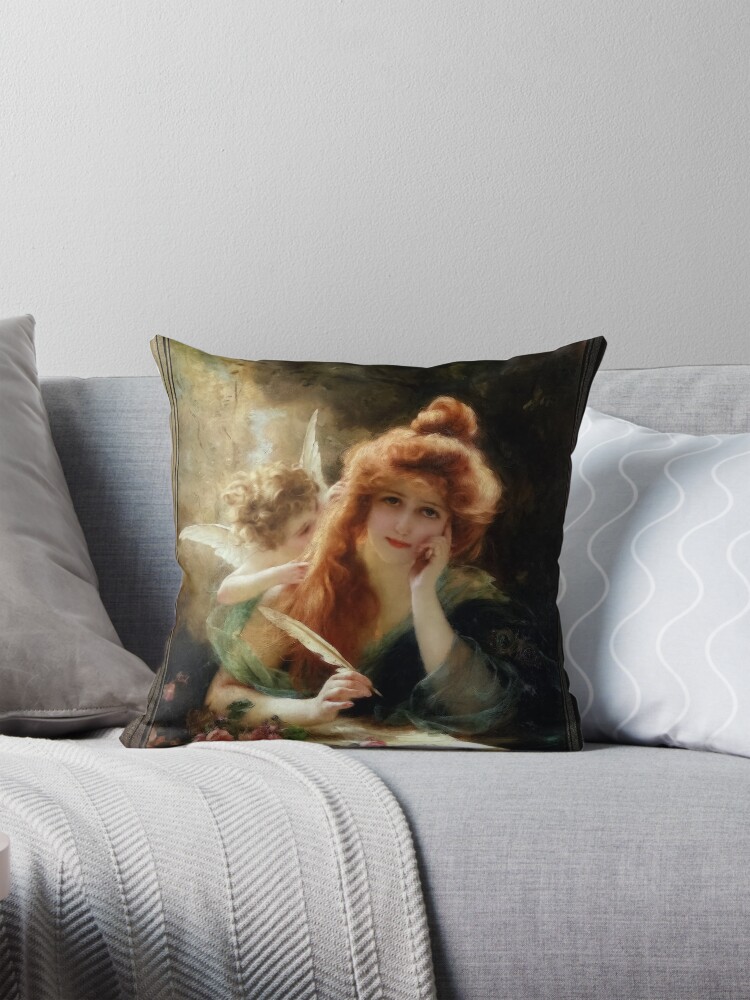
Bredvid henne, en mjuk rosa och vit bukett rosor kan ses vila på bordets yta. Rosorna, målade med omsorg, förmedla en känsla av romantik och tidlös skönhet, ytterligare förstärker den känslomässiga tonen i stycket. Det mjuka samspelet av färger, från det dämpade gröna i hennes klädsel till de subtila rosa nyanserna i rosorna, framkallar en känsla av lugn och nåd. Färgpaletten överlag förblir delikat, med en harmonisk blandning av mjuka pastellfärger och djupa skuggor.
I det övre vänstra hörnet, en ängelliknande figur dyker upp, svävar försiktigt bakom kvinnan. ängelns vingar, depicted with delicate brushstrokes, are soft and almost translucent. The figure’s youthful form, with an innocent and almost mischievous expression, adds a layer of mystical charm to the composition. The angel appears to be whispering or playing a role of guidance, which infuses the scene with a sense of divine intervention or inspiration.
The mood of the painting is soft, introspective, and infused with a sense of romanticism. It evokes a timeless moment of quiet solitude, where the viewer feels drawn into the emotional world of the subject. The artist has carefully created a sense of privacy and intimacy, inviting the viewer to imagine what the woman might be writing or contemplating, and the angel’s presence lends an air of spiritual guidance, suggesting that her words are significant, perhaps the beginnings of a love letter, a poem, or a missive imbued with personal sentiment.
The theme of communication, whether through written word or quiet reflection, är central i berättelsen, reinforced by the presence of the writing tools, the paper, and the serene ambiance.
Användningen av ljus är särskilt anmärkningsvärd. The artist employs a gentle, diffused light that bathes the figures in soft radiance, creating an almost dreamlike atmosphere. The light seems to emanate from a source off-screen, casting a glow that highlights the woman’s face and shoulders, while the shadows around her deepen, focusing attention on her thoughtful expression and the delicate motions of the angel. The play of light and shadow enhances the emotional depth of the artwork, giving it a timeless, Nästan annan världskvalitet.
The style of the painting leans toward the late 19th century Romanticism, with soft brushstrokes, a focus on emotional expression, and an ethereal, almost mystical theme. The soft focus and blurred background reflect the technique of soft-focus realism, a method commonly used by artists of this period to capture the idealized beauty of the subject without sharp, distracting details. The use of color also follows the romantic tradition, med mjuk, muted tones creating a serene atmosphere, while still allowing for deep shadows to evoke mystery and introspection.
När det gäller material, the artist’s medium appears to be oil on canvas, with a richly layered application of paint. The texture of the brushstrokes is visible, especially in the portrayal of the angel’s wings and the woman’s clothing, where the artist has applied the paint in a loose, fluid manner to create a sense of movement and softness. The contrast between the soft textures of the figures and the still life elements, such as the roses and parchment, adds a tactile quality to the artwork, inviting the viewer to feel as though they could reach out and touch the surface of the canvas.
Total, The Letter captures a moment of profound introspection and spiritual connection, framed within a richly romantic narrative. The harmonious use of color, ljus, and form creates a captivating, timeless image that speaks to the viewer on an emotional and intellectual level. The presence of the angel offers an element of divine inspiration, while the quiet contemplation of the young woman draws the viewer into a narrative that is both personal and universal.
The Letter is a retouched digital art old masters reproduction of a public domain image that is available as a rullat tryck online.
Info nedan härledd från Wikipedia.org
Gabriel började sina konststudier vid École des Beaux-Arts, där han arbetade med franska akademiska målare Ernest Hébert (1817 – 1908) och Isidore Pils (1815 – 1875); han studerade också vid franska akademin i Rom från 1873 till 1876.
Hans första utställning var på salongen i 1869; och två år senare när han var i Rom, han tilldelades Prix de Rome för sin skildring av en scen från syndafloden.
När han återvände till Frankrike, han började specialisera sig på att skapa porträtt av anmärkningsvärda figurer kopplade till Franska tredje republiken.
I 1883, han tog en längre resa till Algeriet, där han skapade verk i orientalistisk stil; med några av de verken som ger honom en guldmedalj på Exposition Universelle i 1889.
Gabriel utsågs senare till professor i design vid House of Education of the Legion of Honor, och sedan blev han föreläsare vid École des Beaux-arts, efterträdande franska akademiska målaren Jean-Léon Gérôme (1824 – 1904).
Han var också instruktör på Académie Julian; och i 1906, han valdes till Académie des Beaux-Arts. Han var också medlem i Société des Artistes Français, och i 1911, blev riddare i Légion d’honneur.
Bland Gabriel Ferrier mest kända studenter finns Paul-Émile Bécat (1885 – 1960), Roger bissiere (1886 – 1964), André Fau (1896 – 1982), Luis Ricardo Falero (1851 – 1896) och Albert Lynch (1860 – 1950); några av deras verk finns också på denna webbplats.