

Le petit fleuriste
“Le petit fleuriste” is a captivating portrayal of childhood innocence and the delicate beauty of nature, Créé par le peintre britannique Thomas-Francis Dicksee (1819 – 1895). Painted in the mid-19th century, this artwork invites the viewer into a serene world, where a young child interacts with the natural world. Dicksee’s remarkable attention to detail and his use of soft, realistic techniques make this piece stand out in the genre of Victorian portraiture.
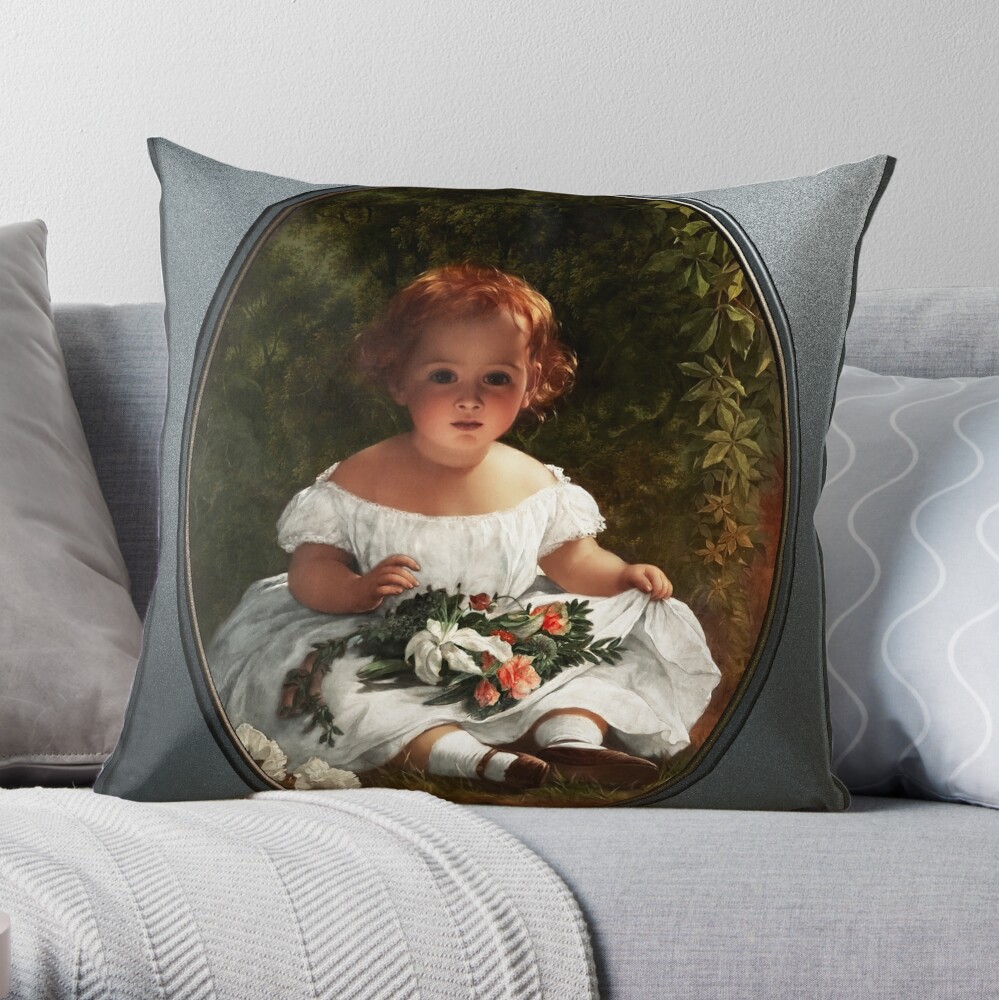
Table des matières
Sujet et composition
Au coeur de “Le petit fleuriste” is a young girl, dressed in a simple, white dress, seated gracefully on the lush green grass. Her delicate figure is poised with a natural elegance that is emblematic of the artist’s ability to capture the purity and innocence of childhood. The girl’s large, wide eyes are full of wonder and curiosity, entraînant le spectateur dans son monde. She is holding a small bouquet of flowers, including lilies, that she seems to have gathered from the surrounding environment. The child’s red curls cascade gently around her face, enhancing the youthful, innocent aura that pervades the scene.
Son expression, somewhat serious yet thoughtful, provides a sense of introspection, as though she is taking a moment to appreciate the beauty she holds. The girl’s hands delicately grasp the flowers, suggesting both a sense of gentleness and a budding connection to nature. The juxtaposition of her tender care for the bouquet with the seemingly unhurried mood of the piece invites the viewer to reflect on the innocence and peace of early childhood.
Terrain et environnement
The setting of this portrait adds another layer of richness to the composition. En arrière-plan, there is a lush, green woodland with dense foliage that frames the child. This natural setting, rendered in a realistic and almost painterly manner, provides a stark contrast to the simplicity of the child’s white dress and the delicate bouquet she holds. The greens of the plants and trees give the piece a soft vibrancy, which harmonizes with the soft tones of the girl’s clothing. It is as if the child is part of the natural world, in harmony with the flora around her.
The background is not just a passive setting; it actively contributes to the mood of the piece. The rich foliage creates a sense of seclusion and tranquility, enhancing the feeling of intimacy between the viewer, the child, et la nature. The softness of the brushstrokes that define the terrain speaks to the artist’s mastery in creating a realistic yet gentle portrayal of nature, reinforcing the serenity of the scene.
Matériaux et techniques
Au niveau des matériaux, the artist likely used oil paints on canvas, which was typical of the period. This allowed for a rich depth of color and a blending of tones that would give the artwork a life-like, three-dimensional quality. Le doux, almost ethereal quality of the girl’s skin and the delicate rendering of the flowers suggest a fine level of brushwork, indicative of Dicksee’s skill and the artistic standards of the Victorian era.
The texture of the work also highlights Dicksee’s technical ability. The light and shadows on the child’s face are subtle, yet they contribute to the depth and realism of the portrait. The smoothness of the brushwork used on her skin contrasts with the rougher, more textured application of paint in the background foliage. The light is diffused, contributing to an overall soft atmosphere that enhances the mood of calmness and reflection. The precision with which the bouquet is painted—each petal and leaf defined with clarity—further demonstrates the artist’s attention to detail, ensuring that the flowers are as prominent and central to the composition as the figure herself.
Style et influence
Le style de “Le petit fleuriste” is consistent with the Victorian tradition of portraiture, though it moves slightly beyond the formal, stiff portraits that were characteristic of the period. Dicksee was known for his classical training, ce qui se reflète dans le rendu gracieux des formes de l’enfant et la fluidité de sa tenue vestimentaire. L'œuvre n'est pas simplement un portrait mais une pièce narrative qui parle de l'innocence de l'enfance et du lien avec la nature., thèmes souvent explorés dans l'art victorien.
La palette sourde du tableau : des blancs doux, légumes verts terreux, et de subtiles touches de rouge - reflète le style classique adopté par Dicksee. L'ambiance du tableau est sereine et contemplative, mais il conserve un sentiment de dynamisme, notamment dans l'interaction entre l'enfant et le bouquet qu'il tient. Le coup de pinceau, l'utilisation de la lumière et de l'ombre, et la palette de couleurs douces travaillent ensemble pour transmettre un sentiment de paix et de simplicité., qui rappelle l'innocence de l'enfance.
Thème et humeur
Le thème de “Le petit fleuriste” tourne autour de l'enfance, innocence, and a harmonious relationship with nature. The girl’s gentle demeanor, as she interacts with the flowers, symbolizes purity, while the flowers themselves represent growth and natural beauty. The quiet, thoughtful expression on her face suggests a connection to the world around her, one that is both contemplative and serene.
The mood of the painting is peaceful and introspective. There is no urgency in the child’s movements, and the overall tone is one of calm. The painting invites the viewer to pause and reflect, much like the child in the artwork, on the simple beauties of the world. The background’s lush greenery and the soft glow of light that envelops the figure create an atmosphere of serenity, allowing the viewer to experience the stillness and calmness of the scene.
Conclusion
“Le petit fleuriste” by Thomas-Francis Dicksee is a timeless masterpiece that encapsulates the delicate beauty of childhood and the quiet splendor of nature. Through his skilled use of color, lumière, et texture, Dicksee brings to life a serene, contemplative moment that is both intimate and universal. The painting speaks to the viewer on a deeply emotional level, drawing attention to the purity of the child and the harmonious relationship between humanity and the natural world. In its simplicity, the piece becomes a powerful reflection on the transient beauty of youth and the natural world.
Notes About The Image Restoration
Since the background was severely damaged (looked like water damage), and the background was almost completely black; I decided to use the trees of another classical art piece called Anglers by a Pond by Jacob van Ruisdael (1628 – 1682) for the background; and blend it in with the plants that were still visible on the Little Florist.
Il s'agit d'une reproduction de maîtres anciens d'art numérique remasterisée d'une image du domaine public qui est disponible en tant que canvas print online for purchase in sizes up to 24 pouce par 30 inch in a variety of mediums including acrylic, métal, wood and rolled canvas prints.