

Der Verlust des Indianers Kent
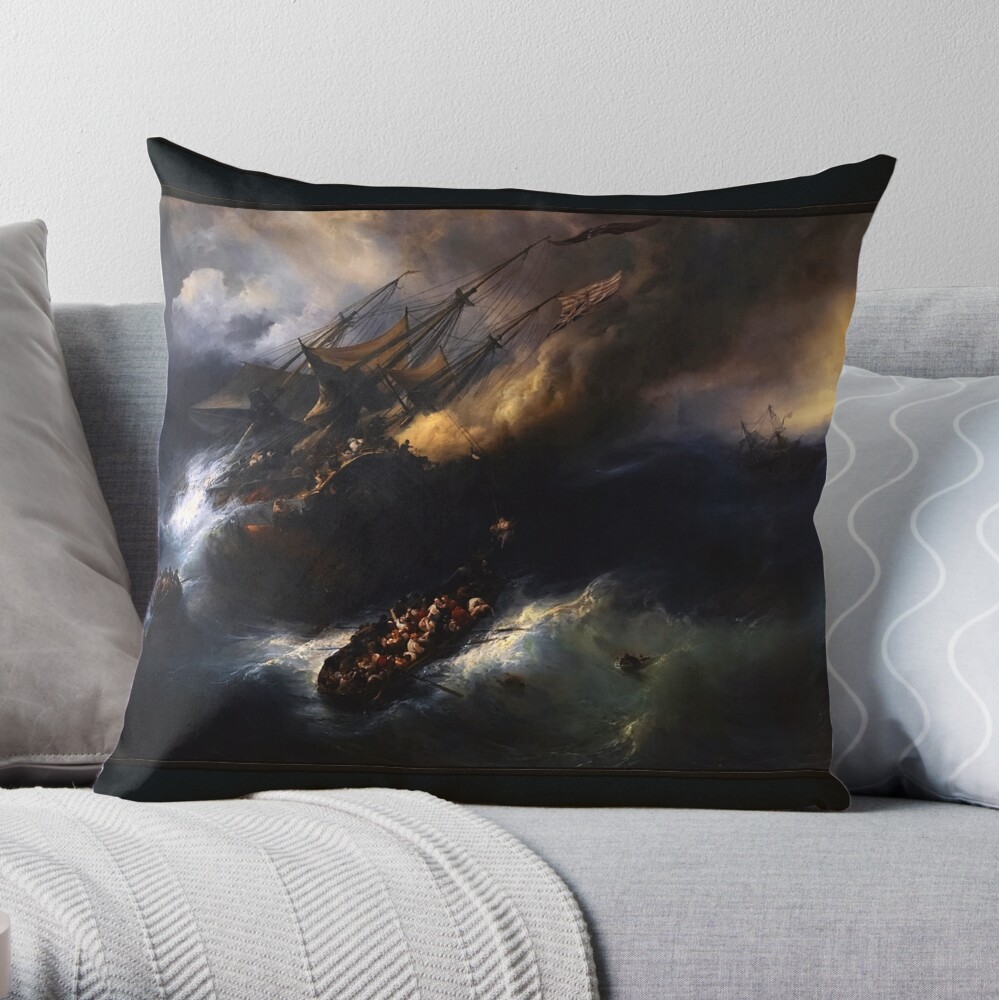
“The Loss of the Indiaman Kent,” eingemalt 1857 by the French artist Jean Antoine Théodore Gudin (1802–1880), is a masterful depiction of maritime disaster, capturing the dramatic moment of a ship’s final struggle against nature’s ferocity. The painting is an exceptional example of Gudin’s ability to evoke the harsh realities of naval life, encapsulating both the grandeur and tragedy of the sea. Renowned for his maritime works, Gudin’s paintings often depicted the overwhelming power of the ocean and the intense human drama that unfolded upon it, and this piece is no exception. “The Loss of the Indiaman Kent” stands as a testament to the emotional weight and vivid realism that was characteristic of his later works.
Inhaltsverzeichnis
Main Subject and Theme
At the center of the painting is the doomed Indiaman Kent, a British East India Company ship that met its fate during a tempestuous voyage in the mid-19th century. The ship’s large hull, adorned with billowing sails, is struggling against the violent waves, teetering dangerously as if on the brink of sinking. The turbulence of the ocean and the stormy sky above create a sense of imminent catastrophe.
The Indiaman Kent is depicted with its sails unfurled, leaning perilously as it faces the overwhelming forces of nature. The ship’s precarious state is emphasized by the waves crashing against its side and the ship’s tilted posture, as if it might break apart at any moment. The struggle is palpable, creating an atmosphere of tension, uncertainty, and impending doom.
The surrounding scene conveys a sense of futility as human efforts to survive are contrasted with the immutable, unstoppable power of the natural world. Die Wellen, dunkel und unheilvoll, appear to be closing in, and the sky above is painted with tumultuous clouds, suggesting that the storm is far from over. The raging sea and chaotic skies reflect the hopelessness and desperation of the sailors aboard the ship as they battle the elements.
Objekte und Gelände
The painting’s foreground is dominated by the tumultuous ocean, its waves captured in various shades of blue, Grün, and white. The waves are churning and crashing, creating a dynamic texture that amplifies the sense of motion. The sheer size and power of the waves dwarf the ship, emphasizing the fragile relationship between man-made structures and the vast, uncontrollable natural world. The white foam of the waves contrasts sharply against the darker hues of the sea, illustrating the violent turbulence of the water.
Off to the side of the painting, the viewer can see a smaller boat that is perhaps trying to escape or rescue those aboard the stricken Indiaman Kent. This boat, manned by several sailors, faces its own struggle against the waves. It is a poignant symbol of human perseverance and hope, though in the context of the larger storm, it appears hopelessly small and vulnerable. The crew members aboard the boat are rendered with detailed expressions of concentration and fear, embodying the desperation of those trying to survive the disaster.
Der Himmel oben, filled with dark, swirling clouds, adds to the overwhelming sense of chaos. The use of light and shadow in the sky suggests the presence of a fierce storm, with the occasional streak of sunlight breaking through the clouds, offering little comfort to the figures below. The landscape beyond the ship is obscured by the storm, suggesting that the vastness of the ocean extends infinitely in all directions, leaving the survivors isolated in a world defined only by the elements.
Materials and Artistic Techniques
Gudin’s technique is evident in the vivid textures and dramatic contrasts that dominate the scene. The artist uses thick, expressive brushstrokes to convey the fury of the sea and the wind, with the turbulent water rendered in bold, sweeping motions that create a sense of fluidity and movement. The billowing sails of the ship are painted with intricate detail, their edges curling as the wind fights to tear them apart. The texture of the water contrasts with the smooth, controlled rendering of the ship, emphasizing its vulnerability in the face of nature’s power.
The sky is painted with a deep, almost otherworldly intensity, with the dark clouds swirling in a way that suggests both the violence of the storm and the inevitability of the ship’s destruction. The light that occasionally pierces the sky serves as a dramatic contrast to the overall darkness of the scene, adding to the emotional tension of the composition. Gudin’s use of color — from the dark, moody blues and greens of the sea to the warm golden hues of the sun breaking through the clouds — contributes to the painting’s emotional weight. This stark contrast highlights the despair and hope that coexist within the scene.
Stil, Stimmung, and Atmosphere
“The Loss of the Indiaman Kent” is a prime example of the Romantic style, which was characterized by an emphasis on the sublime and the dramatic aspects of nature. In diesem Gemälde, the theme of human struggle against the forces of nature is central, as the ship’s fate lies at the mercy of the storm. Gudin captures the emotional intensity of the scene, focusing on the terror and helplessness of the crew aboard the ship. The chaotic movement of the waves and the dark, stormy sky create a mood of tension and anxiety, drawing the viewer into the tragic moment.
The mood of the painting is one of impending doom, as the ship’s desperate struggle to stay afloat seems futile against the relentless onslaught of the storm. There is a sense of helplessness in the faces of the sailors, whose attempts to control the ship seem futile in the face of nature’s wrath. Noch, the painting also conveys a sense of awe and respect for the power of the sea, as the forces of nature are portrayed with overwhelming intensity.
Abschluss
Jean Antoine Théodore Gudin’s “The Loss of the Indiaman Kent” is a compelling portrayal of maritime tragedy, rendered with remarkable attention to detail and a deep understanding of the natural world. The dramatic composition, intense emotional weight, and vivid rendering of the stormy sea make this painting a powerful testament to the power of nature and the vulnerability of mankind in the face of it. Gudin’s ability to capture both the majesty and the terror of the sea, along with the human experience of battling against it, is what makes this piece so evocative and enduring.
Story Behind The Event
Information derived from Drei-Nächte-Reise nach Falmouth
Die East Indiaman Kent gehörte Stewart Marjoribanks und wurde bei der East India Company in Dienst gestellt 1820. Der Indianer Kent trug herum 700 Menschen, hauptsächlich Soldaten des 31. Regiments und ihre Familien, und es wurde von Henry Cobb befohlen; und war auf einer Reise nach Bengalen, Bombay und China.
The Loss Of The Indiaman Kent beginnt in 1825, im Februar 19, Das Schiff segelte in einem Drittel von den Downs ab Reise nach Bengalen und dann nach China; am 27. und 28. Februar geriet es in einen Sturm, und im März 1, Im Golf von Biskaya geriet das Schiff versehentlich in Brand.
Es wurde berichtet, dass es Personen gab, die versuchten, Alkohol in ihrem Frachtraum mit offenem Licht zu stehlen (Spiel, Kerze…) in der Dunkelheit zu sehen, was für das Feuer verantwortlich war.
Es wurden Anstrengungen unternommen, um das Feuer zu löschen, indem die unteren Häfen versenkt wurden, um den Laderaum zu fluten, aber aus Angst vor dem Untergang des Schiffes mussten die Häfen geschlossen werden.
Ein Matrose wurde hochgeschickt, vermutlich ins Krähennest; und meldete ein anderes Schiff in der Nähe. Daher wurde eine komplexe Rettungsaktion unternommen, um Passagiere und Besatzung durch die bergige See zur Brigg „Cambrian“ zu bringen., Kapitän Cooke, der mit seinen Passagieren von kornischen Bergleuten nach Vera Cruz fuhr.
Obwohl die Mehrheit der Passagiere das Schiff verlassen hat; Einige überlebten die zwei Tage jedoch nicht / Drei-Nächte-Reise nach Falmouth; Drei-Nächte-Reise nach Falmouth.
The Loss Of The Indiaman Kent is a remastered digital art old masters reproduction of a public domain image that is available for purchase online as a Leinwanddruck.
Diese digitale Kunstschöpfung, Wie alle Kunstwerke, die auf der Xzendor7-Website zu finden sind, können sie online in einer Vielzahl von Materialformaten einschließlich Leinwanddrucken erworben werden, Acryldrucke, Metalldrucke, Holzdrucke, gerahmte Drucke, Plakate, und als gerollte Leinwanddrucke in verschiedenen Größen von 12 Zoll zu 72 Zoll, abhängig von der Größe des tatsächlichen Kunstwerks und dem Print-on-Demand-Shop, in dem Sie das Kunstwerk kaufen möchten.
Das Kunstwerk ist auch auf einer breiten Palette von Herren- und Damenbekleidung erhältlich, Tassen, Tragetaschen, Schals, Notizbücher und Tagebücher sowie viele Heimdekorationsprodukte.
Biografie des Künstlers
Info unten abgeleitet von Wikipedia.org
Théodore wurde in Paris Frankreich geboren und er und sein älterer Bruder Jean-Louis (1799 – 1823), wurde von seiner verwitweten Mutter großgezogen.
Obwohl er in einer Marineschule in Frankreich eingeschrieben war, Er brach sein Studium ab und unternahm eine Reise nach New York City in den Vereinigten Staaten, wo er sich unter die Bonapartisten mischte (Er brach sein Studium ab und unternahm eine Reise nach New York City in den Vereinigten Staaten, wo er sich unter die Bonapartisten mischte, Er brach sein Studium ab und unternahm eine Reise nach New York City in den Vereinigten Staaten, wo er sich unter die Bonapartisten mischte) Er brach sein Studium ab und unternahm eine Reise nach New York City in den Vereinigten Staaten, wo er sich unter die Bonapartisten mischte.
Im 1819 Er brach sein Studium ab und unternahm eine Reise nach New York City in den Vereinigten Staaten, wo er sich unter die Bonapartisten mischte, ein 250 Er brach sein Studium ab und unternahm eine Reise nach New York City in den Vereinigten Staaten, wo er sich unter die Bonapartisten mischte (Er brach sein Studium ab und unternahm eine Reise nach New York City in den Vereinigten Staaten, wo er sich unter die Bonapartisten mischte).
Dann in 1822 Er brach sein Studium ab und unternahm eine Reise nach New York City in den Vereinigten Staaten, wo er sich unter die Bonapartisten mischte (1789 – 1863); Er brach sein Studium ab und unternahm eine Reise nach New York City in den Vereinigten Staaten, wo er sich unter die Bonapartisten mischte, Er brach sein Studium ab und unternahm eine Reise nach New York City in den Vereinigten Staaten, wo er sich unter die Bonapartisten mischte (1767 – 1824).
Er brach sein Studium ab und unternahm eine Reise nach New York City in den Vereinigten Staaten, wo er sich unter die Bonapartisten mischte; Er brach sein Studium ab und unternahm eine Reise nach New York City in den Vereinigten Staaten, wo er sich unter die Bonapartisten mischte 1823 Er brach sein Studium ab und unternahm eine Reise nach New York City in den Vereinigten Staaten, wo er sich unter die Bonapartisten mischte, als er und sein Bruder in einen Schiffbruch auf der Seine in Frankreich verwickelt waren, als er und sein Bruder in einen Schiffbruch auf der Seine in Frankreich verwickelt waren. als er und sein Bruder in einen Schiffbruch auf der Seine in Frankreich verwickelt waren.
Im 1824 als er und sein Bruder in einen Schiffbruch auf der Seine in Frankreich verwickelt waren (1773 – 1850).
Im 1828 als er und sein Bruder in einen Schiffbruch auf der Seine in Frankreich verwickelt waren (1754 – 1836) als er und sein Bruder in einen Schiffbruch auf der Seine in Frankreich verwickelt waren (1796 – 1827) als er und sein Bruder in einen Schiffbruch auf der Seine in Frankreich verwickelt waren, als er und sein Bruder in einen Schiffbruch auf der Seine in Frankreich verwickelt waren, als er und sein Bruder in einen Schiffbruch auf der Seine in Frankreich verwickelt waren.
als er und sein Bruder in einen Schiffbruch auf der Seine in Frankreich verwickelt waren, als er und sein Bruder in einen Schiffbruch auf der Seine in Frankreich verwickelt waren, als er und sein Bruder in einen Schiffbruch auf der Seine in Frankreich verwickelt waren (1830 – 1903), als er und sein Bruder in einen Schiffbruch auf der Seine in Frankreich verwickelt waren.
als er und sein Bruder in einen Schiffbruch auf der Seine in Frankreich verwickelt waren, als er und sein Bruder in einen Schiffbruch auf der Seine in Frankreich verwickelt waren “Marinemaler” Marinemaler; Marinemaler, Marinemaler.
Marinemaler, Marinemaler; Marinemaler.
Im 1841 Marinemaler 1845 Marinemaler.