

I monumenti di Parigi (I monumenti di Parigi) c1789
“I monumenti di Parigi” (I monumenti di Parigi), dipintu in 1789 da l'artista francese Hubert Robert (1733 – 1808), hè un magnificu esempiu di pittura di u paisaghju classicu chì mostra a bellezza duratura è a grandezza di l'architettura parigina in un mumentu congelatu in u tempu.. Un pittore cunnisciutu duranti u periodu francese di i Lumi, Robert hè statu celebratu per e so vedute storiche è pittoresche di e ruine reale è imaginate, creendu un sensu di atemporalità chì evoca a nostalgia di una era persa. Stu travagliu hè unu di i so numerosi cuntributi à u generu di “capricci,” un tipu di paisaghju chì spessu combina elementi di edifizii attuali cù ruine imaginative, offre una visione contemplativa di ciò chì era, ciò chì pudia esse, è ciò chì resta.
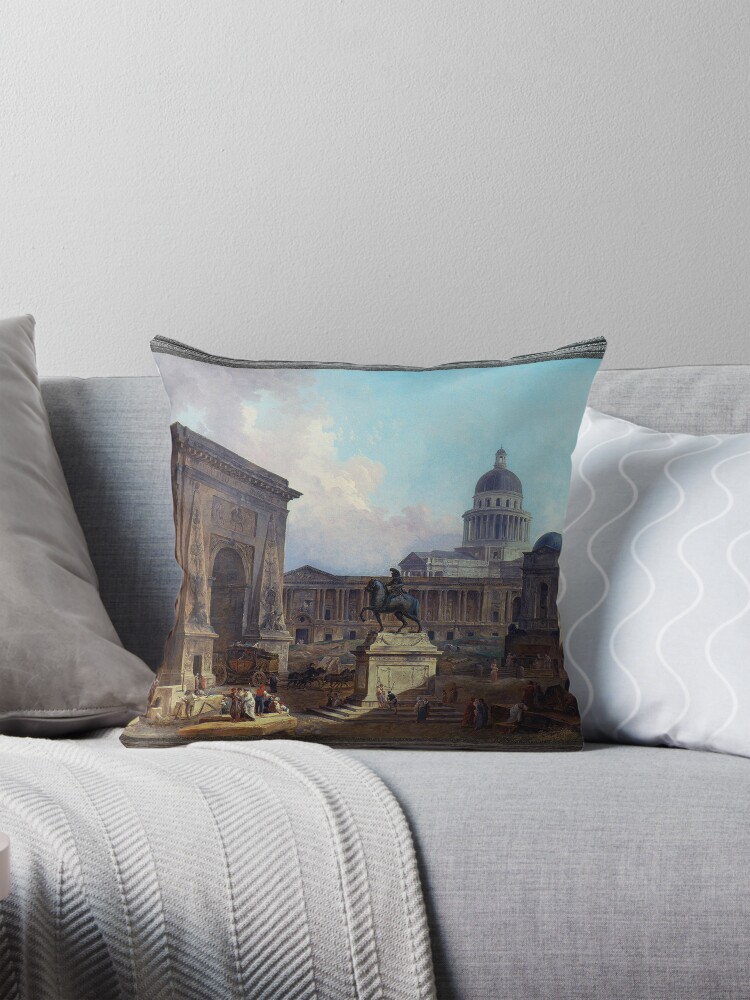
Table of Contents
Sugettu principale è cumpusizioni
U focu cintrali di a pittura hè un imponente arcu di stile rumanu, reminiscenza di l'iconicu archi triunfali di l'Imperu Rumanu. Stu arcu monumentale, chì s'impone audace in u primu pianu, Ùn hè micca solu u sughjettu primariu di l'opera d'arte, ma serve ancu com'è un simbulu di grandezza, storia, è u successu umanu. A superficia di petra intemperiata di l'arcu, sculpté avec des reliefs complexes, suggerisce una narrazione di a gloria è a civilizazione passata. Hè strategicamente situatu in u centru di a cumpusizioni, ancorandu l'ochju di u visore è creanu un sensu di equilibriu in l'opera d'arte.
A manca di l'arcu, vedemu una statua regia di una figura à cavallu, forse un capu storicu o imperatore, aghjunghjendu più grandezza è pesu storicu à a scena. Sta figura, resu in un dettagliu squisitu, cuntrasta cù e ruvine chì si sgretolanu circundante, aumentà u sensu di a magnificenza imperiale è u passaghju inevitabbile di u tempu. A figura pare guardà i resti in decadenza di ciò chì una volta era, catturà l'imaginazione di u visore cù a giustapposizione di a forza umana contr'à l'erosione inexorable di a natura.
U fondu di a pittura hè duminatu da a cupola maestosa di un edifiziu neoclàssicu, chì si trova cum'è un faro di a realizazione umana è di capacità architettonica. A grande cupola di l'edifiziu hè affiancata da colonne, è tutta a struttura pare irradià un sensu di permanenza è maestà. Contrasta cù e ruine circundante, rinfurzendu u tema di a grandezza persa. Stu edifiziu, forse significatu per rapprisintà u Pantheon o un'altra struttura significativa in Parigi, ghjoca un rolu cruciale in enfatizà a natura temporale di l'imperi è i sforzi architettonici.
Terrain, Materiali, è Texture
U terrenu illustratu in “I monumenti di Parigi” hè una di superfici irregolari è resti spargugliati. Grandi petri è culonni rotti sò spargugliati in u primu pianu, cum'è s'è a scena chjappà a seguita di qualchì avvenimentu storicu. Questi frammenti caduti simbulizeghjanu a decadenza di e grandi civiltà una volta, invitendu a riflessione nantu à a fragilità di e rializazioni umane. I scogli, anche se rottu, conservanu sempre e so forme monumentali, serve com'è un ricordu chì mentre e strutture fisiche ponu sfracicà, u so legatu storicu è artisticu dura in a memoria cullettiva.
L'usu di i materiali da l'artista hè maestru, cù una pennellata delicata chì dà texture è prufundità à a scena. I petri di l'arcu è a statua pussede una qualità tactile, quasi invitendu u visore à ghjunghje è toccu e so superfici intemperie. La lumière douce qui baigne la scène accentue le sens du réalisme, lampendu ombre longu chì suggerenu u passaghju di u tempu. E ruine stesse, bagnatu in a luce d'oru di l'alba o di u crepuscolo, pari di piglià una bellezza melancolica, rinfurzà ancu l'umore di riflessione nostalgica chì permea a pittura.
In a distanza, vedemu una vista di a cità chì pare à tempu intemporale è sognu. L'edifizii s'arrizzanu in u fondu, ma a nebbia dolce di l'atmosfera li dà una qualità etereu, cum'è s'è a cità hè à tempu reale è imaginaria. Questa fusione di u tangibile è l'intangible sottolinea ancu l'ideali romantichi di u tempu di Robert - idee centrate intornu à l'emozione., nostalgia, è u sublime.
Stile, Tema, è Umore
U stilu di Hubert Robert “I monumenti di Parigi” hè fermamente arradicatu in a tradizione neoclassica, ma innota ancu una interpretazione romantica di e ruine è u passaghju di u tempu. Mentre a cumpusizioni di u pittura, perspettiva, è l'attenzione à i dettagli architettonici aderiscenu à i principii di l'arti neoclàssicu, Robert imbues a scena cun una prufundità emotiva chì suggerisce una visione più romantica. A giustapposizione di ruine monumentali cù maestosi, edifizii ancora in piedi suscita un sensu di malincunia, cum'è u visore hè ricurdatu di l'impermanenza di a realizazione umana. L'umore hè unu di riflessione è reverenza per u passatu, cumminatu cù un ricunniscenza di l'inevitabbile decadenza di tutte e cose.
U tema di decadenza è rinnuvamentu hè prevalenti in tutta a pittura, enfatizendu a natura transitoria di e civiltà. Posiziunendu u munimentu in un cuntestu ruinoso, Robert invita a cuntemplazione nantu à a natura fugace di u putere è e qualità perduranti di l'arti è l'architettura. U cuntrastu trà u primu pianu arruvinatu è e strutture architettoniche ancora in piedi suggerisce a pussibilità di rigenerazione, suggerenu chì ancu in decadenza, ci hè bellezza da truvà.
L'illuminazione dolce è a paleta di culori gentili, cun toni caldi di ocra, marrone, e sfumature dorate, rinfurzà ancu l'umore nostalgicu è contemplativu di a pittura. I detaglii di a scena currettamente resi evocanu un sensu di reverenza per u passatu è u mondu naturali, dendu à u visore l'uppurtunità di mette in pausa è riflette nantu à u passaghju di u tempu.
Questa hè una ripruduzzione di vechji maestri d'arte digitale retouched di una maghjina di duminiu publicu chì hè dispunibule cum'è a stampa su tela arrotolata in linea.
Biografia di l'artista
Sottu Info Derived From Wikipedia.org
Hubert Robert hè natu in Parigi in 1733. U so babbu, Nicolas Robert, era al servizio di François-Joseph de Choiseul, marchese de Stainville un primu diplomaticu di Lorena. U ghjovanu Robert hà finitu i so studii cù i Gesuiti à u Collège de Navarre in 1751 et entra dans l'atelier du sculpteur Michel-Ange Slodtz qui lui apprit le design et la perspective mais l'encouragea à se tourner vers la peinture.. In 1754 partì per Roma in u trenu di Étienne-François de Choiseul, figliolu di u patronu di u so babbu, qui avait été nommé ambassadeur de France et deviendra secrétaire d'État aux Affaires étrangères auprès de Louis XV en 1758.
Passò undici anni in Roma, un longu tempu notevuli; dopu chì a residenza ufficiale di u ghjovanu artistu à l'Accademia Francese di Roma hè stata finita, il s'est soutenu par des œuvres qu'il réalisa pour des connaisseurs en visite comme l'abbé de Saint-Non, chi pigliò Rupertu in Napuli d'aprile 1760 per visità e ruine di Pompei. U marchese de Marigny, direttore di i Bâtiments du Roi hà tenutu u so sviluppu in currispundenza cù Natoire, direttore di l'Académie française, chì urgeu à i pensionarii à sketch fora di a porta, da a natura: Robert ùn avia bisognu di urgenza; disegni da i so sketchbooks documentanu i so viaghji: Villa d'Este, Caprarola.
Vista di u Portu di Rippeta in Roma, c. 1766, chì mostra l'Anticu Pantheon Rumanu accantu à un portu imaginariu
U cuntrastu trà e ruine di l'antica Roma è a vita di u so tempu suscitatu u so interessu maiò. Hà travagliatu per un tempu in l'studiu di Pannini, dont l'influence peut être vue dans la Vue imaginaire de la galerie du Louvre en ruine (illustrazione). Robert passava u so tempu in cumpagnia di ghjovani artisti in u circulu di Piranesi, chì i so capricci di rovine romanticamente invase l'hà influenzatu tantu chì hà guadagnatu u soprannomu Robert des ruines. Les albums de croquis et de dessins qu'il a réunis à Rome lui ont fourni des motifs qu'il a transformés en peintures tout au long de sa carrière..