

Landscape with a Stairs and Obelisk
“Landscape with a Stairs and Obelisk” is a striking example of 18th-century French landscape painting, created by Hubert Robert around 1770-1780. Known for his fascination with classical ruins and grand architectural settings, Robert (1733 – 1808) captures a scene that exemplifies the romanticized aesthetic of the period. His work blends natural and man-made elements, illustrating a harmonious coexistence between the human-crafted structures and the vast, timeless landscape. This piece invites viewers to immerse themselves in a world where history, natura, and architecture converge.
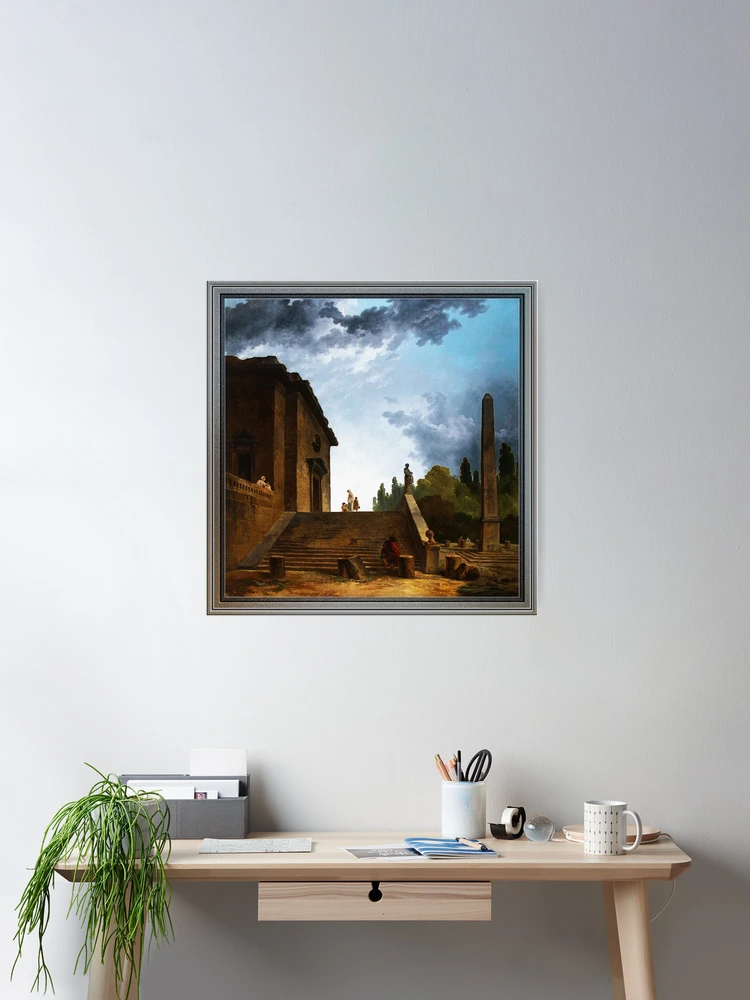
Table of Contents
Sugettu principale è cumpusizioni
The central focus of this artwork is the majestic set of stairs leading to a grand building or temple, complemented by the towering obelisk in the background. The stairs themselves are weathered and appear to be made of stone, their steps leading upward toward a stone structure. The presence of these stairs suggests an ancient or noble setting, possibly linked to historical or mythological references, characteristic of Robert’s romanticized depictions of classical ruins.
In u primu pianu, two individuals are depicted—one seated and another standing on the stairs. They are seemingly inconsequential to the grandeur of the setting but still play a vital role in adding a human presence that contrasts with the monumental architecture. Their placement helps balance the scale of the composition, providing a sense of human proportion amid the towering structures.
The obelisk, an ancient Egyptian monument re-imagined within a classical European setting, stands as another focal point to the right side of the composition. This object symbolizes the ancient world, evoking the sense of a lost civilization while anchoring the piece in the romantic classical themes Robert was known for. The use of the obelisk reinforces the notion of timelessness, a central theme in much of Robert’s work, where classical ruins are idealized to evoke both nostalgia and contemplation of past civilizations.
Ugetti è Terrenu
The terrain surrounding the stairs and obelisk is lush and expansive. The ground appears to be cultivated or at least managed, with well-kept paths leading through the terrain. On the right, we see a few figures in the distance, seated or walking, giving the landscape a dynamic feel while reinforcing the setting’s tranquility. The backdrop of trees, with their expansive reach toward the sky, provides a striking contrast against the harsh lines of the stone architecture. The viewer’s eye is naturally drawn toward the horizon, where the trees begin to thin out, leading to a space dominated by clouds and a slightly darker sky.
The juxtaposition of human-made elements—such as the staircase, the obelisk, and the figures—and nature highlights the tension between civilization and the natural world. Robert’s careful rendering of the foliage, combined with the crisp outlines of the architectural elements, underscores the precision of his technique. This harmony between nature and architecture is a key characteristic of the Rococo and Neoclassical periods, where the human desire for understanding and order is reflected through such meticulously designed structures amid nature’s free-flowing form.
Stile è tecnica
Robert’s style in this work is distinctly Rococo with elements of Neoclassicism, blending the ornate with the classical. His use of light, ombra, and texture creates a sense of depth and dimension, inviting the viewer to step into the landscape. The clouds in the sky seem to swirl in dramatic motion, contrasting with the stillness of the stone objects below. This use of light and dark not only adds to the mood but also enhances the sense of timelessness that pervades the entire scene.
The application of light is masterful, with shadows creeping along the stone steps, highlighting the weathered texture of the structure. The obelisk, ancu, is illuminated with soft, diffuse light, giving it an almost ethereal quality. I figuri, small in comparison to the surrounding objects, are subtly shaded, further emphasizing their secondary role within the larger composition.
Robert’s technique, while focused on naturalistic detail, maintains an idealized interpretation of the ruins. The rocks and stone are not simply representations of decay but are infused with a sense of romantic nostalgia for an era gone by. The stones seem to have a timeless quality, making them not just relics of the past, but symbols of enduring beauty.
Umore è tema
The mood of the painting is one of quiet contemplation. U paràmetru, with its peaceful yet awe-inspiring structures, invites viewers to reflect on the past, u passaghju di u tempu, and the impermanence of human creations. The natural landscape, in its lushness and vividness, contrasts with the stone architecture, suggesting the ephemeral nature of human achievement against the vast, enduring power of nature.
The classical ruins, while not overtly ancient in this depiction, invoke the grandeur of civilizations long past, evoking a sense of nostalgia and reverence for the lost civilizations of Rome and Egypt. The obelisk, with its Egyptian origins, stands as a reminder of these ancient powers. By choosing to depict such ruins, Robert not only preserves the legacy of these ancient structures but also elevates them, presenting them as objects of beauty rather than mere remnants of past civilizations.
The inclusion of figures adds a human touch to the scene, but their small scale and passive actions suggest that humanity, while significant, is but a fleeting moment in the timeline of history. The vast sky, dotted with dark clouds and illuminated by bursts of light, further amplifies the theme of nature’s dominance over time and human endeavors.
Cunclusione
“Landscape with a Stairs and Obelisk” is a masterful example of Hubert Robert’s ability to merge the beauty of nature with the elegance of classical architecture. The scene captures a moment where the monumental and the natural coexist, creating a serene yet thought-provoking atmosphere. Robert’s meticulous attention to detail, his skillful use of light and shadow, and his celebration of classical ruins all serve to reinforce the timeless theme of nature’s dominance and the fleeting nature of human achievement. This work invites the viewer not only to admire its technical brilliance but to reflect on the deeper themes of history, time, and memory.
Landscape with a Stairs and Obelisk is a retouched digital art old masters reproduction of a public domain image that is available as a stampa su tela arrotolata in linea.
Biografia di l'artista
Below Info Derived From Wikipedia.org
Hubert Robert hè natu in Parigi in 1733. U so babbu, Nicolas Robert, era al servizio di François-Joseph de Choiseul, marchese de Stainville un primu diplomaticu di Lorena. U ghjovanu Robert hà finitu i so studii cù i Gesuiti à u Collège de Navarre in 1751 et entra dans l'atelier du sculpteur Michel-Ange Slodtz qui lui apprit le design et la perspective mais l'encouragea à se tourner vers la peinture.. In 1754 partì per Roma in u trenu di Étienne-François de Choiseul, son of his father’s employer, qui avait été nommé ambassadeur de France et deviendra secrétaire d'État aux Affaires étrangères auprès de Louis XV en 1758.
Passò undici anni in Roma, un longu tempu notevuli; after the young artist’s official residence at the French Academy in Rome ran out, il s'est soutenu par des œuvres qu'il réalisa pour des connaisseurs en visite comme l'abbé de Saint-Non, chi pigliò Rupertu in Napuli d'aprile 1760 per visità e ruine di Pompei. U marchese de Marigny, direttore di i Bâtiments du Roi hà tenutu u so sviluppu in currispundenza cù Natoire, direttore di l'Académie française, chì urgeu à i pensionarii à sketch fora di a porta, da a natura: Robert ùn avia bisognu di urgenza; disegni da i so sketchbooks documentanu i so viaghji: Villa d’Este, Caprarola.
Vista di u Portu di Rippeta in Roma, c. 1766, showing the Ancient Roman Pantheon next to an imaginary port
The contrast between the ruins of ancient Rome and the life of his time excited his keenest interest. Hà travagliatu per un tempu in l'studiu di Pannini, dont l'influence peut être vue dans la Vue imaginaire de la galerie du Louvre en ruine (illustrazione). Robert passava u so tempu in cumpagnia di ghjovani artisti in u circulu di Piranesi, chì i so capricci di rovine romanticamente invase l'hà influenzatu tantu chì hà guadagnatu u soprannomu Robert des ruines. Les albums de croquis et de dessins qu'il a réunis à Rome lui ont fourni des motifs qu'il a transformés en peintures tout au long de sa carrière..