

The Nightmare c1781
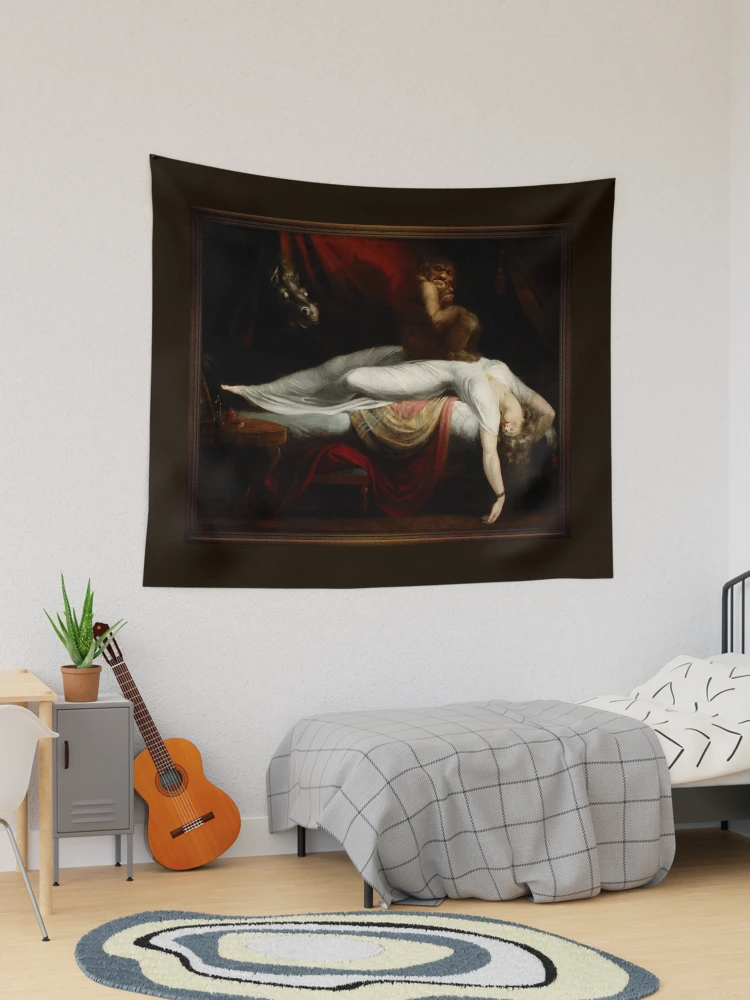
“Der Albtraum,” eingemalt 1781 by Swiss artist Henry Fuseli (1741-1825), is one of the most iconic and unnerving works of the late 18th century, melding themes of the supernatural and psychological unease. This dramatic and haunting piece explores the realm of nightmares and the grotesque. Known for its bold use of contrast, its striking depiction of a woman in a state of deep sleep, and its symbolic elements, “Der Albtraum” stands as a testament to Fuseli’s unique approach to Romanticism, blending elements of the gothic with intense emotion and surrealism. Fuseli’s art often questioned the boundaries between reality and dreams, and this piece exemplifies his mastery in portraying the darkness of the human subconscious.
Inhaltsverzeichnis
Hauptfach und Komposition
At the center of the mythological composition lies a woman, draped in a white gown, her head tilted back, her eyes shut, and her mouth slightly agape. She lies sprawled across a bed, her posture one of apparent vulnerability. Die Positionierung ihres Körpers, her limp arms, and her slouched form suggest that she is not merely asleep, but entrapped in the grip of a terrible nightmare.
Her face is pale, accentuating the fear or distress she may be experiencing in her dream. The body language of the figure reveals both a sense of helplessness and submission, as though the woman is at the mercy of forces beyond her control. On top of her, partially crouched on her chest, is a grotesque, monstrous figure that resembles a demonic creature. This being, with its exaggerated features and intense expression, conveys a sense of malevolent power.
The creature’s posture, its crouched, almost primal stance, suggests a symbolic representation of a nightmare or night terror, which many during the period believed to be the work of supernatural forces. The sinister character appears to be pressing down on the woman, as if suffocating her, yet it exudes an aura of satisfaction and dominance, as if it derives pleasure from her torment.
In the background of the composition, a darkened, blurred silhouette of a horse’s head looms, eyes wide with a fearful expression. This spectral horse adds an additional layer of psychological intensity to the piece, as if the creature’s vision is skewed and tortured, suggesting the nightmare is shared between both the woman and the horse. Its presence only heightens the viewer’s sense of unease, as it represents the creeping nature of irrational fear, constantly lurking in the shadows of the dreamer’s mind.
Objekte und Details
The room surrounding the central figure is rich in dark tones, which evoke a sense of unease and confinement. Nach links, a small table holds objects like a candle and an overturned vase, adding to the atmosphere of disarray and disturbance.
The faint illumination from the candle casts dark shadows on the walls, heightening the sense of isolation and the unknown. The dimness of the interior suggests that the nightmare takes place in the dead of night, further emphasizing the vulnerability and helplessness of the woman in her vulnerable state.
The bed itself, draped with a deep red velvet curtain, plays a significant role in amplifying the atmosphere. Die Tiefe, rich color of the bedding suggests both luxury and danger, implying that even in a space of comfort, horror can strike. This lavishness, often associated with the opulence of a safe and peaceful domestic life, is sharply contrasted by the horrific apparition that dominates the scene.
The interplay of light and shadow in this piece is significant. Fuseli’s use of chiaroscuro, the technique of using strong contrasts between light and dark, amplifies the drama of the composition. The light falling on the woman’s form illuminates her body in stark contrast to the surrounding darkness, focusing the viewer’s attention on her helpless state while casting her surroundings into an oppressive shadow. This creates a powerful sense of depth and dimensionality, evoking a tension between the reality of her physical form and the nightmare that haunts her.
Stimmung, Stil, and Theme
“Der Albtraum” evokes a mood of horror, anxiety, and suffocation. It is a powerful visual representation of the psychological terror associated with nightmares, the kind of fear that seems tangible yet is completely irrational. The artist blends elements of gothic horror with a romanticized exploration of the unknown. In the 18th century, people were particularly fascinated by the supernatural and the unknown realms of the mind, making the depiction of these elements a natural focus for Fuseli’s work.
Fuseli’s approach to painting often emphasized intense emotional experiences, and this piece is no exception. The tension in the scene is palpable, not just through the central figures but in the stark contrast between light and dark.
The theme of suppressed terror is explored through the supernatural, as both the woman and the viewer are drawn into a world that is both unsettling and bizarre. This dark exploration of the human psyche invites questions about the limits of consciousness, the fear of the unseen, and the potential for terror that resides within dreams.
The style of Fuseli’s work was influenced by his exposure to Neoclassicism, but he departed from its rationality and balance by incorporating exaggerated forms and dramatic, fantastical elements. The surreal nature of the creature that straddles the woman’s chest reflects his interest in psychological subjectivity and his rejection of realism in favor of emotional intensity.
Abschluss
Henry Fuseli’s “Der Albtraum” is a provocative, chilling exploration of human fear, both real and imagined. The surreal quality of the painting, the disturbing imagery, and the unsettling use of light and shadow all contribute to the timeless power of this piece. Fuseli captured a universal experience, the sensation of being vulnerable and at the mercy of forces beyond understanding, in a way that continues to resonate with viewers today. The painting is a masterclass in both technique and emotional depth, exploring themes of vulnerability, terror, and the haunting nature of dreams.
The Nightmare ist eine retuschierte Reproduktion der digitalen Kunst alter Meister eines gemeinfreien Bildes.
Künstler Bio von Wikipedia.org
Fuseli wurde in Zürich geboren, Schweiz, der zweite von 18 Kinder. Sein Vater war Johann Caspar Füssli, ein Maler von Porträts und Landschaften, und Autor von Lives of the Helvetic Painters. Er hat Heinrich für die Kirche bestimmt, und schickte ihn an die Caroline Hochschule Zürich, wo er eine ausgezeichnete klassische Ausbildung erhielt. Einer seiner Schulkameraden dort war Johann Kaspar Lavater, mit denen er enge Freunde wurde.
Nach Auftragsannahme 1761, Fuseli musste das Land verlassen, weil er Lavater geholfen hatte, einen ungerechten Richter zu entlarven, deren mächtige Familie Rache suchte. Er reiste durch Deutschland, und dann, im 1765, besuchte England, wo er sich einige Zeit durch diverses Schreiben ernährte.
Letztlich, er lernte kennen Sir Joshua Reynolds, wem er seine Zeichnungen zeigte. Nach Reynolds’ Ratschlag, er beschloss, sich ganz der Kunst zu widmen. Im 1770 er machte eine Kunstwallfahrt nach Italien, wo er blieb bis 1778, Namensänderung von Füssli in das eher italienisch klingende Fuseli.
Früh rein kommen 1779 er kehrte nach Großbritannien zurück, auf dem Weg in Zürich. In London fand er eine Kommission, die ihn von Alderman Boydell . erwartete, der damals seine Shakespeare-Galerie einrichtete.
Fuseli malte eine Reihe von Stücken für Boydell, und veröffentlichte eine englische Ausgabe von Lavaters Werk über Physiognomie. Er gab William Cowper auch wertvolle Hilfe bei der Vorbereitung einer Übersetzung von Homer ..
Im 1788 Fuseli heiratete Sophia Rawlins (ursprünglich eines seiner Modelle), und bald darauf wurde er ein Mitarbeiter der Royal Academy. Die frühe Feministin Mary Wollstonecraft, wessen Porträt er gemalt hatte, eine Reise mit ihm nach Paris geplant, und verfolgte ihn entschlossen, aber nach Sophias Intervention die Fuselis’ Die Tür war ihr für immer verschlossen.
Fuseli sagte später “Ich hasse kluge Frauen. Sie sind nur lästig”. Im 1790 er wurde ein vollwertiger Akademiker, präsentiert Thor Battering the Midgard Serpent als seine Diplomarbeit. Im 1799 Fuseli wurde als Professor für Malerei an die Akademie berufen. Vier Jahre später wurde er zum Hüter gewählt, und legte seine Professur nieder, aber wieder aufgenommen in 1810, bis zu seinem Tod beide Ämter inne.[4] Als Hüter, ihm folgte Henry Thomson.
Im 1799 Fuseli stellte eine Reihe von Gemälden aus, die von den Werken von John Milton . geliefert wurden, im Hinblick auf die Bildung einer Milton-Galerie vergleichbar mit Boydells Shakespeare-Galerie.
Es gab 47 Milton-Gemälde, viele davon sehr groß, in Abständen über neun Jahre abgeschlossen. Die Ausstellung erwies sich als kommerzieller Misserfolg und wurde geschlossen 1800. Im 1805 er brachte eine Ausgabe von Pilkingtons Leben der Maler heraus, was seinem Ruf nicht gut tat.
Antonio Canova, bei seinem Besuch in England, war von Fuselis Werken sehr angetan, und bei der Rückkehr nach Rom in 1817 veranlaßte ihn zur Wahl zum Mitglied der ersten Klasse der Lukas-Akademie.