

The Nightmare c1781
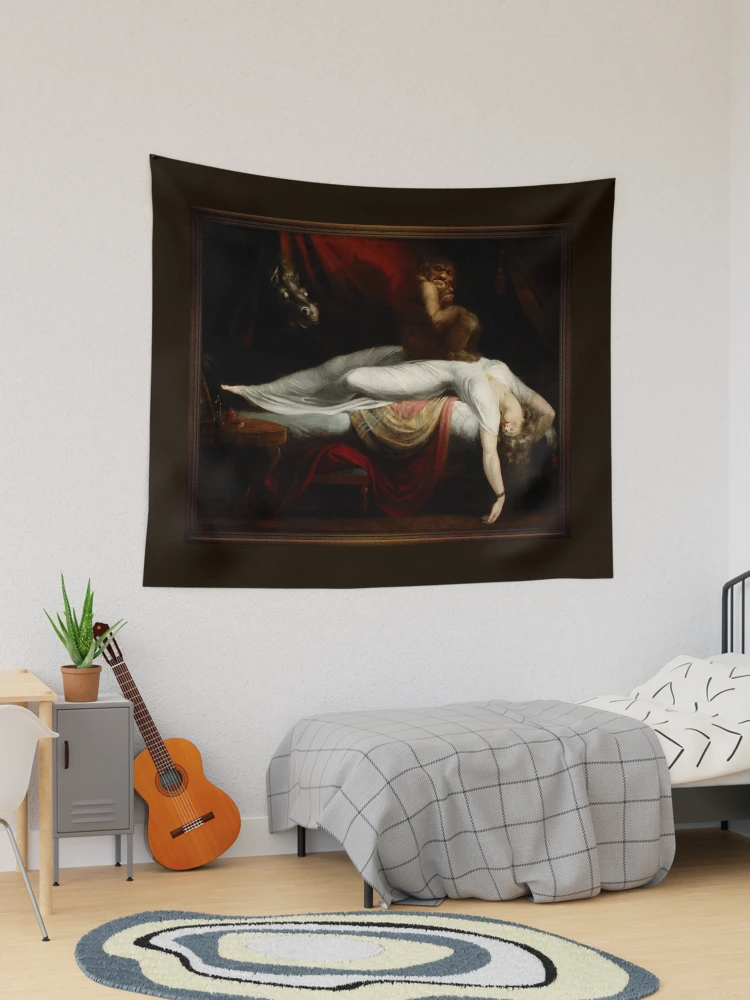
“De nachtmerrie,” erin geschilderd 1781 by Swiss artist Henry Fuseli (1741-1825), is one of the most iconic and unnerving works of the late 18th century, melding themes of the supernatural and psychological unease. This dramatic and haunting piece explores the realm of nightmares and the grotesque. Known for its bold use of contrast, its striking depiction of a woman in a state of deep sleep, and its symbolic elements, “De nachtmerrie” stands as a testament to Fuseli’s unique approach to Romanticism, blending elements of the gothic with intense emotion and surrealism. Fuseli’s art often questioned the boundaries between reality and dreams, and this piece exemplifies his mastery in portraying the darkness of the human subconscious.
Inhoudsopgave
Hoofdonderwerp en compositie
In het centrum van de mythological composition lies a woman, draped in a white gown, her head tilted back, her eyes shut, and her mouth slightly agape. She lies sprawled across a bed, her posture one of apparent vulnerability. The positioning of her body, her limp arms, and her slouched form suggest that she is not merely asleep, but entrapped in the grip of a terrible nightmare.
Her face is pale, accentuating the fear or distress she may be experiencing in her dream. The body language of the figure reveals both a sense of helplessness and submission, as though the woman is at the mercy of forces beyond her control. On top of her, partially crouched on her chest, is a grotesque, monstrous figure that resembles a demonic creature. This being, with its exaggerated features and intense expression, conveys a sense of malevolent power.
The creature’s posture, its crouched, almost primal stance, suggests a symbolic representation of a nightmare or night terror, which many during the period believed to be the work of supernatural forces. The sinister character appears to be pressing down on the woman, as if suffocating her, yet it exudes an aura of satisfaction and dominance, as if it derives pleasure from her torment.
In the background of the composition, a darkened, blurred silhouette of a horse’s head looms, eyes wide with a fearful expression. This spectral horse adds an additional layer of psychological intensity to the piece, as if the creature’s vision is skewed and tortured, suggesting the nightmare is shared between both the woman and the horse. Its presence only heightens the viewer’s sense of unease, as it represents the creeping nature of irrational fear, constantly lurking in the shadows of the dreamer’s mind.
Objecten en details
The room surrounding the central figure is rich in dark tones, which evoke a sense of unease and confinement. Naar links, a small table holds objects like a candle and an overturned vase, adding to the atmosphere of disarray and disturbance.
The faint illumination from the candle casts dark shadows on the walls, heightening the sense of isolation and the unknown. The dimness of the interior suggests that the nightmare takes place in the dead of night, further emphasizing the vulnerability and helplessness of the woman in her vulnerable state.
The bed itself, draped with a deep red velvet curtain, plays a significant role in amplifying the atmosphere. The deep, rich color of the bedding suggests both luxury and danger, implying that even in a space of comfort, horror can strike. This lavishness, often associated with the opulence of a safe and peaceful domestic life, is sharply contrasted by the horrific apparition that dominates the scene.
The interplay of light and shadow in this piece is significant. Fuseli’s use of chiaroscuro, the technique of using strong contrasts between light and dark, amplifies the drama of the composition. The light falling on the woman’s form illuminates her body in stark contrast to the surrounding darkness, focusing the viewer’s attention on her helpless state while casting her surroundings into an oppressive shadow. This creates a powerful sense of depth and dimensionality, evoking a tension between the reality of her physical form and the nightmare that haunts her.
Stemming, Stijl, and Theme
“De nachtmerrie” evokes a mood of horror, anxiety, and suffocation. It is a powerful visual representation of the psychological terror associated with nightmares, the kind of fear that seems tangible yet is completely irrational. The artist blends elements of gothic horror with a romanticized exploration of the unknown. In the 18th century, people were particularly fascinated by the supernatural and the unknown realms of the mind, making the depiction of these elements a natural focus for Fuseli’s work.
Fuseli’s approach to painting often emphasized intense emotional experiences, and this piece is no exception. The tension in the scene is palpable, not just through the central figures but in the stark contrast between light and dark.
The theme of suppressed terror is explored through the supernatural, as both the woman and the viewer are drawn into a world that is both unsettling and bizarre. This dark exploration of the human psyche invites questions about the limits of consciousness, the fear of the unseen, and the potential for terror that resides within dreams.
The style of Fuseli’s work was influenced by his exposure to Neoclassicism, but he departed from its rationality and balance by incorporating exaggerated forms and dramatic, fantastical elements. The surreal nature of the creature that straddles the woman’s chest reflects his interest in psychological subjectivity and his rejection of realism in favor of emotional intensity.
Conclusie
Henry Fuseli’s “De nachtmerrie” is a provocative, chilling exploration of human fear, both real and imagined. The surreal quality of the painting, the disturbing imagery, and the unsettling use of light and shadow all contribute to the timeless power of this piece. Fuseli captured a universal experience, the sensation of being vulnerable and at the mercy of forces beyond understanding, in a way that continues to resonate with viewers today. The painting is a masterclass in both technique and emotional depth, exploring themes of vulnerability, terror, and the haunting nature of dreams.
The Nightmare is een geretoucheerde digitale kunst oude meesters reproductie van een afbeelding uit het publieke domein.
Kunstenaar bio van Wikipedia.org
Fuseli werd geboren in Zürich, Zwitserland, de tweede van 18 kinderen. Zijn vader was Johann Caspar Füssli, een schilder van portretten en landschappen, en auteur van Lives of the Helvetic Painters. He intended Henry for the church, and sent him to the Caroline college of Zurich, where he received an excellent classical education. One of his schoolmates there was Johann Kaspar Lavater, with whom he became close friends.
After taking orders in 1761, Fuseli was forced to leave the country as a result of having helped Lavater to expose an unjust magistrate, whose powerful family sought revenge. He travelled through Germany, and then, in 1765, visited England, where he supported himself for some time by miscellaneous writing.
Eventueel, hij maakte kennis met Sir Joshua Reynolds, aan wie hij zijn tekeningen liet zien. Reynolds volgen’ het advies, hij besloot zich volledig aan de kunst te wijden. In 1770 hij maakte een kunstbedevaart naar Italië, waar hij bleef tot 1778, het veranderen van zijn naam van Füssli naar de meer Italiaans klinkende Fuseli.
Vroeg in 1779 hij keerde terug naar Groot-Brittannië, onderweg naar Zürich. In Londen vond hij een commissie die op hem wachtte van wethouder Boydell, die toen zijn Shakespeare-galerij aan het opzetten was.
Fuseli schilderde een aantal stukken voor Boydell, en publiceerde een Engelse editie van Lavaters werk over fysionomie. Hij gaf William Cowper ook waardevolle hulp bij het voorbereiden van een vertaling van Homerus.
In 1788 Fuseli trouwde met Sophia Rawlins (oorspronkelijk een van zijn modellen), en kort daarna werd hij een medewerker van de Royal Academy. De vroege feministe Mary Wollstonecraft, wiens portret hij had geschilderd, plande een reis met hem naar Parijs, en achtervolgde hem vastberaden, maar na Sophia's tussenkomst de Fuselis’ de deur was voor altijd voor haar gesloten.
Fuseli zei later: “I hate clever women. They are only troublesome”. In 1790 he became a full Academician, presenting Thor Battering the Midgard Serpent as his diploma work. In 1799 Fuseli was appointed professor of painting to the Academy. Four years later he was chosen as Keeper, and resigned his professorship, but resumed it in 1810, continuing to hold both offices until his death.[4] As Keeper, he was succeeded by Henry Thomson.
In 1799 Fuseli exhibited a series of paintings from subjects furnished by the works of John Milton, with a view to forming a Milton gallery comparable to Boydell’s Shakespeare gallery.
There were 47 Milton paintings, many of them very large, completed at intervals over nine years. The exhibition proved a commercial failure and closed in 1800. In 1805 he brought out an edition of Pilkington’s Lives of the Painters, wat weinig deed voor zijn reputatie.
Antonio Canova, tijdens zijn bezoek aan Engeland?, was erg ingenomen met de werken van Fuseli, en bij terugkeer naar Rome in 1817 zorgde ervoor dat hij werd gekozen tot lid van de eerste klas in de Academie van Sint-Lucas.