

The Russian Brides Attire
The Russian Brides Attire c1889 by Russian Painter Konstantin Makovsky (1839 – 1915); gespecialiseerd in Russische historische schilderijen die een geïdealiseerd beeld geven van het Russische leven in de afgelopen eeuwen.
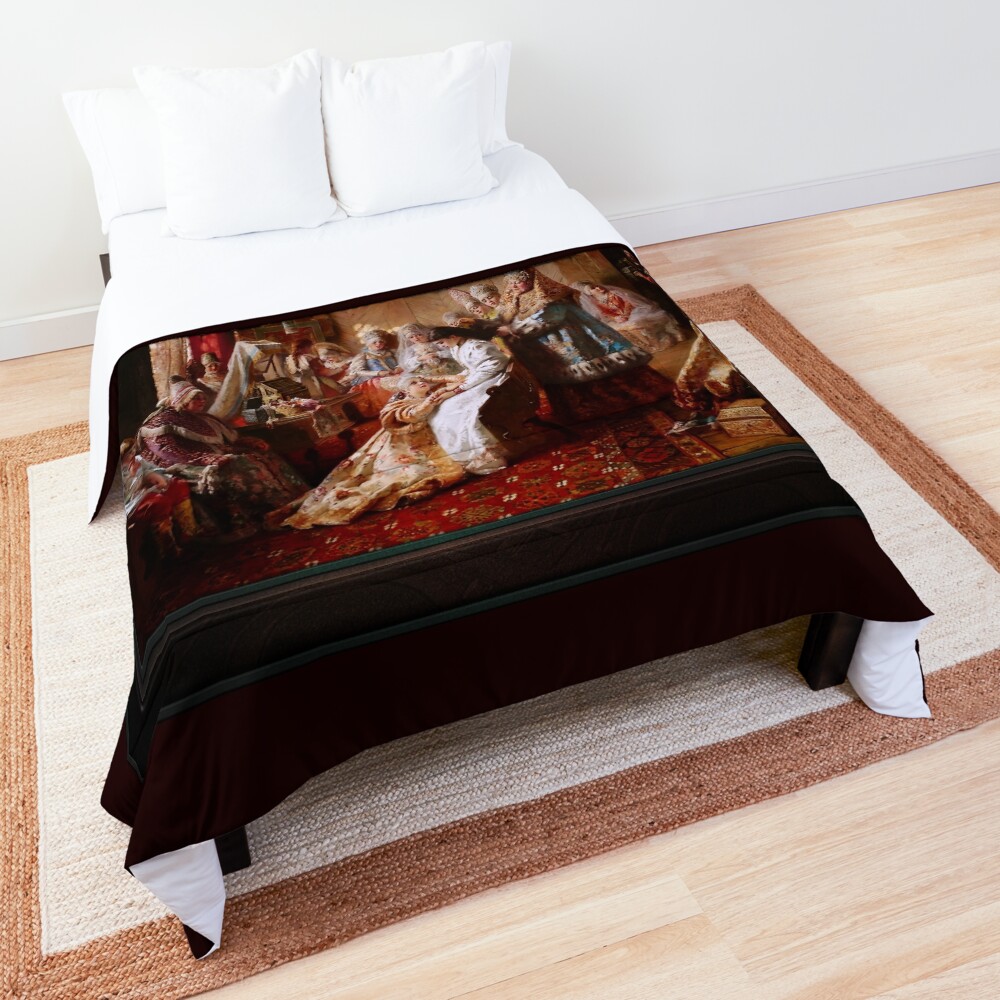
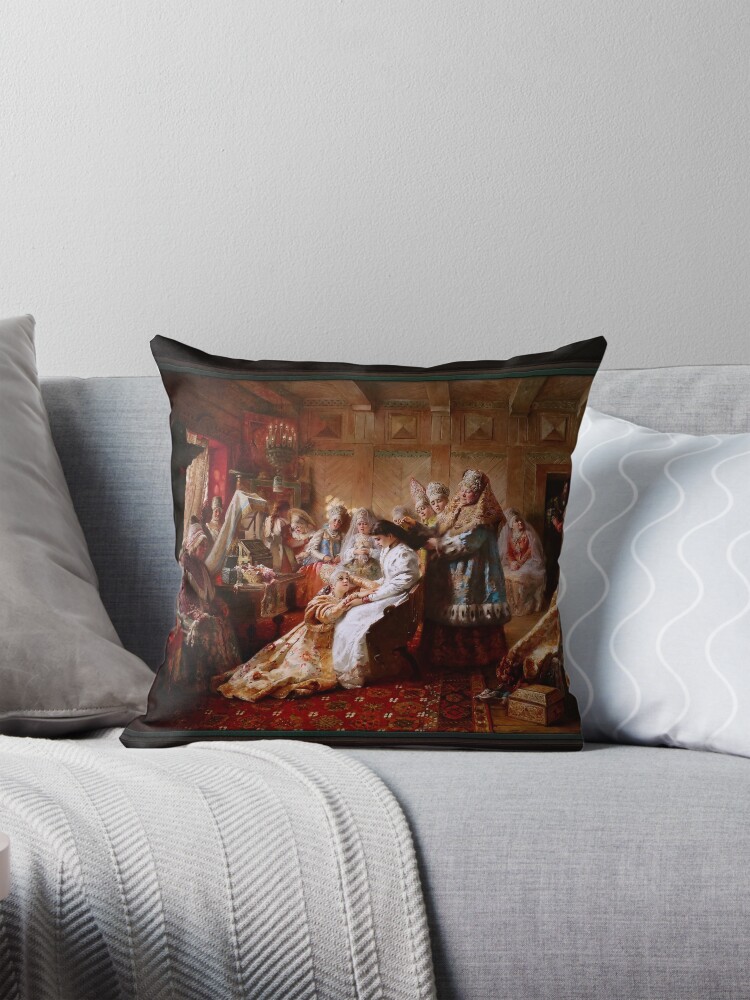
Konstantin Makovsky’s The Russian Brides Attire (1889) presents a captivating glimpse into the ceremonial preparations of a Russian bride in a traditional 19th-century setting. The scene is set within an intimate, richly adorned room where the bride-to-be, poised in anticipation, is surrounded by her closest family and friends. This historical genre painting, rooted deeply in Russian culture, reflects both the bride’s personal moment and the social customs of the time.
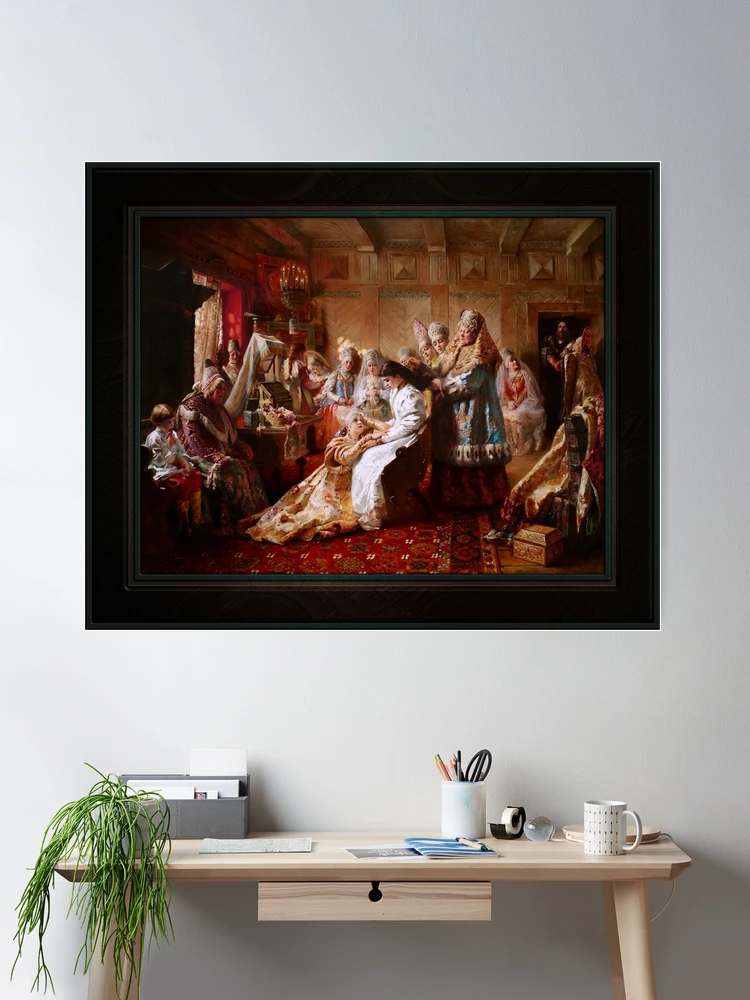
At the heart of the painting sits the young bride, dressed in an opulent, meticulously detailed gown of traditional Russian wedding attire. The intricacies of her attire are striking; every fold and embellishment in her richly embroidered dress echoes the skill and craftsmanship of the period. The gown’s texture, enhanced by the gentle play of light, emphasizes its luxurious fabric, hinting at the bride’s high social standing.
De jurk, with its intricate patterns and vibrant colors, combines tradition with beauty, setting her apart as the central figure in the composition. Haar uitdrukking, serene yet tinged with the anticipation of the upcoming union, contributes to the painting’s overall sense of reverence for this momentous life event.
The surrounding figures enhance the emotional depth of the scene. Bridesmaids, family members, and an attentive mother are present, each contributing to the bride’s preparations. The bridal party’s clothing is also detailed, showcasing the opulence typical of the Russian aristocracy during the era.
These individuals are all engaged in the intimate tasks of finalizing the bride’s appearance, with one figure seated at the bride’s feet, holding her hands tenderly—a subtle gesture of familial connection and support. In tegenstelling tot, a young man, possibly the groom, appears at the threshold of the room, holding a gift box. His presence is restrained, his access to the bride’s space halted by a gentle but firm barrier, as custom would dictate.
The setting further complements the mood of the painting. The room is lavishly decorated, met donker, rich tones contrasting against the soft glow of candlelight and the bride’s radiant attire. This use of light symbolizes both the bride’s purity and the solemnity of the occasion.
The opulent, antique furniture and the delicate furnishings suggest an upper-class household, indicative of the wealth and status of the bride’s family. These elements come together to transport the viewer to the Russian nobility’s private spaces, where tradition and social rituals were deeply ingrained.
Makovsky’s approach to the painting reflects his expertise in academic art and historical realism, grounded in his training and experience with the Peredvizhniki (Zwervers) beweging. Known for portraying the everyday lives of Russians, Makovsky’s work in De kledij van de Russische bruid transcends mere documentation, offering an emotional portrait of a pivotal moment in a young woman’s life. His mastery of detail, kleur, and light conveys a sense of reverence for the traditions of Russian weddings, while the gentle interactions between the figures in the scene imbue the work with a sense of warmth and familial love.
The mood of the painting is one of quiet anticipation, ceremonial dignity, and a deep respect for cultural traditions. The bride is presented not just as the central figure in a social ritual, but as a symbol of purity, continuïteit, and heritage.
The work conveys a mixture of joy and solemnity, emphasizing the gravity of the wedding ceremony while celebrating the familial bonds that are integral to it. The groom, awaiting his bride’s arrival, is a figure of patience and longing, and the space between the bride and groom symbolizes the sacredness and exclusivity of the pre-wedding ritual.
Qua stijl, De kledij van de Russische bruid is a quintessential example of Russian academic realism. Makovsky’s technique, with its sharp focus on the textures of fabrics, the naturalism of facial expressions, and the subtle play of light, creates a vivid, almost tangible atmosphere.
The figures are carefully posed to convey a sense of unity and purpose, while the careful rendering of the bride’s dress and the surrounding details showcases the artist’s skill in depicting texture and material.
Thematisch, the work explores the cultural importance of the Russian wedding, which was more than just a personal event—it was a public and familial milestone. Through the artist’s portrayal of the bride’s attire, the familial interaction, and the ceremonial anticipation, the viewer is invited to witness an intimate, yet highly structured moment in Russian society. The painting also highlights the role of tradition in Russian culture, where customs surrounding marriage were highly ritualized and carefully observed.
De kledij van de Russische bruid is not only a visual narrative of a traditional wedding but also an insightful reflection of the values and customs of 19th-century Russian aristocracy. It stands as a testament to Konstantin Makovsky’s ability to blend historical accuracy with emotional depth, offering the viewer a vivid portrayal of Russian cultural heritage at its most beautiful and ceremonial.
Dit is een retoucheerde digitale reproductie van kunst oude meesters van een openbaar domeinafbeelding.
Info hieronder afgeleid van Wikipedia.org
Konstantin Makovsky was een invloedrijke Russische schilder, aangesloten bij de “Peredvizhniki (Zwervers)”. Veel van zijn historische schilderijen, zoals onder de kroon (1889) ook bekend als de kleding van de Russische bruid en voor de bruiloft, toonde een geïdealiseerd beeld van het Russische leven van voorgaande eeuwen. Hij wordt vaak beschouwd als een vertegenwoordiger van de academische kunst.
Konstantin Makovsky werd geboren in Moskou. Zijn vader was de Russische kunstfiguur en amateurschilder, Yegor Ivanovitsj Makovsky. Zijn moeder was een componist, en ze hoopte dat haar zoon op een dag in haar voetsporen zou treden. Zijn jongere broers Vladimir en Nikolay en zijn zus Alexandra werden ook schilders.
In 1851 Makovsky ging naar de Moskouse schilderschool, Beeldhouwkunst en architectuur waar hij de beste student werd, gemakkelijk alle beschikbare onderscheidingen krijgen. Zijn leraren waren Karl Bryullov en Vasily Tropinin. Makovsky's neigingen tot romantiek en decoratieve effecten kunnen worden verklaard door de invloed van Bryullov.
Hoewel kunst zijn passie was, hij dacht ook na over wat zijn moeder had gewild dat hij deed. Hij ging op zoek naar componisten naar wie hij kon verwijzen, en ging eerst naar Frankrijk. Voordat, hij was altijd een liefhebber van klassieke muziek geweest, en luisterde naar veel stukken. Hij wenste vaak dat hij de melodie kon veranderen, of stijl van sommigen om ze leuker te maken. Later in zijn leven kwam het uit.
In 1858 Makovsky ging naar de keizerlijke kunstacademie in Sint-Petersburg. Van 1860 hij nam deel aan de tentoonstellingen van de Academie met schilderijen zoals Curing of the Blind (1860) en agenten van de valse Dmitry doden de zoon van Boris Godunov (1862). In 1863 Makovsky en dertien andere studenten hielden een protest tegen de instelling van onderwerpen uit de Scandinavische mythologie door de Academie in de competitie voor de Grote Gouden Medaille van de Academia; allen verlieten de academie zonder een formeel diploma.
Makovsky werd lid van een coöperatie (artel) van kunstenaars onder leiding van Ivan Kramskoi, typisch het produceren van Wanderers-schilderijen over het dagelijks leven (Weduwe 1865, Haring-verkoper 1867, enz.). Van 1870 hij was een van de oprichters van de Society for Traveling Art Exhibitions en bleef werken aan schilderijen die gewijd waren aan het dagelijks leven. Hij exposeerde zijn werken op zowel de Academia-tentoonstellingen als de Travelling Art Exhibitions of the Wanderers.
Een belangrijke verandering in zijn stijl vond plaats na een reis naar Egypte en Servië in het midden van de jaren 1870. Zijn interesses veranderden van sociale en psychologische problemen naar de artistieke problemen van kleur en vorm.
In de jaren 1880 werd hij een modieuze auteur van portretten en historische schilderijen. Op de Wereldtentoonstelling van 1889 in Parijs ontving hij de Grote Gouden Medaille voor zijn schilderijen Dood van Ivan de Verschrikkelijke, Het oordeel van Parijs, en Demon en Tamara. Hij was een van de meest gewaardeerde en best betaalde Russische kunstenaars van die tijd. Veel democratische critici beschouwden hem als een afvallige van de Wanderers’ idealen, produceren (zoals Henryk Siemiradzki) opvallende maar oppervlakkige werken,[2] terwijl anderen hem zien als een voorloper van het Russische impressionisme.
Makovsky werd vermoord in 1915 toen zijn paardenkoets werd aangereden door een elektrische tram in Sint-Petersburg.