

The Ninth Wave c1850
Hovhannes Aivazovsky’s (1817 – 1900) pintura La novena onada (Novena onada), creat a 1850, is a breathtaking portrayal of the unyielding power of the ocean. Nascut a 1817, Aivazovsky was one of Russia’s most renowned Romantic painters, and his depictions of seascapes remain iconic in art history. This masterpiece is no exception, vividly capturing the terror, bellesa, and awe-inspiring strength of nature.
Aivazovsky’s deep fascination with the sea and its inherent mysteries is unmistakably present, particularly in how he portrays the ocean’s waves and their interaction with light. Through his remarkable technique, he elevates the scene to a level of dramatic intensity that reflects not just the physical struggle between man and nature, but also the philosophical and existential challenges humans face when confronted with the forces beyond their control.
Taula de continguts
Assumpte i composició principal
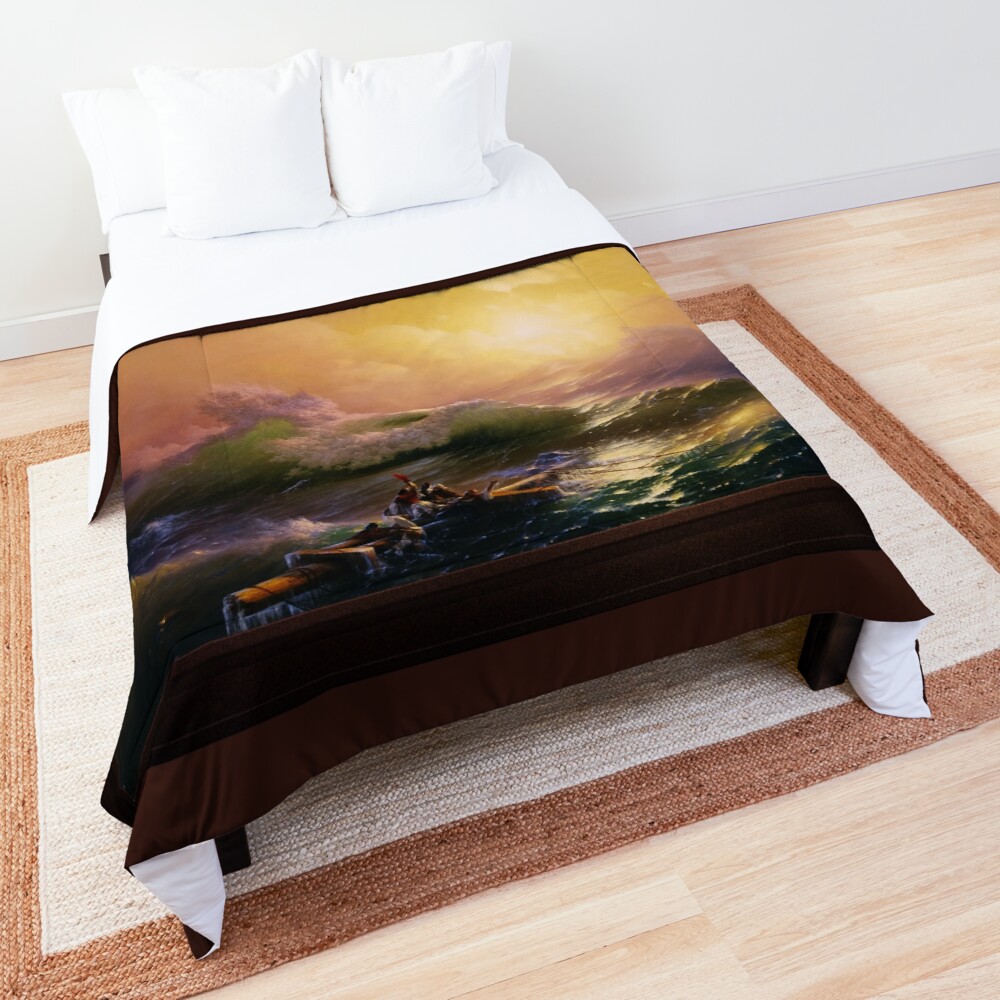
En La novena onada, Aivazovsky showcases a moment of peril at sea. The central theme of the work is encapsulated in the immense wave, which dominates the foreground. The wave, towering in its menacing beauty, appears as if it is about to crash down upon the small, fragile raft caught beneath it. The subject of the artwork is a group of shipwrecked individuals, stranded on a makeshift raft after a violent storm.
Their struggle for survival against the overwhelming might of nature speaks to the broader theme of human fragility. The men on the raft, desperate but determined, cling to whatever remains of their ship. Their expressions are a mixture of exhaustion and hopelessness, yet there is a trace of defiance as they face what seems an inevitable fate.
The image conveys a sense of dramatic tension, with the survivors framed against the backdrop of the mighty ocean and sky. Aivazovsky’s brilliant use of color and light emphasizes the wave’s enormity and the emotional weight of the scene. The individuals are dwarfed by the size and power of the natural elements, highlighting their vulnerability and humanity in the face of a world beyond their control.
Terreny i Materials
El terreny dins La novena onada is defined primarily by the vast ocean, stretching as far as the eye can see. The water is tumultuous, characterized by swirling, churning waves that seem to roll with the fury of a tempest. Aivazovsky’s mastery of seascapes is evident in the way he captures the movement of the water. Each wave is painted with such precision that the viewer can almost feel the rush of water, the tumultuous spray, and the undercurrent that threatens to pull the raft into the abyss. The waves seem to glow with an eerie energy, with each crest highlighted by the soft light that permeates the canvas, revealing the delicate texture of foam and water.
The colors used in this seascape further elevate the tension. The warm golden light, which spills from the horizon, contrasts dramatically with the deep blues and greens of the sea. The sunlight, muted yet powerful, offers a glimmer of hope, a small contrast to the otherwise overpowering forces of nature. This interplay between light and dark not only enhances the visual drama but also symbolizes the delicate balance between despair and hope that the survivors on the raft experience.
Beyond the waves, the sky above is equally tumultuous. The billowing clouds, painted in shades of pale gold, rosa, and violet, convey an almost otherworldly atmosphere, enhancing the painting’s dramatic mood. The horizon is vague and distant, offering no clear path to safety, just an infinite expanse of sky and sea. This vast, unbroken expanse suggests the unknown, reinforcing the helplessness of the survivors, and emphasizing the theme of human insignificance in the face of nature’s power.
Estil, Tema, i l'estat d'ànim
Aivazovsky’s painting is an exemplary piece of Romanticism, a movement that often focused on the sublime, nature’s overwhelming power, and the emotional responses evoked by such forces. La novena onada evokes a strong sense of awe and terror, as well as an underlying hope. The storm’s ferocity speaks to nature’s absolute authority, while the survivors’ fight for survival represents the resilience of the human spirit, a theme that resonates deeply with the Romantic ideals of struggle against the vast unknown.
The painting’s mood is both tense and contemplative. It exudes a sense of dramatic impending doom, the survivors on the raft caught in the middle of a fight they cannot fully win. No obstant això, the radiant light that bathes the horizon suggests a hope for rescue, a faint possibility of survival against overwhelming odds. This contrast between light and darkness imbues the painting with a complex emotional layer, one where both despair and optimism coexist, forcing the viewer to reflect on the fragility of life and the strength of the human will.
Aivazovsky’s technique contributes greatly to the mood. The swirling forms of the waves, the soft glow of the light, and the highly detailed figures all work together to heighten the dramatic tension. The motion in the water is fluid and dynamic, and the sheer scale of the ocean and sky creates an immersive experience. The survivors, though small in comparison to the wave, are imbued with life, their posture and expressions showing the wear of their struggle but also the undeniable will to continue.
Conclusió
Hovhannes Aivazovsky’s La novena onada is a timeless masterpiece that encapsulates the awe-inspiring power of the sea and the vulnerability of humankind. La interacció de la llum, water, and the figures trapped in the storm creates a dynamic narrative that speaks to the Romantic ideals of the sublime—nature’s capacity to evoke both wonder and terror. With its meticulous attention to detail, its dramatic use of light, and its profound emotional depth, the painting continues to resonate with viewers, offering a poignant reminder of both the fragility and resilience of life.
Es tracta d'una reproducció retocada d'art digital antic d'una imatge de domini públic que està disponible com a Impressió de tela en línia.
Aquesta creació d'art digital, com amb totes les obres d'art que es poden trobar al lloc web de Xzendor7, es poden comprar en línia en una varietat de formats de material, incloses impressions de llenç, impressions acríliques, estampes de metall, estampes de fusta, impressions emmarcades, cartells, i com impressions de llenços enrotllats en una varietat de mides de 12 polzades a 72 polzades depenent de la mida de l'obra d'art real i de la botiga d'impressió sota demanda on trieu comprar l'art.
L'obra d'art també està disponible en una àmplia gamma de roba d'home i dona, tasses, bosses, mocadors, quaderns i revistes i molts productes de decoració de la llar.
Artista Bio
Informació a continuació de Wikipedia.org
Ivan Konstantinovich Aivazovsky (rus: Ivan Constantinovich Aivazovski; armeni: Hovhannes Ayvazyan; 29 Juliol 1817 – 2 maig 1900) va ser un pintor romàntic rus considerat un dels més grans mestres de l'art marí. Batejat com Hovhannes Aivazian, va néixer en el si d'una família armènia al port de Feodosia, al mar Negre, a Crimea i es va establir principalment allà..
Després de la seva formació a l'Acadèmia Imperial de les Arts de Sant Petersburg, Aivazovsky va viatjar a Europa i va viure breument a Itàlia a principis de la dècada de 1840. Després va tornar a Rússia i va ser nomenat pintor principal de l'armada russa.
Aivazovsky tenia estrets vincles amb l'elit militar i política de l'Imperi rus i sovint assistia a maniobres militars..
Va ser patrocinat per l'estat i va ser ben considerat durant la seva vida. La dita “digne del pinzell d'Aivazovsky”, popularitzat per Anton Txèkhov, s'utilitzava a Rússia per descriure alguna cosa encantadora. Continua sent molt popular a Rússia al segle XXI.
Un dels artistes russos més destacats de la seva època, Aivazovsky també era popular fora de l'Imperi Rus.
Va fer nombroses exposicions individuals a Europa i als Estats Units. Durant els seus gairebé 60 anys de carrera, va crear al voltant 6,000 pintures, convertint-lo en un dels artistes més prolífics de la seva època.
La gran majoria de les seves obres són paisatges marins, però sovint representava escenes de batalla, Temes armenis, i el retrat.
La majoria de les obres d'Aivazovsky es conserven en rus, Museus ucraïnesos i armenis, així com col·leccions privades.