

The Ninth Wave c1850
Hovhannes Aivazovsky’s (1817 – 1900) La peinture La Neuvième Vague (Neuvième vague), créé dans 1850, is a breathtaking portrayal of the unyielding power of the ocean. Né dans 1817, Aivazovsky was one of Russia’s most renowned Romantic painters, and his depictions of seascapes remain iconic in art history. This masterpiece is no exception, vividly capturing the terror, beauté, and awe-inspiring strength of nature.
Aivazovsky’s deep fascination with the sea and its inherent mysteries is unmistakably present, particularly in how he portrays the ocean’s waves and their interaction with light. Through his remarkable technique, he elevates the scene to a level of dramatic intensity that reflects not just the physical struggle between man and nature, but also the philosophical and existential challenges humans face when confronted with the forces beyond their control.
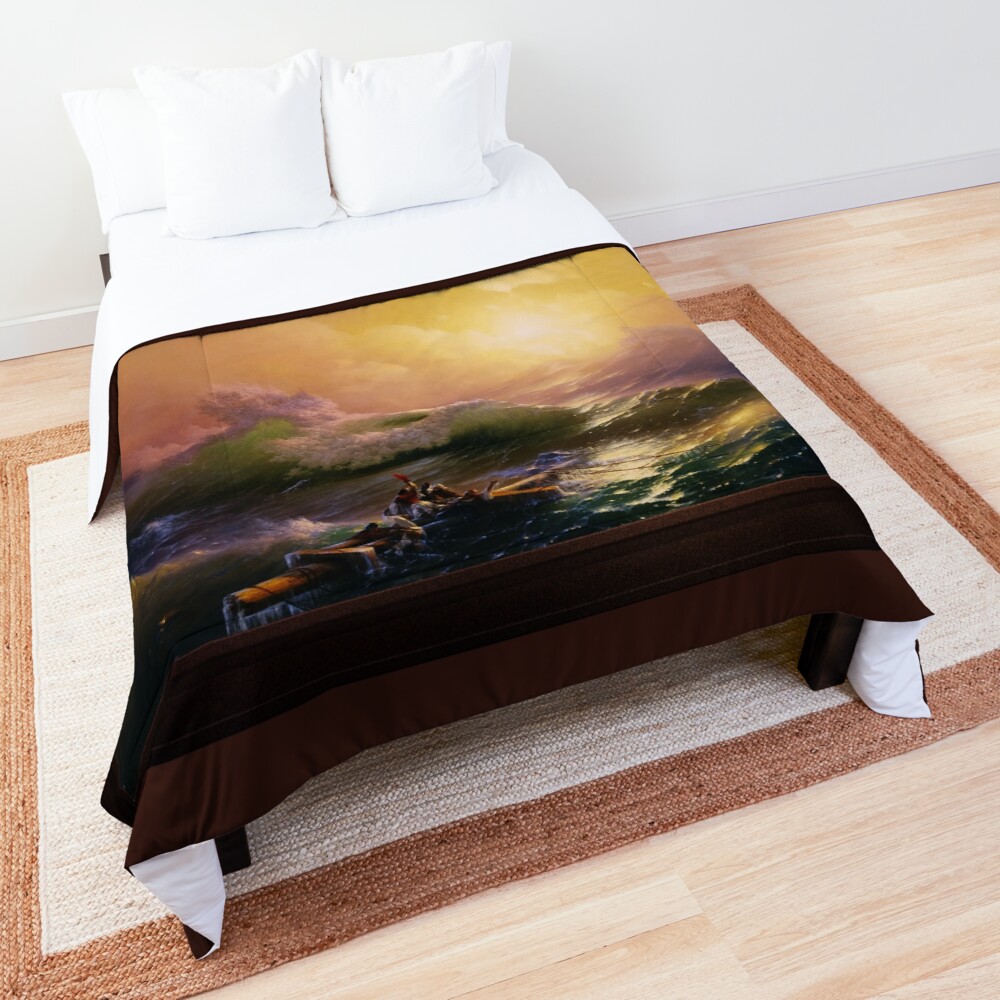
Table des matières
Sujet principal et composition
Dans La Neuvième Vague, Aivazovsky showcases a moment of peril at sea. The central theme of the work is encapsulated in the immense wave, which dominates the foreground. The wave, towering in its menacing beauty, appears as if it is about to crash down upon the small, fragile raft caught beneath it. The subject of the artwork is a group of shipwrecked individuals, stranded on a makeshift raft after a violent storm.
Their struggle for survival against the overwhelming might of nature speaks to the broader theme of human fragility. The men on the raft, desperate but determined, cling to whatever remains of their ship. Their expressions are a mixture of exhaustion and hopelessness, yet there is a trace of defiance as they face what seems an inevitable fate.
The image conveys a sense of dramatic tension, with the survivors framed against the backdrop of the mighty ocean and sky. Aivazovsky’s brilliant use of color and light emphasizes the wave’s enormity and the emotional weight of the scene. The individuals are dwarfed by the size and power of the natural elements, highlighting their vulnerability and humanity in the face of a world beyond their control.
Terrain et matériaux
Le terrain dans La Neuvième Vague is defined primarily by the vast ocean, stretching as far as the eye can see. The water is tumultuous, characterized by swirling, churning waves that seem to roll with the fury of a tempest. Aivazovsky’s mastery of seascapes is evident in the way he captures the movement of the water. Each wave is painted with such precision that the viewer can almost feel the rush of water, the tumultuous spray, and the undercurrent that threatens to pull the raft into the abyss. The waves seem to glow with an eerie energy, with each crest highlighted by the soft light that permeates the canvas, revealing the delicate texture of foam and water.
The colors used in this seascape further elevate the tension. The warm golden light, which spills from the horizon, contrasts dramatically with the deep blues and greens of the sea. The sunlight, muted yet powerful, offers a glimmer of hope, a small contrast to the otherwise overpowering forces of nature. This interplay between light and dark not only enhances the visual drama but also symbolizes the delicate balance between despair and hope that the survivors on the raft experience.
Beyond the waves, the sky above is equally tumultuous. The billowing clouds, painted in shades of pale gold, rose, and violet, convey an almost otherworldly atmosphere, enhancing the painting’s dramatic mood. The horizon is vague and distant, offering no clear path to safety, just an infinite expanse of sky and sea. This vast, unbroken expanse suggests the unknown, reinforcing the helplessness of the survivors, and emphasizing the theme of human insignificance in the face of nature’s power.
Style, Thème, et humeur
Aivazovsky’s painting is an exemplary piece of Romanticism, a movement that often focused on the sublime, nature’s overwhelming power, and the emotional responses evoked by such forces. La Neuvième Vague evokes a strong sense of awe and terror, as well as an underlying hope. The storm’s ferocity speaks to nature’s absolute authority, while the survivors’ fight for survival represents the resilience of the human spirit, a theme that resonates deeply with the Romantic ideals of struggle against the vast unknown.
The painting’s mood is both tense and contemplative. It exudes a sense of dramatic impending doom, the survivors on the raft caught in the middle of a fight they cannot fully win. Encore, the radiant light that bathes the horizon suggests a hope for rescue, a faint possibility of survival against overwhelming odds. This contrast between light and darkness imbues the painting with a complex emotional layer, one where both despair and optimism coexist, forcing the viewer to reflect on the fragility of life and the strength of the human will.
Aivazovsky’s technique contributes greatly to the mood. The swirling forms of the waves, the soft glow of the light, and the highly detailed figures all work together to heighten the dramatic tension. The motion in the water is fluid and dynamic, and the sheer scale of the ocean and sky creates an immersive experience. The survivors, though small in comparison to the wave, are imbued with life, their posture and expressions showing the wear of their struggle but also the undeniable will to continue.
Conclusion
Hovhannes Aivazovsky’s La Neuvième Vague is a timeless masterpiece that encapsulates the awe-inspiring power of the sea and the vulnerability of humankind. Le jeu de la lumière, eau, and the figures trapped in the storm creates a dynamic narrative that speaks to the Romantic ideals of the sublime—nature’s capacity to evoke both wonder and terror. With its meticulous attention to detail, its dramatic use of light, and its profound emotional depth, the painting continues to resonate with viewers, offering a poignant reminder of both the fragility and resilience of life.
Les Monuments de Paris par Hubert Robert impression sur toile.
Cette création d'art numérique, comme toutes les œuvres d'art disponibles sur le site Web Xzendor7, elles sont disponibles à l'achat en ligne dans une variété de formats de matériaux, y compris des impressions sur toile., impressions acryliques, impressions métalliques, gravures sur bois, impressions encadrées, affiches, et sous forme d'impressions sur toile roulées dans une variété de tailles de 12 pouces à 72 pouces en fonction de la taille de l'œuvre d'art réelle et de la boutique d'impression à la demande auprès de laquelle vous choisissez d'acheter l'art.
L’œuvre d’art est également disponible sur une large gamme de vêtements pour hommes et femmes., tasses, fourre-tout, écharpes, cahiers et journaux et de nombreux produits de décoration intérieure.
Biographie de l'artiste
Info ci-dessous de Wikipedia.org
Ivan Constantinovitch Aïvazovski (russe: Ivan Constantinovitch Aivazovski; arménien: Hovhannes Ayvazyan; 29 juillet 1817 – 2 Mai 1900) était un peintre romantique russe qui est considéré comme l'un des plus grands maîtres de l'art marin. Baptisé Hovhannes Aivazian, il est né dans une famille arménienne dans le port de la mer Noire de Feodosia en Crimée et y était principalement basé.
Après ses études à l'Académie impériale des arts de Saint-Pétersbourg, Aivazovsky a voyagé en Europe et a vécu brièvement en Italie au début des années 1840. Il retourne ensuite en Russie et est nommé peintre principal de la marine russe..
Aivazovsky avait des liens étroits avec l'élite militaire et politique de l'Empire russe et assistait souvent aux manœuvres militaires.
Il était parrainé par l'État et était bien considéré de son vivant. Le dicton “digne du pinceau d'Aivazovsky”, popularisé par Anton Tchekhov, a été utilisé en Russie pour décrire quelque chose de beau. Il reste très populaire en Russie au 21e siècle.
L'un des artistes russes les plus en vue de son temps, Aivazovsky était également populaire en dehors de l'Empire russe.
Il a tenu de nombreuses expositions personnelles en Europe et aux États-Unis. Au cours de sa carrière de près de 60 ans, il a créé autour 6,000 peintures, faisant de lui l'un des artistes les plus prolifiques de son temps.
La grande majorité de ses œuvres sont des marines, mais il a souvent représenté des scènes de bataille, thèmes arméniens, et portrait.
La plupart des œuvres d'Aivazovsky sont conservées en russe, Musées ukrainiens et arméniens ainsi que collections privées.